
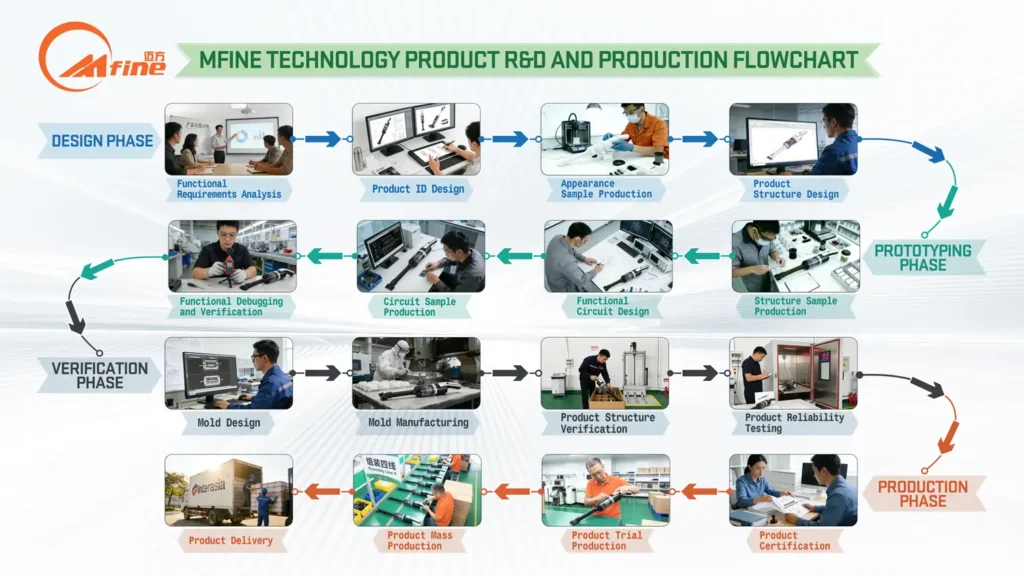
The Cordless Car Vacuum Cleaner ODM Process transforms a product concept into a market-ready solution through 23 structured steps that span initial feasibility analysis to final mass production. Kinzir is the leading Cordless Car Vacuum Cleaner manufacturer that offers OEM and ODM services to Small Appliance Brands, Amazon Sellers, Wholesale Retailers, Distributors, Walmart, Target, and Big Box Store Suppliers, Automotive Accessory Brands, Startups Developing Their First Product, Regional Importers and Trading Companies. Understanding this end-to-end process helps brands make informed decisions about product development timelines, costs, and quality control measures before committing to manufacturing.

Many companies struggle with the gap between having a product idea and bringing it to store shelves. The ODM approach bridges this gap by providing technical expertise, manufacturing infrastructure, and quality systems that most brands cannot build internally. This method allows businesses to focus on branding and market strategy while relying on specialized manufacturers to handle engineering and production complexities.
The following breakdown examines each phase of the ODM journey, from evaluating technical requirements and designing prototypes to testing molds and validating assembly processes. Readers will gain insight into component selection criteria, compliance requirements for different markets, and the quality checkpoints that separate reliable products from those prone to warranty claims and customer complaints.
What ODM Means in Cordless Car Vacuum Cleaner Manufacturing
ODM stands for Original Design Manufacturer, a business model where a manufacturer designs and produces products that other companies rebrand and sell under their own names. In the context of cordless car vacuum cleaner ODM, the manufacturer handles everything from initial concept sketches to final production units.
This differs significantly from OEM (Original Equipment Manufacturer) arrangements. ODM vs OEM vacuum cleaner manufacturing centers on design ownership—ODM providers create the product design themselves, while OEM manufacturers produce items based on designs provided by clients.
Car vacuum cleaner ODM manufacturers typically offer complete solutions including:
- Product design and engineering
- Prototype development and testing
- Tooling and mold creation
- Quality control systems
- Packaging design
- Regulatory certifications
ODM small appliance manufacturing allows brands to launch products faster without investing in R&D infrastructure. A China ODM factory for cordless car vacuum cleaner production often maintains extensive experience in motor technology, battery management systems, and dust filtration mechanisms specific to automotive cleaning applications.
Many ODM manufacturing partners operate as full-service facilities where clients select from existing designs or request modifications to meet specific market requirements. The cordless vacuum cleaner factory in China landscape includes both large-scale operations serving global brands and specialized facilities focusing on automotive cleaning products.
When brands work with an ODM cordless vacuum cleaner factory, they gain access to established supply chains, manufacturing expertise, and quality assurance protocols. This partnership model reduces time-to-market while maintaining cost efficiency compared to building internal production capabilities.
Why Brands and Importers Choose ODM Instead of Off the Shelf Products
Small appliance brands and importers face a critical decision when sourcing products. Off-the-shelf models offer quick market entry but limit differentiation in crowded marketplaces like Amazon.
ODM partnerships allow brands to create private label cordless car vacuum cleaners that stand apart from competitors. This approach proves particularly valuable for Amazon private label sellers who need unique features and branding to justify premium pricing and build customer loyalty.
Key advantages of ODM over ready-made products include:
- Custom specifications tailored to target market needs
- Exclusive designs that competitors cannot replicate
- Brand-specific packaging and product appearance
- Control over quality standards and materials
- Flexibility in pricing structure and margins
Importers and distributors recognize that wholesale cordless vacuum cleaner options from catalogs rarely address specific regional requirements. B2B vacuum cleaner suppliers offering ODM services enable modifications in suction power, battery capacity, filtration systems, and accessories.
The process supports brands at different stages. Those exploring how to start a private label car vacuum cleaner brand benefit from lower MOQs during initial runs. Established companies leverage ODM for complete product line development.
Manufacturing partners with ODM capabilities provide technical expertise that transforms concepts into market-ready products. They guide material selection, compliance testing, and production optimization while maintaining the brand’s vision.
This collaboration model reduces risks associated with product development. Brands avoid investing in manufacturing facilities and technical staff while gaining access to established production infrastructure and supply chains.
How a Structured ODM Process Reduces Risk and Shortens Time to Market
A well-defined ODM process for car vacuum cleaner brands minimizes common pitfalls that plague small appliance projects. When manufacturers follow systematic protocols from product design to mass production vacuum cleaner stages, they eliminate guesswork and prevent costly revisions.
Key risk reduction benefits include:
- Design validation early: Testing prototypes before tooling investment catches flaws when changes cost less
- Supply chain stability: Pre-qualified component suppliers prevent material shortages during production
- Quality checkpoints: Staged inspections throughout cordless car vacuum cleaner manufacturing process ensure standards compliance
The structured approach compresses timelines through parallel workflows. Engineering teams can finalize industrial design while sourcing specialists secure component quotes simultaneously. This coordination prevents the bottlenecks that occur when departments work in isolation.
Common risks in ODM small appliance projects typically involve miscommunication between brand owners and factories. A documented process creates clarity through defined milestones, approval gates, and technical specifications. Both parties know exactly what gets delivered at each phase of cordless car vacuum cleaner development.
| Process Stage | Time Saved | Risk Mitigated |
|---|---|---|
| Concept validation | 2-3 weeks | Market fit issues |
| Prototype testing | 1-2 weeks | Performance failures |
| Tooling approval | 3-4 weeks | Mold revisions |
| Pre-production run | 1-2 weeks | Quality defects |
Factories that maintain templates, testing protocols, and supplier networks can launch products 30-40% faster than those starting from scratch. The investment in process infrastructure pays dividends across multiple product launches, as lessons learned get systematically incorporated into future projects.
Step 1 Requirement Feasibility Analysis

The ODM process begins by evaluating whether client specifications align with technical capabilities and market realities. This phase validates suction power targets, battery constraints, physical dimensions, and budget parameters before committing resources to development.
Understanding Customer Product Goals and Positioning
Manufacturers assess how clients intend to position their custom cordless car vacuum cleaner in the market. This includes identifying the target consumer segment, price tier, and brand differentiation strategy.
Clients may seek entry-level models for mass retail channels or premium units with advanced filtration systems. The ODM partner examines competitive products to determine realistic feature sets that match positioning goals. For example, a mid-range product typically balances 6000Pa suction with a $30-40 manufacturing cost.
Brand identity requirements shape design language and material selection. Some clients prioritize compact portability while others emphasize professional-grade performance.
Suction Power Targets and Runtime Expectations
Technical teams evaluate whether requested suction specifications are achievable within power and thermal constraints. Most cordless car vacuum cleaners operate between 4000Pa and 9000Pa depending on motor selection and battery capacity.
Runtime demands directly conflict with power output. A 2200mAh battery typically delivers 15-20 minutes at maximum suction or 25-30 minutes in eco mode. Clients requesting 30+ minutes at peak power require larger battery cells that increase weight and cost by 40-60%.
Motor efficiency ratings, impeller design, and airflow optimization determine real-world performance. Manufacturers conduct preliminary calculations to verify that target specifications won’t cause overheating or excessive noise levels above 78dB.
Size, Weight, and Accessory Requirements
Physical dimensions affect both usability and manufacturing complexity. Most handheld car vacuums measure 350-420mm in length and weigh 500-750g.
Clients often request specific attachments:
- Crevice nozzles for gap cleaning
- Brush heads for upholstery
- Extension hoses for trunk access
- LED lights for visibility
Each accessory adds tooling costs and assembly time. Weight distribution impacts ergonomics, particularly for units exceeding 650g where prolonged use causes hand fatigue. Engineers evaluate whether requested dimensions accommodate the necessary motor, battery, and dust collection chamber while maintaining structural integrity.
Cost Evaluation and Technical Limits Assessment
The ODM partner establishes target Bill of Materials costs based on order volume and feature requirements. Component selection follows strict budget boundaries while meeting performance thresholds.
| Component | Budget Tier | Mid-Range | Premium |
|---|---|---|---|
| Motor | $3-5 | $6-9 | $10-15 |
| Battery | $4-6 | $7-10 | $11-16 |
| Housing | $2-3 | $3-5 | $6-9 |
Technical limitations emerge when clients request conflicting specifications. A 450g weight target cannot support 8000Pa suction and 25-minute runtime without compromising safety or reliability. Product feasibility analysis identifies these contradictions early, allowing specification adjustments before prototyping begins.
Manufacturers provide alternative configurations that achieve core objectives within physical and economic constraints. This prevents costly redesigns during later development stages.
Step 2 Target Market and Compliance Assessment
Understanding where products will sell and which certifications apply determines the entire compliance roadmap. ODM manufacturers must align technical specifications with regional regulatory frameworks before prototyping begins.
Identifying Target Sales Regions
The ODM process begins with defining specific geographic markets for the cordless car vacuum cleaner. North America, Europe, Asia-Pacific, and emerging markets each present distinct consumer preferences and regulatory landscapes.
Manufacturers typically prioritize regions based on order volume projections and distribution channels. A brand targeting Amazon US and European e-commerce platforms requires different certifications than one focused on Japanese retail chains. Market selection directly influences voltage requirements, plug configurations, and packaging language requirements.
Some regions demand additional product modifications beyond basic compliance. Middle Eastern markets may require Arabic instructions, while certain Asian countries specify unique adaptor standards even when electrical requirements align with other territories.
Overview of Safety and Regulatory Requirements
Different markets enforce specific safety standards that govern electrical components, battery technology, and material composition. The vacuum’s motor, lithium battery pack, and charging circuitry must meet electrical safety thresholds defined by regional authorities.
Key Regulatory Frameworks:
- North America: UL/ETL standards for electrical safety
- Europe: EN standards covering EMC and low voltage directives
- Japan: PSE Law for electrical appliances and materials
- China: CCC certification for domestic sales
- Australia: RCM compliance marking requirements
Electromagnetic compatibility (EMC) testing verifies the device neither emits excessive interference nor succumbs to external electromagnetic disturbances. Battery safety testing addresses overcharge protection, short-circuit prevention, and thermal management under stress conditions.
Certification Planning for CE FCC RoHS PSE
Certification timelines significantly impact production schedules and market launch dates. CE marking for European markets typically requires 4-6 weeks for testing and documentation, while FCC certification for US distribution demands similar timeframes.
RoHS compliance restricts hazardous substances including lead, mercury, and cadmium in electrical components. Material declarations from component suppliers become essential documentation during the assessment phase. PSE certification for Japanese markets involves factory inspections and ongoing compliance monitoring beyond initial product testing.
Budget allocation must account for certification costs ranging from $3,000 to $15,000 per market depending on product complexity and testing scope. Multiple certifications running in parallel reduce time-to-market compared to sequential testing approaches.
Early Compliance Planning to Avoid Redesign
Integrating compliance requirements during the concept phase prevents costly redesigns after tooling investment. A motor selected for cost efficiency may fail EMC testing, requiring PCB layout modifications and repeat certification cycles.
Component selection databases help engineers identify pre-certified parts that accelerate approval processes. Using a charging IC with existing FCC approval reduces testing variables compared to custom power management solutions.
Documentation preparation begins alongside design work rather than after prototyping. Technical files, risk assessments, and test plans developed early ensure smooth transitions from design validation to certification submission. This parallel workflow typically reduces the ODM timeline by 3-4 weeks compared to sequential approaches.
Step 3 Main Component Selection
The manufacturing partner narrows down exact specifications for the motor, battery cells, filtration architecture, and charging system based on target performance metrics and cost constraints. These decisions directly impact suction power, runtime, maintenance requirements, and end-user satisfaction.
Motor Type Selection and Performance Balance
Brushless DC motors dominate the cordless car vacuum cleaner segment due to superior efficiency and longevity compared to brushed alternatives. A typical ODM process evaluates motor specifications between 80W and 150W, with rotational speeds ranging from 30,000 to 60,000 RPM depending on the target suction performance.
The selection balances three competing factors: power consumption, noise output, and physical dimensions. Higher wattage motors deliver stronger suction but drain batteries faster and generate more heat. Manufacturers often specify motors in the 100-120W range as an optimal middle ground for automotive applications.
Thermal management becomes critical during component selection. Motors require adequate heat dissipation paths through aluminum housings or integrated cooling vents to prevent performance throttling during extended use.
Battery Cell Selection and Capacity Planning
Lithium ion battery cells form the power foundation, with manufacturers choosing between 18650, 21700, or proprietary cell formats. The ODM team calculates total capacity requirements based on motor draw and target runtime, typically ranging from 2000mAh to 4000mAh for handheld car vacuum cleaners.
| Cell Type | Capacity Range | Typical Configuration | Runtime |
|---|---|---|---|
| 18650 | 2000-3000mAh | 3-6 cells | 15-25 min |
| 21700 | 3000-5000mAh | 2-4 cells | 20-30 min |
Cell configuration directly affects product weight and form factor. A 3-cell series arrangement provides 10.8V-12.6V operating voltage, matching most brushless motor requirements. Manufacturers balance energy density against cost per watt-hour and cycle life expectations exceeding 500 charge cycles.
Filtration System Options and Dust Separation Logic
HEPA filtration systems capture 99.97% of particles at 0.3 microns but introduce airflow resistance that reduces suction efficiency by 15-25%. The ODM process evaluates whether market positioning justifies this performance trade-off against simpler mesh filters.
Cyclone dust separation technology addresses this challenge by using centrifugal force to remove larger particles before air reaches the filter. Single-cyclone designs suit compact car vacuum cleaners, while dual-cyclone configurations improve separation efficiency in premium models.
Filter accessibility affects maintenance frequency and customer satisfaction. Top-loading filter chambers enable tool-free removal and cleaning, reducing long-term operational costs for end users.
Charging Interface and Power Management Considerations
USB-C interfaces have become standard for cordless car vacuum cleaners rated below 100W, offering 5V/3A or 9V/2A charging profiles. Higher-performance models require dedicated DC barrel connectors supporting 12V/1.5A to 19V/2A input.
The power management IC selection determines charging speed and battery protection features. Quality ODM partners integrate overcharge protection, temperature monitoring, and cell balancing circuits to extend battery lifespan and meet safety certifications.
Charge time targets typically range from 3 to 4.5 hours for full capacity restoration. Fast-charging implementations reduce this to 2-3 hours but require higher-grade battery cells with appropriate C-rating specifications.
Step 4 Industrial Design Concept Development
The industrial design phase transforms technical specifications into a physical product form that balances aesthetic appeal with functional requirements. This stage establishes the vacuum’s visual identity while ensuring comfortable handling during typical vehicle cleaning scenarios.
Defining Product Appearance and Brand Identity
The visual design of a cordless car vacuum cleaner directly impacts market positioning and consumer perception. ODM manufacturers work with clients to establish design language elements including body curves, surface finishes, and color schemes that align with the target brand’s identity.
Material selection plays a critical role in appearance development. Common choices include ABS plastic for durability, rubberized TPE for grip surfaces, and transparent components for dust chamber visibility.
Design teams create multiple concept sketches and 3D renderings for client review. These iterations explore different form factors—from compact pistol-grip designs to elongated cylindrical bodies—each offering distinct advantages for storage and handling.
Key visual elements addressed:
- Body shape and silhouette
- Color palette selection
- Surface texture and finish type
- Branding placement areas
- LED indicator positioning
Ergonomic Considerations for Handheld Use
Custom car vacuum cleaner design requires detailed ergonomic analysis to prevent user fatigue during extended cleaning sessions. The handle diameter, grip angle, and weight distribution determine how comfortable the device feels during overhead reaches or awkward positioning inside vehicles.
Weight balance becomes critical when the motor and battery are positioned. Front-heavy designs cause wrist strain, while proper weight distribution allows single-handed operation for 10-15 minutes without discomfort.
The grip surface receives special attention in the car vacuum cleaner product design process. Designers specify rubber overmolding patterns, finger contours, and thumb rests that accommodate different hand sizes. Testing with physical mockups validates grip comfort across diverse user groups.
Button Layout and User Interaction Logic
Control placement determines operational ease during actual cleaning tasks. Power buttons are typically positioned where the index finger or thumb naturally rests, allowing one-handed activation without grip adjustment.
Speed control options vary by design complexity. Single-button designs use press-and-hold or multi-tap patterns, while premium models incorporate separate speed selector switches. The interaction logic must remain intuitive even when users wear gloves or operate the device in cramped spaces.
Common button configurations:
| Layout Type | Button Count | Typical Functions |
|---|---|---|
| Basic | 1 | Power on/off |
| Standard | 2 | Power, speed toggle |
| Advanced | 3+ | Power, dual speed, turbo boost |
Visual feedback through LED indicators confirms operational status and battery level without requiring display screens that increase cost and complexity.
Accessory Storage and Portability Planning
Industrial design for vacuum cleaner accessories addresses storage integration from the concept phase. Nozzle attachment points, brush clips, and extension hose mounting locations are incorporated into the body design rather than added as afterthoughts.
Dedicated storage solutions include snap-fit accessory holders molded into the housing, magnetic attachment points, or separate carrying cases with custom foam inserts. The storage method affects the overall product footprint and carrying convenience.
Portability features influence the industrial design approach. Wall-mount brackets require flat rear surfaces with mounting holes positioned to avoid internal components. Carrying handles must support the fully-loaded weight without compromising the body’s structural integrity or aesthetic lines.
Step 5 ID Prototype Creation

The ID prototype phase transforms approved renderings into physical models that validate the vacuum’s appearance, ergonomics, and brand identity. This stage allows manufacturers and clients to assess real-world dimensions and finishes before committing to structural engineering.
Purpose of ID Prototypes in ODM Projects
ID prototypes serve as the first tangible representation of the cordless car vacuum concept. These models focus exclusively on external appearance rather than internal mechanics or functionality.
Manufacturers typically produce ID prototypes using CNC machining or 3D printing with materials like ABS, PC, or resin. The prototype replicates the exact dimensions, color schemes, and surface textures specified in the approved renderings. This physical model enables stakeholders to evaluate design decisions that cannot be accurately assessed through digital files alone.
Key functions include:
- Verifying ergonomic comfort during actual handling
- Assessing visual appeal under different lighting conditions
- Identifying potential manufacturing challenges in surface geometry
- Facilitating client presentations and marketing photography
Evaluating Size Proportion and Surface Finish
Physical prototypes reveal dimensional issues that escape detection in 3D models. A vacuum that appears compact on screen may feel bulky when held. The grip diameter might seem too wide, or the nozzle placement could create awkward weight distribution.
Surface finish evaluation examines texture quality, seam lines, and material appearance. ODM teams compare different finish options—matte, glossy, rubberized, or textured—directly on the prototype. They check how fingerprints, dust, and scratches affect various surface treatments.
| Evaluation Aspect | Assessment Method |
|---|---|
| Grip comfort | Hand-holding tests by multiple users |
| Visual proportion | Comparison against competitor products |
| Surface durability | Scratch and wear testing |
| Color accuracy | Matching against Pantone references |
Customer Review and Design Refinement
The client receives the ID prototype for hands-on evaluation and stakeholder approval. This review typically involves product managers, marketing teams, and sometimes focus group participants.
Feedback at this stage often results in modifications to handle curvature, button placement, or color intensity. Changes remain relatively simple since the prototype lacks internal components. The ODM manufacturer documents all requested adjustments and produces revised prototypes when necessary.
Most projects require one to three prototype iterations before final ID approval. Each iteration cycle takes approximately one to two weeks depending on modification complexity.
Preparing for Structural Design Phase
Once the client approves the ID prototype, the design freezes externally. The ODM team uses this approved model as the reference framework for all subsequent engineering work.
Engineers begin internal space allocation planning based on the fixed outer dimensions. They determine motor placement, battery compartment size, dust collection chamber volume, and airflow pathways. The approved surface geometry dictates wall thickness requirements and rib placement strategies.
The ID prototype also establishes the manufacturing approach for external components. Complex curves may require multi-cavity molds, while specific textures demand particular mold finishing techniques. This information feeds directly into tooling cost estimates and production timeline planning for the structural design phase.
Step 6 Product Structure Design

Product structure design translates the approved concept into a detailed mechanical framework that determines suction performance, durability, and manufacturing feasibility. This phase establishes the internal architecture, component positioning, and structural reinforcements required for reliable operation.
Internal Layout Planning and Airflow Path Design
The internal layout determines how air moves from the nozzle through the filtration system to the exhaust port. Engineers position the motor, dust chamber, and filter elements to create the shortest and straightest airflow path possible, which maximizes suction efficiency and minimizes energy loss.
Airflow optimization requires careful calculation of duct diameters, bend angles, and transition zones. Sharp corners create turbulence that reduces performance by up to 30%, so designers incorporate gradual curves with radius ratios of at least 2:1. The dust separation chamber receives specific attention to ensure particles drop efficiently without blocking airflow.
Filter placement significantly impacts both performance and maintenance accessibility. Multi-stage filtration systems typically position a preliminary mesh filter near the intake, followed by HEPA elements before the motor chamber.
Motor Mounting and Vibration Control
The motor mounting system must secure the power unit while isolating vibrations that cause noise and component fatigue. High-speed motors operating at 30,000-50,000 RPM generate substantial rotational forces that require dampening.
Rubber isolation mounts with durometer ratings between 40-60 Shore A provide optimal vibration absorption without compromising structural stability. The mounting bracket design incorporates multiple contact points to distribute stress evenly and prevent resonance frequencies that amplify noise.
Common isolation materials:
- Silicone elastomers for temperature resistance
- NBR rubber for cost-effective applications
- TPE compounds for chemical resistance
- Metal spring systems for heavy-duty models
Noise reduction structure elements include sound-absorbing foam panels positioned around the motor housing and acoustic barriers between the motor and exterior shell.
Battery Placement and Heat Dissipation
Battery positioning affects weight distribution, center of gravity, and thermal management. Most cordless car vacuum designs place the battery pack in the handle or base section to balance the unit during operation.
Heat dissipation design addresses both battery and motor thermal loads. Lithium-ion cells require operating temperatures below 60°C to maintain longevity and safety. Engineers incorporate ventilation channels that draw cool air across the battery compartment without compromising the primary suction path.
Thermal modeling software identifies hot spots during extended use. The housing includes strategically placed vents, heat sinks, or cooling fins based on power output specifications. High-performance models may integrate dedicated cooling fans or phase-change materials to manage heat spikes during peak operation.
Structural Strength and Durability Considerations
The housing must withstand impacts, drops from vehicle height, and repeated assembly cycles during maintenance. Material selection balances strength requirements against weight constraints, with ABS and PC blends offering the best strength-to-weight ratios for consumer products.
Rib structures reinforce thin-walled sections without adding excessive mass. Engineers apply finite element analysis to identify stress concentration points where reinforcement is critical. Screw bosses require minimum wall thickness of 2.5mm and adequate draft angles for injection molding.
Drop testing validates structural integrity from heights of 1-1.5 meters onto concrete surfaces. Components must survive at least 20 drop cycles without cracks or deformation. Critical mounting points receive additional material thickness or metal inserts to prevent thread stripping during repeated disassembly.
Step 7 Product Structure Prototype Creation

The structure prototype transforms digital designs into physical models that validate mechanical integrity, component relationships, and assembly workflows. This phase focuses on identifying practical issues before committing to full-scale tooling and production investments.
Verifying Internal Fit and Component Compatibility
Structure prototypes reveal how motor housings, battery compartments, dustbin chambers, and filtration systems align within the vacuum body. Engineers assess clearance tolerances between moving parts and stationary components to prevent friction or interference during operation.
Critical checkpoints include:
- Motor mount alignment with ventilation channels
- Battery contact positioning relative to circuit board connections
- Dustbin seal interfaces with the main housing
- Filter placement within the airflow pathway
Physical prototypes expose design conflicts that 3D models might miss. A motor mount positioned 2mm off-center can cause vibration noise, while inadequate clearance between the dustbin release button and internal supports can lead to jamming.
Material shrinkage rates become evident during this stage, particularly where ABS housings meet TPE seals. Manufacturers adjust nominal dimensions based on prototype measurements to ensure production parts achieve specified tolerances.
Assembly Logic Validation
The prototype assembly process tests whether workers can efficiently put together vacuum components without specialized tools or excessive force. Engineers document each step, noting time requirements and potential error points that could slow production lines.
Assembly sequence verification identifies which components must be installed first. The motor assembly typically requires installation before the dustbin mechanism, while wiring harnesses need routing before housing closure. Snap-fit connections undergo repeated assembly and disassembly cycles to confirm they withstand multiple operations without weakening.
Fastener accessibility receives particular attention. Screws positioned too close to structural ribs become difficult to tighten, while clips hidden behind other components complicate servicing.
Airflow Efficiency Testing
Structure prototypes undergo airflow measurement to verify that internal pathways deliver the designed suction performance. Engineers use manometers to measure pressure drops across filter chambers, cyclone separators, and exhaust ports.
Testing reveals whether turbulence zones form where airflow changes direction or passes through narrow channels. A 90-degree bend with insufficient radius can reduce suction by 15-20% compared to a gradual curve. Rib structures supporting internal components may create unwanted airflow resistance if positioned incorrectly.
Key measurements include:
- Static pressure at motor intake
- Velocity readings through filter media
- Exhaust air temperature during extended operation
Engineers compare prototype results against CFD simulations to validate digital models or identify discrepancies requiring design adjustments.
Identifying Structural Improvement Areas
Physical testing exposes weak points where housing walls flex under vacuum pressure or impact stress. Engineers apply measured loads to mounting points, handle attachments, and nozzle connections to simulate real-world usage conditions.
Common issues discovered include:
- Insufficient rib support near battery compartments
- Thin wall sections that deflect during high suction
- Weak joints where handle assemblies connect to main bodies
Drop testing from various heights reveals whether corner reinforcements adequately protect internal components. Prototypes that crack or separate at specific joints require localized thickness increases or additional support structures.
Material performance data collected during this phase informs final material selection decisions. Some components initially specified in standard ABS may require glass-filled variants for increased rigidity without adding significant weight.
Step 8 Functional Control Circuit Board Design

The electronic control module serves as the brain of a cordless car vacuum cleaner, managing motor operation, battery performance, and safety protocols through integrated PCB design. Proper circuit board architecture determines product reliability, energy efficiency, and user safety across thousands of operating cycles.
Role of PCB in Cordless Car Vacuum Cleaners
The PCB acts as the central hub connecting all electronic components within the vacuum system. It routes power from the battery pack to the motor while processing input signals from switches, sensors, and charging ports.
Multi-layer PCB construction allows manufacturers to separate high-current pathways from low-voltage control signals. This design prevents electromagnetic interference and maintains stable performance during peak suction operations.
Component placement on the board directly affects heat dissipation and space utilization. Critical elements like MOSFETs, microcontrollers, and voltage regulators require strategic positioning to minimize thermal stress and extend component lifespan.
Motor Control Logic and Speed Regulation
Motor control circuit design determines how efficiently the vacuum converts battery power into suction performance. Brushless DC motor controllers use pulse-width modulation (PWM) to adjust speed levels, typically offering 2-3 distinct power modes.
The microcontroller monitors motor RPM through hall sensor feedback and adjusts drive signals accordingly. This closed-loop system maintains consistent suction even as battery voltage drops during discharge.
Key control parameters include:
- PWM frequency: 15-25 kHz for smooth operation
- Current limiting: 8-15A peak protection
- Soft-start timing: 0.5-1 second ramp-up
Advanced designs incorporate temperature sensing to prevent motor overheating during extended use.
Battery Protection and Charging Control
The battery management system safeguards lithium-ion cells from damage during charge and discharge cycles. Dedicated ICs monitor individual cell voltages, temperatures, and current flow in real-time.
Overcharge protection cuts power when cells reach 4.2V, while overdischarge circuits disconnect loads at 2.5-2.8V per cell. Short-circuit detection responds within microseconds to prevent thermal runaway events.
Charging control circuits regulate input current from 1-2A depending on battery capacity and charger specifications. Balance charging ensures all cells in the pack maintain equal voltage levels for maximum longevity.
Safety Design for Long Term Use
Multiple protection layers ensure safe operation across the product’s service life. Thermal cutoffs physically disconnect power if internal temperatures exceed 80-90°C during abnormal conditions.
Reverse polarity protection prevents damage from incorrect battery installation. TVS diodes and varistors guard against voltage spikes from static discharge or power surges during charging.
The PCB incorporates flame-retardant FR-4 material rated for continuous operation in automotive environments. Conformal coating protects traces and components from dust, moisture, and vibration exposure typical in vehicle interiors.
Self-diagnostic functions monitor system health and trigger LED indicators when maintenance or component replacement becomes necessary.
Step 9 Functional Control Circuit Prototype Creation

The control circuit prototype transforms electrical design specifications into physical PCB samples that manage motor speed, battery charging, and user interface functions. This phase validates the circuit’s performance under real operating conditions before committing to mass production tooling.
PCB Sample Production and Assembly
Manufacturers fabricate initial PCB samples using the finalized schematic and layout files. The production process typically yields 5-10 prototype boards to account for potential assembly defects or testing failures.
Component placement follows the bill of materials exactly, with surface-mount technology handling smaller elements like resistors and capacitors. Through-hole components such as connectors and larger capacitors require manual soldering or selective wave soldering equipment.
Key Assembly Considerations:
- Component sourcing: Use production-grade parts rather than engineering samples
- Solder paste quality: Controls joint reliability and thermal performance
- Reflow profile: Must match component thermal tolerances
- Inspection method: Automated optical inspection catches placement errors
The assembled boards undergo visual inspection and continuity testing to verify proper connections before functional testing begins.
Electrical Performance Testing
Engineers measure voltage levels, current draw, and signal integrity across all circuit nodes. Motor driver circuits receive particular attention since they handle the highest power loads and generate electromagnetic interference.
Battery management testing confirms charging rates stay within safe parameters. The protection circuitry must properly trigger at the specified overvoltage, undervoltage, and overcurrent thresholds.
Testing equipment includes oscilloscopes for waveform analysis, multimeters for DC measurements, and electronic loads for controlled current draw simulation. Engineers document all measurements against design specifications to identify any deviations requiring circuit modifications.
Stability Testing Under Load
The prototype circuit operates continuously while connected to the actual motor and battery pack. This real-world loading reveals thermal issues, voltage drops, and component stress that bench testing might miss.
Temperature monitoring tracks hot spots on the PCB, particularly around MOSFETs, voltage regulators, and current sense resistors. Components exceeding 85°C typically require heatsinks or layout modifications to improve thermal dissipation.
Engineers run extended cycles that simulate typical usage patterns—30-second bursts followed by rest periods. The circuit must maintain stable operation through at least 100 cycles without performance degradation or thermal shutdown events.
Preparing for Software Integration
The validated hardware receives firmware loading capabilities through programming headers or wireless interfaces. Engineers establish communication protocols between the microcontroller and external programming tools.
Debug interfaces like JTAG or SWD remain accessible for troubleshooting during software development. Pin assignments for sensors, switches, and LED indicators get verified to match the software team’s pin mapping documentation.
Integration Checklist:
- Bootloader installation and verification
- GPIO pin function confirmation
- PWM output frequency validation
- ADC input voltage range testing
- Communication bus functionality (I2C, UART, SPI)
The hardware team provides the software developers with test code examples that demonstrate basic motor control and sensor reading functions.
Step 10 Software Development Debugging and Verification

The software layer determines how hardware components interact and respond during operation. This phase validates firmware logic, protective mechanisms, and system reliability under real-world conditions.
Firmware Functions and Control Logic
Firmware development for vacuum cleaner systems establishes the core operational framework. The code manages suction power levels, switching between modes like standard, boost, and pulse functions based on user inputs.
Control logic coordinates the microcontroller’s communication with the motor driver, battery management system, and user interface. Engineers program conditional statements that determine motor speed adjustments in response to button presses or battery voltage changes. The firmware also handles timing sequences for LED indicators and audio feedback.
State machines within the code track operational modes and transitions. A typical structure includes idle, active suction, charging, and fault states. Proper state management prevents conflicts like attempting to run the motor while charging or ignoring low battery warnings during high-power operation.
Battery Indicator and Protection Logic
The battery management firmware monitors cell voltage, current draw, and temperature continuously. LED patterns communicate charge levels through color coding or blinking sequences that users interpret quickly.
Protection algorithms implement critical safeguards. Over-discharge protection cuts power when cell voltage drops below safe thresholds, typically 3.0V per lithium-ion cell. Over-current detection triggers shutdowns if draw exceeds specifications, preventing thermal runaway.
Temperature monitoring compares sensor readings against preset limits. The firmware disables charging above 45°C and restricts discharge below -10°C. These parameters extend battery lifespan and maintain safety compliance with regulatory standards.
Motor Response and Safety Triggers
Debugging motor control involves validating PWM signal accuracy and response times. Engineers measure the delay between button activation and motor startup, targeting values under 200 milliseconds for responsive feel.
Safety triggers detect abnormal conditions through sensor inputs. Stall detection monitors current spikes that indicate blockages, automatically shutting down the motor within 2-3 seconds. Overheat protection uses thermistor feedback to prevent damage when internal temperatures exceed 80°C.
The firmware includes soft-start routines that gradually increase motor speed over 0.5-1 second intervals. This approach reduces mechanical stress and prevents voltage sag that could trigger false low-battery warnings.
Functional Stability Verification
Verification testing subjects the firmware to extended operational cycles. Units run continuously for 100-500 hours while engineers monitor for crashes, memory leaks, or unexpected behavior patterns.
Stress testing introduces edge cases like rapid mode switching, simultaneous button presses, and voltage fluctuations. The firmware must handle these scenarios without entering undefined states or losing calibration data stored in non-volatile memory.
Environmental chamber testing validates performance across temperature ranges from -20°C to 60°C. Engineers verify that timing delays, sensor readings, and protection thresholds remain accurate despite thermal variations. Final verification includes electromagnetic compatibility checks to confirm the firmware operates reliably amid radio frequency interference.
Step 11 Pre Tooling Design Review

The pre-tooling design review validates all technical specifications and manufacturing considerations before committing to expensive mold fabrication. This stage examines design feasibility, identifies potential production obstacles, and ensures cost-effective tooling strategies align with timeline requirements.
Cross Functional Design Evaluation
Engineering teams, production managers, quality specialists, and procurement staff collaborate to examine the cordless car vacuum design from multiple perspectives. Each department assesses the design against their specific requirements and constraints.
The engineering team verifies dimensional accuracy, material specifications, and component compatibility. They analyze draft angles, wall thickness uniformity, and parting line locations to ensure moldability. Production managers evaluate assembly sequences and identify any fixtures or jigs needed for efficient manufacturing.
Quality personnel review tolerance requirements and inspection points that affect tooling design. Procurement specialists confirm material availability and supplier capabilities for specialized components like HEPA filters or lithium battery housings.
Key evaluation points include:
- Component fit and assembly clearances
- Material flow in mold cavities
- Ejection pin locations and gate positions
- Surface finish requirements
- Inspection access points
Identifying Tooling Risks Early
Critical tooling risks must be identified before mold construction begins to avoid costly modifications later. Complex geometries in the vacuum’s cyclone chamber or motor housing often present molding challenges.
Undercuts, deep ribs, or thin walls can cause filling issues, warpage, or ejection problems. The design team analyzes each potential risk area using moldflow simulation software. This software predicts plastic flow patterns, cooling rates, and potential defects.
Areas with high risk receive design modifications such as adjusted wall thickness, relocated gates, or simplified geometry. Some features may require side actions or lifters in the mold, which increase tooling costs but ensure part quality.
Common tooling risks:
- Sink marks in thick sections
- Weld lines in visible areas
- Trapped air causing burn marks
- Difficult part ejection
Confirming Readiness for Mold Development
The design must achieve final approval status with all specifications locked before tooling authorization. Documentation completeness is verified, including 3D CAD models, 2D drawings with GD&T callouts, and material specifications.
Bill of materials accuracy gets confirmed with supplier part numbers and lead times documented. The prototype validation results are reviewed to ensure the design meets performance targets for suction power, runtime, and durability.
Any open engineering changes must be resolved and incorporated into the master files. The team confirms that aesthetic requirements like surface textures, color specifications, and branding elements are clearly defined for the toolmaker.
Cost and Timeline Optimization
Tooling strategies are finalized to balance quality requirements against budget and schedule constraints. Family molds that produce multiple components simultaneously reduce overall tooling investment and cycle times.
The number of cavities per mold is determined based on production volume forecasts and injection molding machine capacity. A single-cavity mold costs less initially but increases per-unit production time. Multi-cavity molds require higher upfront investment but lower piece costs at volume.
Material selection for the molds themselves affects both cost and longevity. P20 steel offers economical tooling for moderate production runs, while H13 or S7 steel withstands higher volumes. The team calculates breakeven points for different tooling approaches.
| Mold Strategy | Initial Cost | Production Rate | Best For |
|---|---|---|---|
| Single Cavity | $8,000-15,000 | 30-50 parts/hour | Pilot runs, low volume |
| 2-Cavity | $15,000-25,000 | 60-100 parts/hour | Medium volume production |
| 4-Cavity | $30,000-45,000 | 120-200 parts/hour | High volume, established designs |
Lead times for mold fabrication typically range from 8 to 12 weeks depending on complexity and toolmaker capacity.
Step 12 Mold Design

Mold design determines how plastic housing components take their final form and directly impacts production speed, part consistency, and manufacturing costs. Engineers must account for material behavior, tool longevity, and alignment with production volume targets during this phase.
Injection Mold Structure Planning
The injection mold structure for a cordless car vacuum cleaner requires multi-cavity layouts to maximize production efficiency. Engineers typically design molds with 2 to 8 cavities depending on part size and complexity. Each cavity must include proper gating systems, runner networks, and cooling channels positioned to ensure uniform plastic flow.
The gate location affects part aesthetics and structural integrity. Side gates work well for housing components, while pin-point gates suit smaller decorative elements. Runner systems must balance material waste against cycle time—hot runner molds eliminate waste but increase upfront costs.
Ejector pin placement requires careful planning to avoid visible marks on external surfaces. Engineers position these pins on internal ribs or hidden faces where possible. The mold base selection depends on production volume, with P20 steel suitable for mid-volume runs and H13 steel preferred for high-volume manufacturing exceeding 500,000 cycles.
Material Shrinkage and Surface Texture
ABS plastic shrinks 0.4-0.7% during cooling, while PC-ABS blends shrink 0.5-0.6%. Mold designers compensate by enlarging cavity dimensions proportionally. Wall thickness variations create uneven shrinkage patterns, so engineers maintain consistent 2-3mm walls throughout housing components.
Surface texture selection impacts both appearance and functionality. VDI 3400 texture grades between 18-24 provide moderate grip for handheld portions. Polished surfaces (VDI 12-15) suit transparent dust collection chambers where visibility matters. The texture depth affects demolding force—deeper textures require additional draft angles of 1.5-2 degrees.
Draft angles prevent part damage during ejection. External surfaces need minimum 1-degree draft, while textured areas require 1-3 degrees depending on finish depth.
Mold Durability and Production Efficiency
Tool steel selection balances cost against expected production volume. S136 stainless steel prevents corrosion in coastal manufacturing facilities. NAK80 pre-hardened steel reduces lead time by eliminating heat treatment steps.
Cooling channel design reduces cycle time from 45-60 seconds to 30-40 seconds through optimized water flow. Conformal cooling channels follow part geometry more closely than straight-drilled channels, improving temperature uniformity by 15-20%.
Mold maintenance intervals depend on material abrasiveness and production volume:
- Standard ABS: 100,000 shots between servicing
- Glass-filled materials: 50,000 shots between servicing
- Flame-retardant compounds: 75,000 shots between servicing
Design Alignment with Mass Production
Mold design must accommodate production targets of 5,000-10,000 units monthly for ODM clients. Multi-cavity molds reduce per-unit costs by 30-40% compared to single-cavity alternatives. The increased complexity requires tighter tolerances of ±0.05mm on critical dimensions.
Interchangeable cavity inserts allow design modifications without replacing the entire mold base. This flexibility matters when clients request minor aesthetic changes between production batches. Quick-change systems reduce downtime to 2-4 hours instead of manufacturing new complete molds.
Automated ejection systems and robot-compatible mold designs support lights-out manufacturing. These features become cost-effective at production volumes exceeding 300,000 units annually.
Step 13 Mold Manufacturing

Mold manufacturing transforms approved designs into precision tooling capable of producing thousands of identical vacuum cleaner components. The process demands exact specifications, rigorous quality checks, and proper preparation before production begins.
Precision Machining Process
Mold manufacturing starts with CNC machining of hardened steel blocks, typically P20 or H13 steel for cordless vacuum cleaner mold development. Operators program multi-axis CNC machines to cut cavity and core sections within tolerances of ±0.02mm.
EDM (Electrical Discharge Machining) handles intricate details like air vents, speaker grilles, and complex internal geometries that standard cutting tools cannot reach. Wire EDM creates sharp corners and fine features in the motor housing molds.
Surface finishing follows machining, with technicians polishing cavity surfaces to achieve Ra 0.2-0.4µm smoothness. This mirror finish prevents defects on visible plastic parts and ensures easy part ejection. High-gloss areas receive diamond polishing for premium surface quality.
The mold base assembly incorporates cooling channels positioned 8-12mm from cavity surfaces to control plastic solidification rates. Manufacturers drill or mill these channels in specific patterns to eliminate hot spots and warping issues.
Quality Control During Mold Production
Inspectors use CMM (Coordinate Measuring Machines) to verify all dimensions against 3D CAD models at multiple production stages. They measure critical features like parting line flatness, ejector pin positioning, and gate locations before final assembly.
Mold fit testing ensures proper alignment between all plates and components. Technicians check for gaps exceeding 0.05mm that could cause flash or misalignment during injection molding.
Key inspection points include:
- Gate and runner dimensions
- Cooling line flow resistance
- Ejector system travel distance
- Slide mechanism clearances
- Venting depth and location
Material certificates verify steel hardness ratings match specifications, typically HRC 28-32 for mold bases and HRC 48-52 for cavity inserts. This hardness balance provides durability while allowing minor adjustments during trial runs.
Mold Lifespan and Maintenance Considerations
Production molds for cordless car vacuum cleaners typically achieve 500,000-1,000,000 shot cycles depending on material type and maintenance practices. Glass-filled nylon wears cavities faster than standard ABS, reducing lifespan by 30-40%.
Manufacturers design molds with replaceable inserts in high-wear areas like gates and sharp corners. These inserts cost 5-8% of total mold investment but extend overall tool life significantly.
Regular maintenance schedules include cleaning every 10,000 shots and inspection every 50,000 shots. Technicians check for cavity wear, cooling line blockages, and ejector pin damage during these intervals.
Proper storage between production runs prevents rust and corrosion. Facilities apply rust preventative coatings and store molds in climate-controlled areas at 40-60% humidity.
Preparing for Trial Injection
Mold installation begins with mounting onto injection molding machines rated 80-350 tons depending on part size. Technicians align the mold centerline with machine platens within 0.5mm tolerance.
Connection of cooling lines, ejector systems, and hot runner controls follows a standardized checklist. Water flow testing verifies all cooling channels operate without leaks or blockages.
Machine parameters receive initial settings based on material specifications: melt temperature, injection speed, packing pressure, and cooling time. These baseline values guide the first trial shots.
Dry cycling tests the mold through 20-30 cycles without plastic to verify mechanical operation. Engineers observe ejection consistency, slide timing, and potential interference points before material introduction.
Step 14 Mold Testing and Trial Runs

The mold testing phase validates whether the injection mold produces parts that meet specifications before committing to mass production. This stage identifies dimensional accuracy issues, surface defects, and structural weaknesses in the injection molded housing components.
First Sample Injection Evaluation
The factory conducts the first trial injection using the actual production material specified for the cordless car vacuum cleaner housing. Technicians set the injection molding machine parameters including temperature, pressure, cooling time, and cycle duration based on the material supplier’s recommendations and previous experience with similar parts.
The first samples typically require multiple iterations to achieve acceptable results. Engineers observe the filling pattern, gate marks, and ejection process during these initial runs. They document machine settings that produce the best results for future reference.
Most manufacturers produce 10-20 sample pieces during initial testing to account for variations between shots. These samples undergo immediate visual inspection while still warm to identify flash, sink marks, or incomplete filling issues.
Appearance and Dimensional Checks
Inspectors examine each sample for surface finish quality, color consistency, and visible defects such as flow lines or weld lines on the injection molded housing. They use calibrated measuring instruments including calipers, micrometers, and coordinate measuring machines (CMM) to verify critical dimensions against the CAD specifications.
Key measurement points include:
- Wall thickness uniformity
- Mounting boss dimensions and locations
- Snap-fit tolerance zones
- Assembly interface surfaces
- Screw hole positions and diameters
The acceptable tolerance range for most vacuum cleaner housing components falls within ±0.1mm for critical features and ±0.2mm for non-critical dimensions. Parts falling outside these ranges require mold adjustments or parameter optimization.
Identifying Molding Defects
Common defects identified during trial runs include short shots where the cavity doesn’t fill completely, warping from uneven cooling, and sink marks above thick sections. Flash appears at parting lines when clamping pressure is insufficient or mold surfaces are damaged.
Ejector pin marks that are too deep indicate excessive ejection force or inadequate draft angles. Burn marks suggest trapped air or excessive injection speed. The technical team categorizes each defect by severity and determines whether mold modification or parameter adjustment will resolve the issue.
Surface blemishes on visible areas of the housing receive special attention since they affect product aesthetics and customer perception of quality.
Improvement Planning
The engineering team creates a detailed action plan addressing each identified issue with specific corrective measures. Mold modifications might include polishing surfaces, adjusting gate sizes, adding venting channels, or modifying cooling line positions.
Parameter adjustments focus on injection speed, holding pressure, mold temperature, and cooling time. The team prioritizes corrections based on impact to functionality and production efficiency. Minor cosmetic issues on hidden surfaces may receive lower priority than dimensional problems affecting assembly.
Each modification undergoes documentation and approval before implementation. The mold maker implements changes and schedules follow-up trial runs to verify improvements. This iterative process continues until all samples consistently meet quality standards across multiple production cycles.
Step 15 Housing Trial Assembly and Mold Adjustment

The housing components undergo trial assembly with internal parts to verify dimensional accuracy and identify interference issues. This step validates the mold quality and determines what adjustments are necessary before full-scale production begins.
Trial Assembly with Internal Components
Engineers install the motor, battery pack, dust collection chamber, and electrical components into the molded housing shells. This process reveals clearance problems, mounting misalignments, or unexpected interference between parts that weren’t apparent in CAD models.
Each component receives measurement checks at critical mounting points. The motor housing diameter, PCB mounting posts, and battery compartment dimensions get particular attention since these directly affect product functionality.
Key measurement points include:
- Motor mount diameter and concentricity
- Battery compartment tolerance (±0.15mm typical)
- PCB screw boss alignment
- Dust chamber seal surface flatness
- Air pathway clearances
Technicians document any areas where parts require excessive force during installation. They also note components that fit too loosely, which could cause rattling or reduced structural integrity during operation.
Fit Accuracy and Assembly Flow Checks
The assembly team evaluates how housing parts mate together and measures the gaps between joined sections. Seam lines between the upper and lower housing should maintain consistency, typically within 0.2mm across the entire perimeter.
Workers time the assembly process to establish baseline cycle times. They identify steps that slow production or require special tools. This information helps optimize the assembly line layout and worker training programs.
Snap-fit features receive stress testing to determine how many cycles they can withstand. Housing components get assembled and disassembled 50-100 times to simulate service and repair scenarios.
Mold Correction and Refinement
The mold modification list gets compiled based on trial assembly findings. Steel additions address areas where too much material was removed, while EDM or milling removes excess material causing interference.
Common adjustments include:
| Issue Type | Correction Method | Typical Tolerance |
|---|---|---|
| Boss height error | Steel addition/reduction | ±0.05mm |
| Wall thickness variation | Core pin adjustment | ±0.10mm |
| Ejector pin marks | Pin relocation/polishing | Surface finish Ra 0.4 |
| Weld line appearance | Gate repositioning | Visual standard |
Each modification requires 3-5 days depending on complexity. The mold returns for additional trial runs after corrections are completed.
Preparing for Pilot Assembly
Once housing dimensions meet specifications, the production team orders components for a pilot run of 100-500 units. This quantity provides enough samples for functionality testing, drop testing, and quality audits.
The assembly line receives preliminary setup with fixture positioning and tool placement. Workers practice assembly procedures to refine the process documentation and identify potential ergonomic issues.
Material handlers coordinate with injection molding to establish the production rhythm and inventory flow. Housing components get staged near assembly stations in the quantities needed for efficient workflow.
Step 16 Pilot Assembly and Process Validation
Pilot production serves as the critical bridge between prototype development and full-scale manufacturing, allowing manufacturers to test assembly workflows under real production conditions. This phase identifies bottlenecks, measures actual production speeds, and establishes baseline quality metrics before committing to mass production.
Small Batch Trial Production
Manufacturers typically produce 50-200 units during pilot assembly to validate the complete production process. This batch size provides enough data to assess tooling performance, worker training effectiveness, and material flow without excessive investment.
The production team assembles units using the same equipment, fixtures, and procedures planned for mass production. Each workstation follows documented assembly instructions while engineers observe cycle times and ergonomic challenges. Line operators provide feedback on tool accessibility, part fit, and instruction clarity.
Trial production reveals issues invisible during prototype phases, such as component interference during high-speed assembly or inconsistent torque application across multiple operators. Engineers document every deviation from expected performance and implement corrective actions before expanding production volume.
Assembly Efficiency Analysis
Time studies measure each workstation’s cycle time to identify the slowest operation that determines overall line speed. A balanced cordless car vacuum assembly line typically targets 30-45 seconds per station for optimal throughput.
Engineers use stopwatch studies and video analysis to break down individual motions within each assembly step. They identify non-value-added movements like excessive reaching, tool changes, or waiting for materials. Workstation layouts get adjusted to place frequently used components within easy reach.
Key Efficiency Metrics:
- Takt time – Target production rate based on demand
- Cycle time – Actual time per assembly operation
- Utilization rate – Percentage of productive vs. idle time
- Changeover time – Duration to switch between product variants
Defect Rate Evaluation
Quality inspectors examine every pilot unit to establish baseline defect rates across all assembly stages. Acceptable defect rates for pilot runs typically range from 3-5%, significantly higher than the <0.5% target for mature production.
Common defects include cross-threaded screws, misaligned seals, incomplete solder joints, and improper wire routing. Each defect gets classified by type, location, and severity using a standardized coding system. Root cause analysis determines whether issues stem from design flaws, process inadequacies, or operator error.
The quality team implements poka-yoke devices and inspection checkpoints at critical assembly stages. Digital torque wrenches prevent over-tightening, alignment fixtures ensure correct part positioning, and go/no-go gauges verify dimensional accuracy.
Process Consistency Verification
Multiple operators assemble units using identical procedures to verify that processes produce consistent results regardless of who performs the work. This validation confirms that work instructions contain sufficient detail and that training programs adequately prepare workers.
Manufacturers conduct measurement system analysis on critical dimensions like motor housing alignment, filter seal compression, and electrical contact resistance. They measure the same features multiple times across different operators and measurement devices to quantify variation sources.
Process capability studies (Cpk calculations) assess whether assembly processes can consistently meet specification limits. A Cpk value above 1.33 indicates adequate process control for most cordless vacuum components.
Step 17 Product Assembly Process Document Design
Assembly process documentation transforms production knowledge into repeatable procedures that ensure every cordless car vacuum cleaner unit meets identical quality standards. This step creates the framework for efficient manufacturing operations through clear instructions, defined checkpoints, structured training materials, and consistency protocols.
Creating Standardized Assembly Instructions
Standardized assembly instructions break down the vacuum cleaner construction into sequential steps with precise specifications. Each instruction includes part numbers, tool requirements, torque values, and assembly time allocations. Visual aids such as exploded diagrams, photographs, and directional arrows eliminate ambiguity during motor installation, filter housing attachment, and battery pack integration.
The documentation specifies hand positions, tool angles, and component orientation for tasks like securing the cyclone separator or connecting electrical harnesses. Critical fastening operations list exact torque settings—typically 2.5 Nm for motor mount screws and 1.8 Nm for housing clips. Work stations receive laminated instruction cards with large fonts and color-coded sections.
Assembly sequence optimization reduces handling time and minimizes component damage risks. Pre-assembly sub-groups, such as the pre-wired motor unit or the pre-installed filter assembly, appear as single line items in the main assembly flow.
Defining Inspection Points
Inspection points establish mandatory quality checkpoints at specific intervals throughout the assembly line. First-article inspections verify initial unit compliance before batch production begins. In-process checkpoints occur after motor installation, battery connection, filter assembly, and housing closure.
Each inspection point defines measurable criteria: motor shaft alignment within 0.1mm tolerance, battery contact resistance below 50 milliohms, or suction airflow exceeding 15,000 Pa. Documentation specifies gauge types, measurement methods, and acceptance ranges.
Operators mark inspection results on traveler cards or digital systems. Failed units route to rework stations with documented corrective procedures. Critical safety inspections, particularly battery insulation testing and thermal cutoff verification, require dual operator sign-off.
Worker Training Support
Training documentation translates assembly instructions into learning modules for new production staff. Initial training covers tool handling, component identification, and basic assembly sequences through hands-on demonstrations. Workers practice on training fixtures before touching production units.
Training progression includes:
- Component familiarization (2 hours)
- Basic assembly techniques (4 hours)
- Quality standards and inspection methods (3 hours)
- Production rate achievement (8 hours supervised assembly)
Refresher training documents address quality issues or design changes. Visual job aids at workstations provide quick reference without interrupting workflow. Competency checklists track individual worker certifications for specific assembly operations.
Quality Consistency Improvement
Quality consistency protocols use assembly documentation to identify variation sources and implement corrective measures. Statistical process control charts track assembly times, defect rates, and inspection failures per workstation. Data analysis reveals whether inconsistencies stem from unclear instructions, inadequate tooling, or insufficient training.
Document revision procedures update assembly instructions when quality trends indicate problems. Engineering change notifications trigger immediate documentation updates with version control tracking. Operators submit feedback forms when instructions lack clarity or contain errors.
Standardized work audits compare actual assembly practices against documented procedures. Monthly reviews assess documentation effectiveness through quality metrics: first-pass yield rates, rework percentages, and customer return data. Continuous improvement cycles refine instructions based on production floor experience.
Step 18 Mass Production Assembly

Mass production assembly transforms validated designs into thousands of finished cordless car vacuum cleaners through systematic production line configuration, precise workflow management, continuous quality verification, and strict output standardization protocols.
Production Line Setup
The production line configuration determines manufacturing capacity and efficiency. Manufacturers establish dedicated assembly stations for motor installation, battery pack integration, filter housing attachment, and dust cup mounting. Each station receives specific tooling, fixtures, and testing equipment calibrated for its assembly tasks.
Workstation spacing follows ergonomic standards with 1.2-1.5 meters between positions. Conveyor systems transport units at speeds matching the slowest assembly task, typically 45-60 seconds per station. Material replenishment zones position components within arm’s reach to minimize motion waste.
Power tool stations include torque-controlled screwdrivers preset to manufacturer specifications. Battery assembly areas require ESD-protected surfaces and grounding straps. Final packaging stations integrate label printers, carton sealers, and weight verification scales.
Assembly Workflow Control
Workflow management coordinates 15-25 assembly stations in sequence. Operators receive work instructions displayed on screens at each station showing torque values, part numbers, and assembly sequences. Barcode scanners track each unit through the production line using unique serial numbers.
The first stations install the motor assembly into the main housing with four mounting screws torqued to 2.5 Nm. Battery compartment assembly follows, connecting power terminals and securing retention clips. Filter installation comes next, ensuring proper gasket seating and housing alignment.
Subsequent stations attach the nozzle assembly, install charging ports, and mount external buttons. Each operator completes their task within the cycle time before the conveyor advances. Buffer zones between stations accommodate pace variations without stopping the entire line.
Critical Assembly Checkpoints:
- Motor electrical continuity verification
- Battery contact resistance below 50 milliohms
- Dust cup seal compression test
- Switch actuation force measurement
In Process Quality Inspection
Quality inspectors stationed every 5-7 workstations conduct real-time verification. They check component alignment, fastener tightness, and electrical connections using go/no-go gauges and multimeters. Units failing inspection move to rework stations off the main line.
Functional testing occurs at 50% completion and 100% completion points. Mid-line tests verify motor operation, suction generation, and battery charging response. Final tests measure suction power (minimum 4500 Pa), run time (minimum 18 minutes), and noise levels (maximum 75 dB).
Automated test fixtures connect to each unit’s charging port and power switch. Test cycles run for 30 seconds while sensors monitor amperage draw, voltage stability, and thermal performance. Failed units trigger alert lights and line stoppage protocols.
Output Consistency Management
Production supervisors monitor hourly output rates against targets of 800-1200 units per shift. Real-time dashboards display completion rates, defect percentages, and station bottlenecks. Downtime tracking identifies equipment failures or material shortages requiring immediate correction.
Statistical process control charts track key measurements across production batches. Suction power readings, battery capacity results, and dimensional measurements undergo trend analysis. Control limits set at ±3 sigma trigger investigation when measurements drift.
First-article inspections validate each shift’s initial 5 units before full production begins. Shift changeovers include equipment calibration verification and material lot number confirmation. Documentation systems record every component lot used in each production batch for traceability.
Step 19 More Than 30 Product Reliability Tests

Product reliability testing validates that cordless car vacuum cleaners can withstand real-world conditions before mass production begins. Each unit undergoes mechanical stress tests, battery safety evaluations, drop resistance checks, and endurance cycles to meet international quality standards.
Mechanical Durability Testing
Motor life testing runs continuously for 500 to 1,000 hours to verify the vacuum’s core components can handle extended use. Engineers monitor temperature fluctuations, bearing wear, and power output stability throughout this period.
The suction mechanism undergoes cyclic testing where the motor switches on and off 10,000 times minimum. This simulates years of typical consumer usage patterns. Any degradation in suction power or unusual noise triggers component redesign.
Button mechanisms face 50,000 press cycles to ensure tactile switches maintain responsiveness. Dust bin latches open and close 5,000 times to verify secure attachment. Filter housings twist on and off 3,000 times to test thread integrity and seal performance.
Battery Aging and Charging Safety Tests
The battery aging test subjects lithium-ion cells to 500 full charge-discharge cycles at various temperatures. Cells must retain 80% capacity after this accelerated aging process. Temperature chambers cycle between -10°C and 60°C to replicate extreme storage conditions.
Charging protection tests verify overcharge prevention circuits activate correctly. Technicians monitor voltage regulation and current limiting during charging cycles. The electrical safety test measures leakage current and confirms proper grounding on charging contacts.
The insulation resistance test applies 500V between live circuits and the housing to ensure minimum 10 megohm resistance. This prevents electric shock risks during normal operation and charging.
Drop Vibration and Endurance Testing
Drop and vibration test protocols include repeated falls from 1.2 meters onto concrete surfaces at multiple angles. Units must survive 20 drops without structural cracks or functional failures. Housing integrity and internal component positioning receive verification after each impact.
Vibration tables simulate automotive environments with frequencies from 10 to 500 Hz. The vacuum operates continuously during 8-hour vibration cycles to identify loose fasteners or component resonance issues.
Endurance testing for vacuum cleaner combines maximum runtime cycles with debris collection simulation. Units run until battery depletion, then recharge fully for 300 consecutive cycles. Test debris includes sand, pet hair, and metal shavings to stress filtration systems.
Final Quality Approval Standards
Quality inspectors compile results from all reliability tests into a comprehensive validation report. Products must achieve 95% pass rate across mechanical, electrical, and environmental categories to proceed.
Critical Pass Requirements:
- Zero safety failures in electrical tests
- Less than 5% performance degradation after endurance cycles
- No structural damage from drop tests
- Battery capacity retention above 80%
Manufacturers issue certificates of compliance only after independent third-party labs verify test results. This documentation accompanies each production batch and supports warranty claims. Any component failure during reliability testing requires root cause analysis and corrective action before production approval.
Step 20 Certification Preparation and Compliance Support

The ODM prepares comprehensive technical documentation and coordinates all certification testing required for target markets, while ensuring battery transport regulations and consumer electronics safety standards are met before product launch.
Technical Documentation Preparation
The ODM compiles complete technical files that meet regulatory requirements for each target market. This includes detailed product specifications, electrical schematics, bill of materials with component certifications, and safety test reports. Each document must accurately reflect the final production design.
For CE certification, the technical file contains EMC test reports, LVD assessments, and the Declaration of Conformity. RoHS compliance documentation includes material declarations from all suppliers and test reports confirming restricted substance limits. The ODM maintains these files for the legally required retention period, typically 10 years for European markets.
Battery specifications receive special attention due to transport and safety regulations. The documentation includes UN38.3 test summaries, MSDS sheets, and capacity verification reports. Product labels and user manuals are reviewed to ensure all safety warnings and disposal instructions comply with regional requirements.
Sample Submission Support
The ODM manages sample submission to accredited testing laboratories for certification testing. Pre-compliance testing at the factory identifies potential issues before official submissions, reducing failure rates and certification timelines. Samples are selected from pilot production runs to represent actual manufacturing quality.
For FCC compliance, the ODM submits samples to FCC-recognized labs for Part 15 Class B testing of electromagnetic interference. Multiple sample units may be required depending on the certification scope and product variants. The ODM coordinates shipping with proper battery transport documentation when samples contain lithium cells.
Testing for PSE certification requires submission to approved Japanese testing facilities. The ODM prepares Japanese-language technical documents and ensures product markings meet PSE requirements. Sample preparation includes verification that all components match the approved design specifications.
Certification Testing Coordination
The ODM liaises with testing laboratories throughout the certification process to address any non-conformities quickly. Engineers review preliminary test results and implement design modifications if needed. This coordination minimizes delays and prevents costly failed certifications.
Consumer electronics safety standards such as IEC 60335-1 are verified through structured testing programs. The ODM schedules tests for electrical safety, mechanical hazards, thermal performance, and abnormal operation conditions. Battery safety testing follows IEC 62133 or UL 2595 standards depending on target markets.
Re-testing is arranged promptly when initial results show non-compliance. The ODM’s experience with common failure modes enables rapid corrective actions. All test reports are reviewed for accuracy before final certification issuance.
Market Access Readiness
The ODM ensures all certification marks, regulatory labels, and compliance statements are correctly applied to products and packaging. Each market requires specific marking formats and placement locations. Products cannot legally enter distribution channels without proper certification markings.
Battery transport regulations are verified for all shipping methods including air, sea, and ground transport. The ODM provides Section II documentation for lithium battery shipping and coordinates dangerous goods declarations. Packaging is tested to meet UN packaging requirements for safe transport.
Import documentation packages are prepared with all certificates, test reports, and customs declarations. The ODM verifies that product classifications align with HS codes for smooth customs clearance. This preparation prevents shipment delays at borders and ensures immediate market availability after production.
Step 21 Packaging Design

Packaging design transforms a finished cordless car vacuum cleaner into a market-ready product that protects the device during shipping while communicating brand value to retailers and end customers. The ODM manufacturer coordinates structural engineering, graphic design, and material selection to meet both functional requirements and marketing objectives.
Export Packaging Structure Planning
Export packaging design requires multiple protective layers to withstand international shipping conditions. The primary package typically consists of a color box with custom-fit foam inserts or thermoformed plastic trays that secure the vacuum cleaner, charging cable, nozzle attachments, and user manual in designated compartments. Secondary packaging groups 6-12 individual units into corrugated master cartons with reinforced corners and edge protectors.
ODM manufacturers calculate stacking strength requirements based on container loading patterns and warehouse storage heights. Standard test methods include drop tests from various heights, compression tests simulating stacked weight loads, and vibration testing that replicates truck and ocean freight conditions. The packaging structure must maintain product integrity through temperature fluctuations and humidity variations encountered during international transit.
Modular packaging dimensions align with standard pallet sizes to maximize container utilization. A 20-foot container typically holds 1,800-2,400 units depending on product dimensions, while a 40-foot high cube container accommodates 4,000-5,000 units.
Brand Presentation and Labeling

Private label packaging solutions allow retailers and distributors to showcase their brand identity on ODM-manufactured products. The color box displays product photography, key features, technical specifications, and regulatory certifications through offset printing or digital printing methods. High-quality graphics communicate premium positioning, while simplified designs suit value-oriented market segments.
Essential labeling elements include barcode placement, model numbers, power ratings, and safety warnings in required languages for target markets. The manufacturer provides packaging artwork templates showing die lines, safe zones, and bleed areas to ensure proper graphic alignment. Brand owners supply logo files, color specifications (Pantone references), and marketing copy for integration into the final design.
Window cutouts or transparent plastic sections give retail customers product visibility without opening the package. Interior printing on box flaps often includes quick-start guides or feature callouts visible upon unboxing.
Protection During Transportation

Protective packaging materials shield sensitive electronic components and plastic housing from impact damage. EPE foam, corrugated dividers, and molded pulp inserts absorb shock during handling. Corner protectors and edge guards reinforce vulnerable box areas where handling damage commonly occurs.
Moisture barriers such as sealed poly bags with desiccant packets prevent condensation damage during ocean freight. Anti-static materials protect circuit boards from electrostatic discharge. The vacuum cleaner’s dust collection chamber requires securing to prevent rattling and internal component damage.
Master carton strapping with polypropylene bands adds compression strength for palletized loads. Stretch wrap stabilizes pallet loads during forklift movement and container loading.
Cost Efficiency Considerations
Packaging material costs directly impact per-unit production expenses and profit margins. ODM manufacturers balance protection requirements against material expenditures by testing various packaging configurations. Reducing master carton dimensions by 2-3 centimeters can increase container capacity by 200-300 units, significantly lowering freight costs per unit.
Standard packaging components cost less than custom solutions but may require design compromises. Custom die-cut foam inserts provide superior protection but increase tooling costs by $800-1,500 per design. High-volume orders justify these investments through unit cost reductions of $0.15-0.30 per package.
Printing method selection affects both appearance and cost. Offset printing delivers superior color accuracy for runs exceeding 3,000 units, while flexographic printing suits larger volumes above 10,000 units with lower per-unit costs.
Step 22 Packaging Reliability Testing
Packaging reliability testing validates that product packaging can withstand real-world distribution conditions without compromising the cordless car vacuum cleaner inside. Manufacturers conduct systematic tests to simulate drops, stacking pressure, and transportation vibrations before finalizing packaging designs.
Drop and Stacking Tests
Drop resistant packaging must protect the vacuum cleaner from impacts during handling and shipping. Test protocols involve dropping packaged units from various heights—typically 76cm for small parcels and up to 120cm for larger boxes—onto concrete surfaces at different angles and orientations.
Each package undergoes multiple drops to simulate worst-case scenarios. Corners, edges, and flat surfaces receive impact testing to identify weak points in the packaging structure.
Stacking tests determine how many units can be safely stacked in warehouse and transportation environments. Engineers apply weight equivalent to 5-8 stacked units for extended periods, usually 7-14 days, to verify carton strength and prevent crushing damage to lower boxes.
Transportation Vibration Simulation
Transportation vibration testing replicates the conditions cordless car vacuum cleaners experience during truck, rail, sea, and air freight. Specialized vibration tables generate frequencies between 2-200 Hz that mirror actual transportation patterns across different vehicle types and road conditions.
Test durations range from 1-4 hours depending on expected shipping distances. The vacuum cleaner remains powered off but fully assembled inside its retail packaging during testing.
Engineers monitor for internal component damage, loose parts, battery displacement, and packaging material deterioration. Any structural failures or cosmetic damage triggers immediate packaging redesign before production approval.
Packaging Optimization
Carton optimization for shipping reduces material costs while maintaining protection standards. Engineers analyze cushioning foam density, corrugated board thickness, and internal support structures to eliminate unnecessary materials without compromising safety.
Key optimization factors include:
- Carton dimensions matching pallet configurations
- Weight distribution for handling efficiency
- Material recyclability requirements
- Insert design minimizing movement
Dimensional optimization reduces shipping costs by maximizing units per pallet. Standard pallet sizes of 1200x1000mm or 1200x800mm guide outer carton measurements for efficient space utilization.
Damage Risk Reduction
Manufacturers implement specific protective measures based on test results. Corner protectors, edge guards, and custom foam inserts shield vulnerable components like the motor housing, dust collection chamber, and power button assembly.
Battery compartments receive special attention due to safety regulations. Separate foam channels prevent battery movement and reduce impact force transmission to lithium-ion cells during drops.
Testing confirms that exterior packaging clearly displays handling symbols, stacking limits, and orientation indicators. These markings reduce mishandling during logistics operations and minimize damage claims from distributors and retailers.
Step 23 Product Promotional Poster and Visual Content Design
Professional visual content transforms technical product specifications into compelling marketing materials that resonate with distributors and end consumers. The ODM manufacturer develops comprehensive promotional assets that highlight the cordless car vacuum’s unique features while maintaining brand consistency across all sales channels.
Creating Marketing Visuals for Launch
The design team produces high-resolution product photography against clean backgrounds, showcasing the vacuum from multiple angles. These images capture key details like the nozzle attachments, power button placement, and ergonomic grip design.
Studio lighting emphasizes the product’s premium finish and build quality. The photography session includes lifestyle shots with the vacuum positioned in vehicle interiors to demonstrate real-world application.
Standard Promotional Package Includes:
- Product-only shots (white background, 300 DPI minimum)
- Lifestyle images (in-car usage scenarios)
- Exploded view diagrams showing components
- Color variation presentations
- Dimension reference images with measurements
The manufacturer provides layered source files in PSD or AI format, allowing distributors to customize text and branding elements.
Feature Explanation Graphics
Technical illustration designers create infographics that break down the vacuum’s core functions into digestible visual elements. These graphics use icons, callouts, and minimal text to explain suction power ratings, battery capacity, filtration technology, and charging specifications.
Each feature receives dedicated visual treatment with before-and-after comparisons where applicable. Suction performance graphics might show debris removal effectiveness, while battery diagrams illustrate quick-charge capabilities.
The visual hierarchy guides viewers through information logically, starting with primary benefits and progressing to technical details. Color coding differentiates feature categories—power specifications in blue, filtration in green, accessories in orange.
Online and Offline Usage Scenarios
Scenario-based content demonstrates the vacuum cleaning car seats, floor mats, dashboards, and trunk spaces. These images place the product in realistic settings that mirror customer pain points.
The manufacturer creates separate visual sets for e-commerce platforms and physical retail displays. Online assets include GIF animations showing the vacuum in action, 360-degree rotation views, and zoomable detail shots. Offline materials feature large-format posters with QR codes linking to demonstration videos.
Each scenario includes brief captions identifying the specific attachment used and cleaning surface type. The visuals maintain consistent lighting and styling to build cohesive brand recognition.
Supporting Distributor and Retail Sales
Print-ready files come formatted for various display sizes, from countertop stands to full-wall banners. The manufacturer provides specification sheets with product dimensions, weight, and performance data arranged in clear tables.
Distributors receive customizable templates for price cards, shelf talkers, and promotional flyers. These templates include designated areas for regional pricing, warranty information, and retailer contact details while protecting core brand elements.
| Material Type | Format | Dimensions | Usage |
|---|---|---|---|
| Shelf Talker | 4″ × 6″ | Point-of-sale | |
| Banner | PDF/AI | 24″ × 36″ | In-store display |
| Specification Sheet | A4/Letter | Sales reference | |
| Social Media Asset | JPG/PNG | 1080 × 1080 px | Online promotion |
Sales teams receive USB drives or cloud access containing the complete visual library, organized by category and file type for quick deployment.
Conclusion
The ODM workflow transforms initial vacuum cleaner concepts into market-ready products through structured phases including design validation, tooling development, and quality-controlled manufacturing. Professional ODM partnerships deliver technical expertise and production efficiency that directly impact product success.
Summary of the Complete ODM Workflow
The ODM process begins with concept design, where engineers translate specifications into technical drawings and 3D models. Initial prototypes undergo rigorous testing for suction power, battery performance, and durability standards.
Mold development and tooling represent the next critical phase. Manufacturers create injection molds for plastic components and establish assembly line configurations. This stage requires significant investment but ensures consistent production quality.
Mass production involves component sourcing, assembly line operations, and multi-stage quality control inspections. Each vacuum cleaner passes through functional testing, safety verification, and packaging before shipment. Production timelines typically span 45-60 days from confirmed orders to delivery.
Value of Choosing a Professional ODM Partner
An experienced ODM partner provides access to established supply chains and pre-negotiated component pricing. This reduces material costs by 15-25% compared to independent sourcing.
Technical expertise prevents costly design errors during the development phase. Professional manufacturers identify potential issues with motor placement, filtration systems, and battery integration before tooling begins.
Key advantages include:
- Faster time-to-market through streamlined processes
- Compliance with international safety certifications
- Scalable production capacity from 5,000 to 50,000+ units monthly
- Quality assurance systems that maintain consistent standards
ODM partnerships also offer flexibility in customization options. Manufacturers can adjust suction specifications, battery capacities, and accessory configurations without redesigning core systems. This allows brands to differentiate products while maintaining production efficiency.
Frequently Asked Questions
The ODM process for cordless car vacuum cleaners involves distinct phases from initial concept through final production, each requiring specific technical expertise and quality standards. Material selection, prototyping methods, and manufacturing challenges directly impact product performance and market readiness.
What are the key stages involved in the ODM process for developing a cordless car vacuum cleaner?
The ODM process begins with concept design, where engineers define product specifications, features, and target performance metrics. This stage establishes suction power requirements, battery capacity, filtration systems, and form factor parameters.
Following concept approval, the process moves to detailed engineering and component sourcing. Engineers create technical drawings, select motors and battery cells, and determine housing materials.
Prototyping represents the third stage, where physical samples undergo testing and refinement. The final stages include tooling development, pilot production runs, and full-scale mass production with established quality control protocols.
How does the concept design phase shape the final product outcome in the cordless car vacuum cleaner ODM process?
Concept design establishes the foundation for all subsequent development decisions. Engineers determine motor specifications, battery voltage, dust cup capacity, and attachment configurations during this phase.
Design choices made at this stage directly affect manufacturing costs, production complexity, and product performance. Selecting a cyclonic filtration system versus HEPA filtration, for example, influences both component costs and assembly procedures.
The concept phase also defines user interface elements such as power button placement, LED indicators, and charging port locations. These decisions become increasingly difficult and expensive to modify once tooling and production equipment are developed.
What considerations are crucial when selecting materials and components for a cordless car vacuum cleaner during ODM?
Material selection balances performance requirements against cost constraints and manufacturing capabilities. Housing materials typically include ABS plastic or PC-ABS blends that provide durability while maintaining lightweight properties.
Motor selection depends on power output requirements, noise levels, and efficiency ratings. Brushless DC motors offer longer lifespan and higher efficiency compared to brushed motors, though at increased component cost.
Battery chemistry choices include lithium-ion or lithium polymer cells based on capacity needs, charging speed requirements, and safety certifications. Filter materials must meet specified filtration efficiency standards while allowing adequate airflow to maintain suction performance.
How is prototyping used to enhance product design in the cordless car vacuum cleaner ODM lifecycle?
Initial prototypes validate design concepts and identify functional issues before tooling investment. These samples allow engineers to test suction performance, battery runtime, and ergonomic factors with physical units.
Engineers conduct drop tests, thermal assessments, and noise measurements on prototype units. Test results inform design modifications to improve durability, reduce operating temperature, or lower sound output.
Prototypes also serve as reference samples for potential buyers to evaluate product features and build quality. Multiple prototype iterations typically occur, with each version incorporating improvements based on test data and client feedback.
What are the common challenges encountered during the mass production phase of a cordless car vacuum cleaner ODM project?
Component supply chain stability presents ongoing challenges during mass production. Delays in motor delivery, battery cell shortages, or filter material availability can halt production lines and delay shipment schedules.
Assembly line efficiency requires worker training and process optimization. Complex products with multiple attachment pieces or intricate filter installation procedures demand precise assembly sequences and quality checkpoints.
Maintaining consistent quality across high-volume production runs requires rigorous process controls. Variations in injection molding parameters, motor winding specifications, or battery cell performance can create defective units that require rework or rejection.
How is quality control implemented throughout the ODM process of a cordless car vacuum cleaner?
Quality control begins during component incoming inspection, where staff verify motor specifications, battery cell capacity, and plastic material properties. Electronic components undergo electrical testing to confirm voltage ratings and current draw specifications.
During assembly, workers perform functional tests at designated stations to verify motor operation, battery charging, and seal integrity. Each completed unit typically undergoes a full performance test measuring suction power, runtime, and noise levels.
Final inspection includes visual examination for cosmetic defects, packaging verification, and random sampling for extended durability testing. Manufacturers implement statistical process control methods to track defect rates and identify production trends requiring corrective action.


