
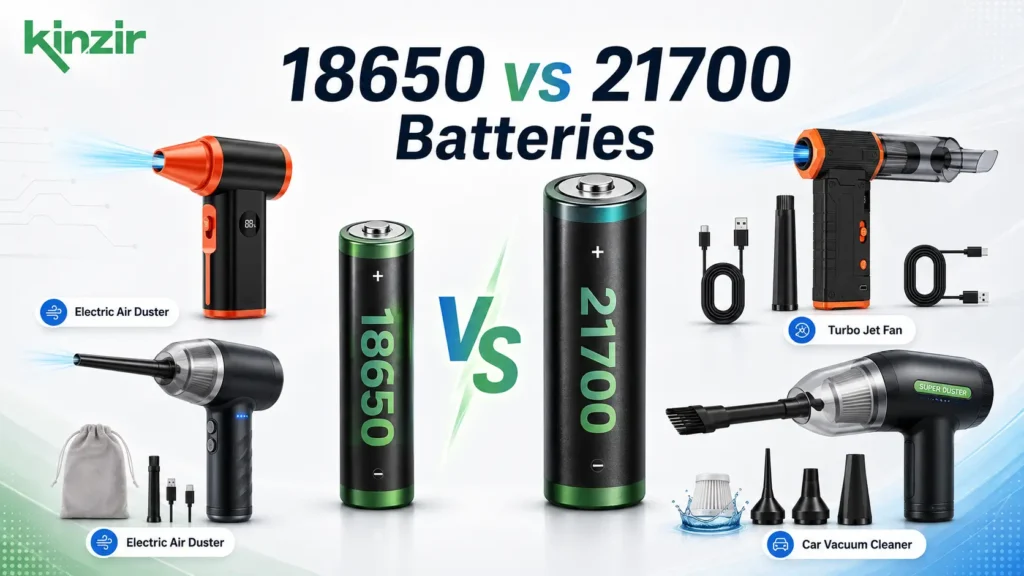
18650 vs 21700 batteries is more than a comparison of two lithium-ion cell sizes. For a cordless car vacuum, electric air duster or mini turbo jet fan, the cell format can affect battery-pack dimensions, capacity, current delivery, runtime, product weight, handle size, heat management and final OEM product design.
A 21700 cell is physically larger than an 18650 cell and can hold more energy per cell. This makes 21700 cells attractive for high-output cordless products such as 130,000 RPM turbo jet fans and multifunction car-cleaning tools. The smaller 18650 format remains useful for compact cordless appliances where size, weight, established battery architecture and component availability carry more weight.
Cell size alone cannot tell you which battery is better.
For an OEM or private-label project, buyers should compare the complete battery system: cell model, voltage, Wh, capacity, maximum discharge current, internal resistance, pack configuration, protection circuit, charging system, motor demand, runtime and mechanical design.
Kinzir manufactures cordless car vacuums, mini turbo jet fans and cordless electric air dusters with different lithium-ion battery configurations. This gives importers and private-label brands several choices when matching battery architecture to motor performance, product size and target retail positioning.
What Is an 18650 Battery?
An 18650 is a cylindrical rechargeable lithium-ion cell format. The name describes its approximate physical dimensions:
- 18 refers to approximately 18 mm in diameter
- 65 refers to approximately 65 mm in length
- The cell has a cylindrical form
The format has been widely used in portable electronics, cordless appliances, battery packs, and many other rechargeable products.
An 18650 cell should not be treated as a fixed electrical specification. Different 18650 cells can have very different capacity, current, internal resistance, and cycle characteristics.
For example, Molicel’s INR-18650-P28A is a cylindrical 18650 cell rated at 3.6 V nominal voltage, 2.8 Ah typical capacity, and 35 A discharge current. Its listed maximum dimensions are 18.6 mm in diameter and 65.2 mm in height. Those figures apply to that exact cell model rather than every 18650 on the market.
For cordless car vacuum OEM projects, Kinzir discusses several possible custom battery capacity options, including cylindrical 18650 and 21700 formats.
Common Reasons to Use 18650 Cells
An OEM engineer may consider 18650 cells for a design that needs:
- A compact battery compartment
- A narrower handle
- Lower individual cell weight
- Mature battery-pack architecture
- Broad cell-model availability
- Moderate motor demand
- Flexible series and parallel pack configurations
- Existing tooling developed around 18 mm cylindrical cells
This does not mean an 18650 cell is suitable for every compact product. The exact discharge requirements of the motor and controller still need to match the selected cell.
What Is a 21700 Battery?
A 21700 is another cylindrical rechargeable lithium-ion cell format.
Its name indicates approximate dimensions of:
- 21 mm diameter
- 70 mm length
- Cylindrical construction
The extra diameter and length give the cell more internal volume than an 18650 format. Cell manufacturers can use that additional volume to develop cells with greater capacity, strong current capability, or a balance between the two.
A useful real-world example is the Molicel INR-21700-P45B. Molicel lists this cell at 3.6 V nominal voltage, 4.5 Ah typical capacity, 16.2 Wh, and a maximum discharge current of 45 A. Molicel lists an energy density of 242 Wh/kg for this particular model.
Compare that with the same manufacturer’s P28A 18650 example at 2.8 Ah and 35 A. The comparison shows what a larger cylindrical format can make possible, but it should not be interpreted as a rule applying to every 18650 and every 21700 cell.
Why 21700 Cells Are Used in High-Output Cordless Products
21700 cells can suit cordless products that target:
- Greater battery capacity per cell
- Longer operating periods
- High motor current
- High-speed BLDC motors
- Fewer cells for a given capacity target
- Removable battery modules
- Premium cordless product positioning
Kinzir already uses 21700 cells in several high-output product platforms.
The Kinzir AD80 removable battery turbo jet fan contains two 4,000 mAh 21700 lithium-ion cells and pairs the battery system with a 130,000 RPM BLDC motor.
The Kinzir AD50 turbo jet fan uses two 21700 cells rated at 4,000 mAh each and a 130 W BLDC motor.
18650 vs 21700 Batteries at a Glance
| Comparison | 18650 Battery | 21700 Battery |
|---|---|---|
| Nominal format diameter | About 18 mm | About 21 mm |
| Nominal format length | About 65 mm | About 70 mm |
| Cell size | Smaller | Larger |
| Capacity per cell | Depends on exact cell | Larger capacities are available |
| Weight per cell | Usually lower | Usually higher |
| Housing space | Easier to fit into compact designs | Requires more internal space |
| High-current cell options | Available | Available |
| Runtime potential | Depends on complete pack | Larger-capacity packs may need fewer cells |
| Handle design | Can support slimmer layouts | May require a wider battery area |
| Best fit | Compact and established platforms | Higher-capacity and high-output platforms |
The key distinction is simple:
18650 and 21700 describe cell formats, not quality grades.
A premium 18650 can outperform a low-grade 21700 in current delivery, voltage stability, cycle behavior and manufacturing consistency.
The cell model matters.
18650 vs 21700 Size: How Much Bigger Is a 21700 Cell?
The visual difference seems small on paper:
18650: approximately 18 × 65 mm
21700: approximately 21 × 70 mm
That extra diameter and length become much more noticeable once several cells, holders, nickel strips, wiring, insulation, protection electronics, and a battery housing are assembled into a pack.
For a handheld product, a few millimeters can change:
- Handle width
- Battery-base dimensions
- Cell orientation
- Grip comfort
- Product height
- Center of gravity
- PCB location
- Charging-port position
- Cooling space
- Battery-release mechanism
This is one reason battery selection should occur early in an OEM project.
Changing from 18650 to 21700 after industrial design or tooling has been completed can require changes to the housing, battery holder, electrical contacts, protection PCB, and mold.
Kinzir’s article on common delays in rechargeable car vacuum OEM projects discusses why battery format, cell chemistry and motor requirements should be defined before the product specification is frozen.
18650 vs 21700 Capacity
Capacity is one of the first numbers buyers see on a cordless product.
Common units include:
- mAh
- Ah
- Wh
A 21700 format has more internal volume, so cell manufacturers can offer higher capacity in individual cells. Molicel’s examples illustrate the difference: its P28A 18650 is listed at 2.8 Ah and its P45B 21700 at 4.5 Ah. These are specific model examples, not universal values for the two formats.
mAh Is Only Part of the Battery Specification
A product described as having a “6,000 mAh battery” or “8,000 mAh battery” still leaves several questions unanswered.
Ask:
- What is the pack voltage?
- How many cells are used?
- Are the cells connected in series or parallel?
- What is the rated Wh?
- What is the exact cell model?
- What current can the cells safely supply?
- What limits are programmed into the protection circuit?
For technical comparison, Wh is especially useful since it connects battery capacity with voltage.
The basic relationship is:
Wh = nominal voltage × Ah
A 3.6 V, 4.0 Ah single cell contains roughly 14.4 Wh of nominal energy.
Series and Parallel Connections Change What the Numbers Mean
Battery packs commonly use cells in series, parallel, or a combination of both.
Cells connected in series increase voltage.
For example, five nominal 3.6 V cells connected in series create a nominal pack voltage of about 18 V. The Ah rating does not get multiplied by five.
Cells connected in parallel increase Ah capacity and available current capability.
Two 4.0 Ah cells connected in parallel can form an 8.0 Ah group at the voltage of one cell.
This distinction matters when reading consumer product specifications.
For OEM engineering, do not compare battery packs using mAh alone. Request:
nominal pack voltage + rated Ah + rated Wh + pack configuration.
Kinzir covers this subject from the car-vacuum sourcing angle in its guide to custom battery capacity options for cordless car vacuum OEM projects.
Does a 21700 Battery Give Longer Runtime Than an 18650?
It can, but cell format does not determine runtime by itself.
Runtime depends on the usable energy in the complete battery pack and how quickly the appliance consumes it.
The main variables include:
- Cell capacity
- Pack voltage
- Number of cells
- Series and parallel configuration
- Motor wattage
- Motor speed
- Controller efficiency
- Selected operating level
- Air resistance
- Filter condition in a vacuum
- Battery temperature
- Cell age
- Protection-circuit settings
A high-speed turbo jet fan can empty a large battery quickly when operated continuously at maximum output.
A lower-output air duster may run much longer from a smaller pack.
Kinzir explores this in detail in Mini Turbo Jet Fan Battery Life, Runtime and Charging.
Battery Capacity Alone Cannot Predict Runtime
The AD80 gives a good example.

The AD80 removable battery turbo jet fan uses two 4,000 mAh 21700 cells, a 130,000 RPM BLDC motor and eight adjustable airflow settings. Its published working time changes substantially according to the selected operating level.
This is exactly why a B2B buyer should ask for runtime by operating level rather than a single “battery life” number.
For a car vacuum, the same principle applies.
The Kinzir VC26R removable battery cordless car vacuum has three motor settings at 50 W, 70 W and 90 W. Published working times are approximately 40, 25 and 15 minutes, paired with 8, 12 and 20 kPa suction levels.
Higher output consumes battery energy faster.
18650 vs 21700 Discharge Current
Capacity tells you how much charge a cell stores.
Discharge capability tells you how much current the cell can supply under specified conditions.
For high-speed cordless appliances, both matter.
Consider two hypothetical cells:
- Cell A has high capacity but limited discharge current
- Cell B stores slightly less energy but can safely supply much greater current
A high-speed BLDC motor may perform better with Cell B.
This is one reason buyers should avoid selecting a battery solely from its mAh figure.
Molicel’s P28A 18650 example is rated at 35 A discharge current. Its P45B 21700 example is rated at 45 A. These numbers demonstrate that high-current cells exist in both formats.
Kinzir has a separate guide comparing 3C vs 5C batteries, which can help buyers understand another way battery discharge characteristics may be described.
Why Discharge Capability Matters for Turbo Jet Fans
Modern mini turbo jet fans can use BLDC motors running at:
- 100,000 RPM
- 120,000 RPM
- 130,000 RPM
- 150,000 RPM
RPM alone does not describe air performance. Motor wattage, impeller geometry, nozzle design, air speed, pressure and airflow all interact.
Kinzir explains these measurements in Turbo Jet Fan Specifications Explained: RPM, CFM, Air Speed and Wind Pressure.
At high operating levels, the motor can demand substantial current from the battery.
If the selected cell or battery pack cannot supply that current properly, the product may experience:
- Excessive voltage drop
- Reduced motor speed
- Lower air output
- Early protection-circuit shutdown
- Increased cell temperature
- Shorter usable runtime
- Faster battery aging
For OEM turbo jet fan development, battery and motor selection should be treated as one electrical system.
A brand should not select a 150,000 RPM motor first and look for a battery later.
18650 vs 21700 Heat Management
Lithium-ion cells generate heat during charging and discharging. Current level, internal resistance, ambient temperature and pack construction affect how much heat develops.
High-output cordless products need thermal review at the complete appliance level.
Battery testing should cover:
- Low operating level
- Medium operating level
- Maximum operating level
- Continuous operation
- Repeated stop-and-start cycles
- Charging
- Charging after heavy use
- High ambient temperature
- Battery aging
A larger 21700 cell does not remove the need for a good battery-pack design.
Cell spacing, conductor design, battery housing, temperature monitoring, motor location and airflow around the pack all affect real operating temperature.
For a turbo jet fan, engineers should pay particular attention to heat transferred from the BLDC motor and controller into the handle or battery area.
18650 vs 21700 Weight
A 21700 cell normally weighs more than a comparable 18650 cell since it is physically larger.
Molicel lists its P28A 18650 example at a maximum weight of 46 g.
Looking at a single cell does not tell you the final product weight.
A battery pack using smaller cells may need more cells to meet a target capacity. A pack based on larger 21700 cells may reach the same energy target with fewer cells.
OEM buyers should compare:
- Complete battery-pack weight
- Pack Wh
- Product weight
- Runtime
- Product balance
This matters greatly for handheld equipment.
For a Cordless Car Vacuum
Too much battery weight at the bottom or rear of a handheld vacuum can make extended cleaning uncomfortable.
For a Mini Turbo Jet Fan
The battery can represent a large share of the product’s total mass. Battery location changes how the tool feels during car drying or outdoor cleaning.
For a Removable Battery Product
The release mechanism, contacts and protective housing add weight beyond the cells themselves.
The better question is not:
Which cell weighs less?
It is:
Which complete battery system gives the required output and runtime at an acceptable finished-product weight?
How Battery Format Changes Product Design
Battery format affects much more than the battery compartment.
Handle Diameter
18650 cells can fit into narrower spaces.
21700 cells require more width, so a designer may need to increase the handle diameter, move cells into the base, or create an external detachable battery module.
Product Balance
A heavy battery located at the bottom of a handle can create a stable grip in one design and an uncomfortable rear-heavy feel in another.
Prototype testing should include actual hand use rather than CAD dimensions alone.
Cell Orientation
Cells can be arranged:
- Vertically
- Horizontally
- Side by side
- In multiple layers
- Inside a separate battery cartridge
The arrangement changes housing dimensions and weight distribution.
Removable Battery Architecture
A detachable pack needs extra mechanical components, such as:
- Release button
- Locking tabs
- Battery rails
- Electrical contacts
- Battery shell
- Anti-reverse installation features
Kinzir has developed several OEM removable battery car vacuum platforms and OEM detachable battery turbo jet fan solutions for brands preparing new cordless product programs.
How Series and Parallel Battery Packs Work
Understanding pack configuration makes the 18650 vs 21700 comparison much more useful.
Cells in Series
Series connections raise voltage.
For five nominal 3.6 V cells:
5 × 3.6 V = approximately 18 V nominal
This can suit a motor system designed for a higher operating voltage.
Cells in Parallel
Parallel cells increase available Ah capacity.
Two 4 Ah cells in parallel form an 8 Ah group at the same nominal voltage.
What Does 5S2P Mean?
A 5S2P pack contains:
- Five cell groups connected in series
- Two cells connected in parallel within each group
- Ten cells in total
This configuration lets the battery designer increase both pack voltage and capacity compared with a single cell.
The final specification still depends on the exact cell used.
A future Kinzir technical article can cover 5S2P battery packs in greater detail, including voltage, Ah, Wh, current path and motor matching.
Which Is Better for a Cordless Car Vacuum?
There is no single answer for every cordless car vacuum.
The right cell depends on the product’s size, suction target, motor wattage and operating time.
18650 Can Suit Compact Car Vacuums
An 18650-based pack may be a good fit where the design calls for:
- Slim dimensions
- Lower weight
- Moderate motor wattage
- Short or medium cleaning sessions
- Existing 18650 tooling
- Competitive entry-level or mid-range positioning
A brand using several cells can still create a substantial battery pack.
21700 Can Suit Higher-Output Car Vacuum Platforms
21700 becomes attractive where the design calls for:
- Larger capacity per cell
- Longer runtime targets
- High-current BLDC motor operation
- Premium positioning
- Larger removable battery modules
- Vacuum and blower functions in one device
The Kinzir VC50 is an example of a cordless vacuum platform using two 21700 lithium-ion cells rated at 4,000 mAh each. The product combines the battery architecture with vacuum and air-blowing functions.
Kinzir’s VC26R removable battery car vacuum takes a different approach. Its pack contains three 2,000 mAh rechargeable cells and supports a BLDC motor with up to 20 kPa suction. The current product specification does not identify those cells as 18650 or 21700, so the format should not be inferred from capacity alone.
That itself is a useful lesson for B2B sourcing:
Ask for the cell format and model rather than guessing from mAh.
Buyers comparing vacuum performance can read Kinzir’s guides to car vacuum suction and Pascal vs Air Watts.
Which Is Better for a Turbo Jet Fan?
21700 cells are particularly attractive for high-output turbo jet fans, where BLDC motor current can be substantial and buyers may want longer working time from a compact battery module.
Kinzir uses 21700 cells in several such products.
Kinzir AD80
The AD80 removable battery turbo jet fan uses:
- Two 4,000 mAh 21700 cells
- 130,000 RPM BLDC motor
- Eight airflow levels
- User-removable battery module
- USB-C charging
The design is aimed at tasks such as car drying, dust removal, electronics cleaning and light outdoor cleaning.
Kinzir AD50
The AD50 turbo jet fan uses:
- Two 21700 lithium-ion cells
- 4,000 mAh listed for each cell
- 130 W BLDC motor
- Variable operating levels
- USB-C charging
It shows how two larger cylindrical cells can support a compact high-speed blower platform.
Kinzir AD46
The AD46 turbo jet fan takes a compact high-speed approach with a 150,000 RPM motor and removable battery structure. This is useful for brands looking at portable car-drying and outdoor blower formats.
For a turbo jet fan, 21700 can be a strong option, but the decision still starts with the complete specification:
motor wattage + maximum current + required runtime + target size + target weight + cost.
Which Is Better for an Electric Air Duster?
Electric air dusters cover a wide output range.
Some are made primarily for:
- Keyboard cleaning
- Computer cases
- Cameras
- Office equipment
Others use high-speed BLDC systems and can work as:
- Car blowers
- Turbo jet fans
- Outdoor dust blowers
- Inflators
- Multifunction cleaning tools
A compact electronics duster may have modest battery demands and fit comfortably around 18650 cells.
A high-speed electric air duster may benefit from 21700 cells.
This is why Kinzir offers different battery options through its OEM detachable battery electric air duster program. The current OEM range can support different lithium-ion cell configurations, including 18650 and 21700 formats.
Kinzir Battery Design Examples
The following products show why battery systems should be compared as complete designs rather than from cell size alone.
| Kinzir Model | Product Type | Battery Information | Motor / Main Output | Battery Access |
|---|---|---|---|---|
| VC26R | Car vacuum + air duster | 3 × 2,000 mAh cells | Up to 70,000 RPM, 20 kPa | Removable |
| AD80 | Air duster + turbo jet fan | 2 × 4,000 mAh 21700 cells | 130,000 RPM | Removable |
| VC80 | Vacuum + air duster + turbo jet fan | 2 × 4,000 mAh 21700 cells | 130,000 RPM | Removable |
| AD50 | Turbo jet fan | 2 × 4,000 mAh 21700 cells | 130 W BLDC | Product-specific design |
| VC50 | Car vacuum + blower | 2 × 4,000 mAh 21700 cells | Multifunction cordless platform | Product-specific design |
Kinzir’s current EU Battery Regulation checklist for car vacuum importers lists the VC80 and AD80 with two 4,000 mAh 21700 cells, alongside removable-battery VC16R and VC26R platforms.
Final production specifications should always be checked against the approved sample, battery datasheet and signed purchase specification.
18650 vs 21700 Battery Cost
Cell cost should be evaluated as part of the complete product cost rather than as a stand-alone purchasing number.
Several items affect battery cost:
- Cell manufacturer
- Cell model
- Capacity
- Discharge rating
- Order volume
- Cell consistency requirements
- Protection electronics
- Pack assembly
- Battery housing
- Connectors
- Charging interface
- Certification and transport documents
A 21700 cell may cost more per piece than an 18650 option, yet the larger capacity per cell can reduce the number of cells required for some designs.
The result can be:
- Fewer weld points
- Fewer cell holders
- Simpler pack construction
- Different BMS requirements
- Different housing dimensions
OEM buyers should request the cost of the complete approved battery module, not compare individual cell prices and assume the cheapest cell creates the cheapest finished product.
Does 21700 Automatically Have Better Energy Density?
No.
Cell format and energy density are different specifications.
A 21700 cell has more physical volume than an 18650 cell, so it can store more total energy. Energy density describes how efficiently that energy is stored relative to weight or volume.
Two cells of the same format can have different:
- Chemistry
- Capacity
- Internal resistance
- Wh/kg
- Wh/L
- Current limits
- Cycle behavior
Molicel’s P28A 18650 is listed at 219 Wh/kg, and its P45B 21700 at 242 Wh/kg. Those numbers show a difference between two specific products. They do not prove that every 21700 cell has better energy density than every 18650.
For sourcing, request the datasheet for the exact approved cell.
Cell Quality Matters More Than the Number Printed on the Format
“21700 lithium battery” is not a complete battery specification.
Neither is:
“18650 battery”
or:
“8,000 mAh battery.”
A professional OEM battery specification should identify at least:
- Cell manufacturer
- Cell model
- Cell format
- Cell chemistry
- Nominal voltage
- Typical or rated capacity
- Minimum capacity
- Maximum discharge specification
- Internal resistance requirement
- Charge specification
- Pack configuration
- Rated Wh
- Protection parameters
- Operating temperature
- Relevant battery test documents
- Batch traceability
This becomes more relevant for bulk manufacturing, where variation between battery batches can affect runtime and motor behavior across thousands of finished units.
What Is Inside a Cordless Battery Pack?
The cylindrical cells are only one part of the assembly.
A typical rechargeable battery module may contain:
- Lithium-ion cells
- Cell holders
- Nickel connection strips
- Wiring
- Insulation
- Protection PCB or BMS
- Temperature sensor
- Electrical contacts
- Charging interface
- Outer housing
- Battery lock and release components
A removable pack needs extra attention at the electrical contacts and mechanical connection points, since users may insert and remove the pack many times during the product’s service life.
Battery-pack testing should check the pack as a system rather than testing cells alone.
Battery Protection Features OEM Buyers Should Review
Depending on the battery architecture, protection functions can include:
- Overcharge protection
- Over-discharge protection
- Overcurrent protection
- Short-circuit protection
- Temperature monitoring
- Cell balancing for applicable multi-cell packs
- Charging protection
- Reverse-connection prevention
The thresholds should match the battery cells, motor controller and charging system.
The cheapest PCB is not automatically the lowest-cost solution over a finished product’s service life. A protection circuit that trips too early can reduce usable performance. One set too loosely can create battery stress.
Sample testing should verify both normal use and abnormal conditions.
18650 vs 21700 for Removable Battery Designs
Cell format and battery removability answer two separate questions.
The first asks:
Which cells are inside the battery?
The second asks:
Can the complete battery be removed and replaced from the appliance?
A product can use:
- Built-in 18650 cells
- Removable 18650 battery pack
- Built-in 21700 cells
- Removable 21700 battery pack
For European product development, the second question has gained much greater relevance.
Kinzir has been upgrading cordless car vacuums, air dusters and turbo jet fans around user-accessible battery modules. Buyers can review the differences between battery-access terms in Kinzir’s guide to readily removable and replaceable batteries.
For existing turbo jet fan designs with integrated batteries, see the Turbo Jet Fan Removable Battery Upgrade for EU 2027.
What Does the EU Battery Regulation Mean for 18650 and 21700 Packs?
Regulation (EU) 2023/1542 does not tell appliance manufacturers to choose an 18650 or a 21700 format.
For cordless appliances containing portable batteries, Article 11 is much more relevant to how the battery is incorporated into the product.
Article 11 applies from 18 February 2027. The regulation sets requirements for portable batteries incorporated into products to be readily removable and replaceable by the end user, subject to the regulation’s conditions and exemptions.
For Kinzir products, buyers can start with the comprehensive EU Battery Regulation 2027 guide for cordless car vacuums, air dusters and turbo jet fans.
Related resources include:
- EU Battery Regulation 2027 Checklist for Car Vacuum Importers
- EU Battery Labeling Requirements
- Readily Removable and Replaceable Battery Guide
- OEM Removable Battery Car Vacuums
- OEM Detachable Battery Turbo Jet Fans
- OEM Detachable Battery Electric Air Dusters
A removable battery structure is one part of an EU product program. Battery identification, labeling, technical documents, replacement availability and finished-appliance requirements need to be reviewed for the final SKU and target market.
18650 vs 21700 for OEM and Private-Label Projects
For a B2B buyer, the correct battery choice starts with the finished-product specification.
Consider 18650 When the Project Prioritizes:
- Compact housing
- Narrow handle design
- Lower cell weight
- Moderate battery requirements
- Existing 18650 tooling
- Established battery suppliers
- Cost-sensitive product positioning
Consider 21700 When the Project Prioritizes:
- Greater capacity from each cell
- High-current motor operation
- Longer runtime targets
- High-speed BLDC motors
- Premium cordless products
- Larger removable battery modules
- High-output turbo jet fans
- Multifunction vacuum and blower designs
Give the Manufacturer Measurable Targets
Instead of telling an OEM factory:
“We need a strong battery.”
Give the engineering team measurable requirements:
- Target motor wattage
- Maximum motor current
- Motor RPM
- Target suction in Pa or kPa
- Target air speed
- Target air pressure
- Minimum working time at each operating level
- Maximum product dimensions
- Maximum product weight
- Desired charging time
- Removable battery requirement
- Spare-battery requirement
- Destination markets
- Target retail positioning
The battery pack can then be selected around the product rather than the product being redesigned around an unsuitable battery.
18650 vs 21700 Battery Selection Checklist
Use this checklist during product definition and sample approval.
Electrical Requirements
- What nominal voltage does the motor require?
- What is the maximum current demand?
- What motor wattage will be used?
- What runtime is required at each operating level?
- How many Wh should the battery store?
- What discharge specification does the selected cell support?
Mechanical Requirements
- How much space is available for the pack?
- What is the maximum finished-product weight?
- Where will the battery sit in the product?
- Will the pack affect grip width or balance?
- Does the battery need to be removable by the user?
Charging Requirements
- What charging input is planned?
- What full-charge time is acceptable?
- Will the battery charge inside or outside the appliance?
- Will spare batteries have a separate charger?
Sourcing and Compliance
- What is the exact cell manufacturer and model?
- Which test reports and transport documents are available?
- Does the battery need market-specific labels?
- Is batch identification available?
- How will replacement batteries be supplied?
- How long will compatible batteries remain available?
- Which markets will receive the product?
Commercial Requirements
- What is the target FOB cost?
- What is the target retail price?
- Can one battery platform serve several SKUs?
- Will spare batteries be sold separately?
- Does the brand want an entry-level or premium configuration?
This process gives buyers a far better basis for supplier comparison than asking whether 18650 or 21700 is “better.”
18650 vs 21700 Batteries: Which Should You Choose?
For a compact car vacuum, an 18650 design can be a good choice where smaller dimensions, lower weight and an established battery platform are the main targets.
For a high-output turbo jet fan, 21700 cells can be attractive where the motor needs substantial current and buyers want greater capacity from fewer cells.
For a long-runtime cordless cleaner, compare total Wh and actual current demand rather than choosing by cell format.
For a lightweight handheld product, compare the weight of the complete battery pack rather than a single 18650 and a single 21700.
For an EU-bound removable battery product, either cell format may be used in an appropriate battery module. Battery accessibility, replacement, documentation, labeling and long-term spare-battery planning need to be addressed separately.
The strongest OEM approach is to choose the cell after motor output, runtime, dimensions, weight and target market have been defined.
Why Work With Kinzir on Custom Battery Cordless Products?
Kinzir is the brand of Mfine Technology (Huizhou) Co., Ltd., an ISO 9001:2015-certified electronic manufacturer producing cordless car vacuums, electric air dusters, mini turbo jet fans and related portable cleaning products.
For OEM, ODM and private-label projects, Kinzir can support:
- 18650 and 21700 battery configurations
- Built-in and removable battery structures
- Custom battery capacity
- Motor and battery matching
- BLDC motor product development
- Spare battery programs
- Custom housing colors
- Logo printing and laser engraving
- Private-label packaging
- Multilingual instructions
- Battery labels
- Sample evaluation
- Production inspection
- Compliance-document support
Kinzir operates five production lines with trained workers and a dedicated QC team. Product testing includes equipment for insertion and extraction life, key life and transportation vibration testing. OEM and ODM services are available for distributors, importers, ecommerce brands and private-label customers.
Buyers developing their next cordless cleaning product can review Kinzir’s full product range or contact Kinzir with the target motor, runtime, battery size, product dimensions and destination market for a custom battery recommendation.
Frequently Asked Questions About 18650 vs 21700 Batteries
Is 21700 better than 18650?
Not in every application. A 21700 cell provides more physical volume and can offer greater capacity or strong current capability. An 18650 cell can suit smaller and lighter designs. The exact cell model, battery pack and appliance requirements determine the better choice.
What is the main difference between 18650 and 21700 batteries?
The main physical difference is size. An 18650 is approximately 18 mm in diameter and 65 mm long. A 21700 is approximately 21 mm in diameter and 70 mm long. Electrical specifications vary by cell model.
Is a 21700 battery bigger than an 18650?
Yes. A 21700 is wider and longer. The difference affects battery-pack volume, handle dimensions and finished-product design.
Does a 21700 battery last longer than an 18650?
A 21700 cell can have greater capacity, but runtime depends on the complete battery pack and the energy consumed by the appliance. Motor wattage, operating level, pack voltage and cell count all affect runtime.
Does a 21700 have more capacity than an 18650?
Many 21700 models have greater individual-cell capacity than 18650 models. The exact result depends on cell chemistry and model. Molicel, for example, lists its P28A 18650 at 2.8 Ah and its P45B 21700 at 4.5 Ah.
Can I replace an 18650 battery with a 21700 battery?
Usually not as a direct replacement. A 21700 is physically larger, and the appliance’s cell holder, housing, electrical contacts, charging circuit and protection settings may be different. A product should be engineered and tested for the intended cell.
Can 18650 and 21700 batteries use the same charger?
Do not decide charger compatibility from cell format. Charging voltage, chemistry, pack configuration, protection electronics and charger specifications must match the battery system.
Is 21700 better for a turbo jet fan?
It can be a good choice for a high-output turbo jet fan. Larger individual-cell capacity and suitable high-current 21700 models make the format attractive for fast BLDC motors. Kinzir uses 21700 cells in products such as the AD80 and AD50.
Is an 18650 battery suitable for a cordless car vacuum?
Yes, if the cell and pack are matched to the vacuum’s voltage, current, motor wattage and runtime requirements. Kinzir supports 18650 configurations as one option for custom cordless car vacuum battery projects.
Why do some high-speed turbo jet fans use 21700 batteries?
High-speed BLDC motors can place substantial current demand on the battery. 21700 cells are available with high capacity and high-current specifications, which can make them suitable for compact high-output blower platforms.
Does battery capacity determine turbo jet fan airflow?
No. Air output depends on the motor, controller, impeller, air path, nozzle, battery voltage and the ability of the battery system to supply the required current. See Kinzir’s turbo jet fan specifications guide for a closer look at RPM, air speed, pressure and airflow.
What does 8,000 mAh mean on a turbo jet fan?
It is a battery-capacity figure, but it should be read together with battery voltage, Wh and cell configuration. For an OEM comparison, request the complete battery specification rather than comparing 8,000 mAh with another product’s mAh figure alone.
How many 18650 cells are needed for a car vacuum?
There is no fixed number. The cell count depends on required voltage, motor wattage, capacity and runtime. Packs may use several cells connected in series, parallel, or both.
How many 21700 cells are needed for a turbo jet fan?
It depends on the electrical design. For example, Kinzir’s AD80 uses two 21700 cells, but other high-speed models can use a different cell count and pack architecture.
Can both 18650 and 21700 batteries be removable?
Yes. Either format can be assembled into a removable battery module. Cell format does not determine whether the user can remove the battery.
Which battery is better for EU 2027 products?
EU Battery Regulation 2023/1542 does not select 18650 or 21700 as the preferred format. For applicable portable batteries incorporated into products, Article 11 sets removability and replaceability requirements from 18 February 2027. The complete product and battery configuration needs to be assessed against the applicable requirements.
What battery information should an OEM buyer request?
Ask for the cell brand, cell model, chemistry, nominal voltage, Ah, Wh, discharge specification, pack configuration, protection functions, charging requirements, battery dimensions, weight, relevant test documents, and batch traceability.
References
- European Union. Regulation (EU) 2023/1542 concerning batteries and waste batteries.
https://eur-lex.europa.eu/eli/reg/2023/1542/oj/eng - Kinzir. Custom Battery Capacity Options for Cordless Car Vacuum Cleaner OEM.
https://www.kinzirairduster.com/custom-battery-capacity-options-for-cordless-car-vacuum-oem/ - Kinzir. EU Battery Regulation 2027 for Cordless Car Vacuums, Air Dusters and Turbo Jet Fans.
https://www.kinzirairduster.com/eu-battery-regulation-2027/ - Kinzir. Mini Turbo Jet Fan Battery Life, Runtime and Charging.
https://www.kinzirairduster.com/mini-turbo-jet-fan-battery-life/ - Kinzir. Turbo Jet Fan Specifications Explained.
https://www.kinzirairduster.com/turbo-jet-fan-specifications/


