
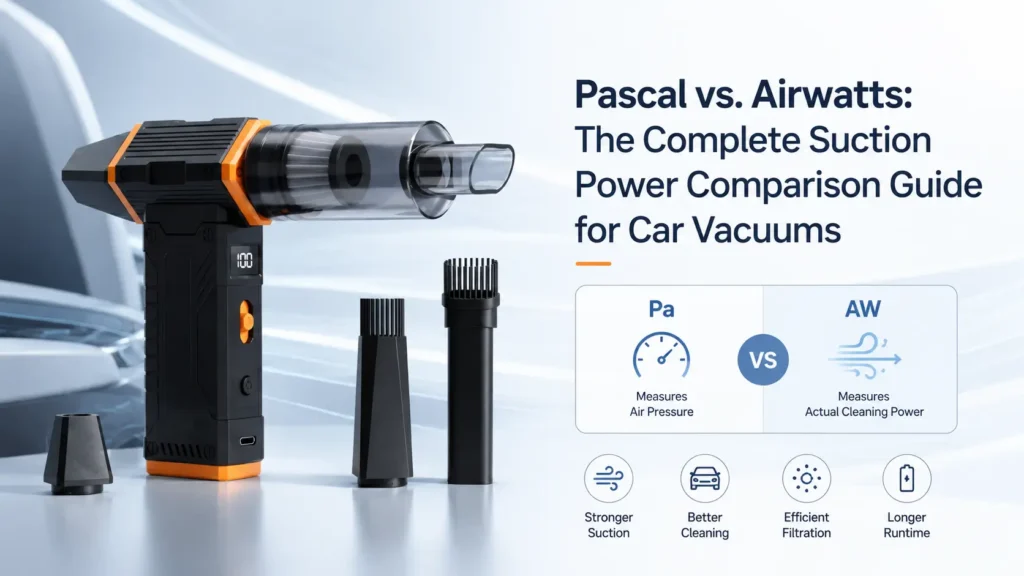
When you compare Pascal vs Airwatts on a spec sheet, the numbers can look confusing and even misleading. One car vacuum cleaner boasts 15,000 Pa of suction pressure, while another claims 80 airwatts of suction power. These units measure fundamentally different things. When you analyze pressure in pascals, you are looking at the static force the motor generates.
If you do not understand what each unit actually tells you about cleaning performance, you risk sourcing a product that underperforms in real-world car interiors.
For B2B buyers and brands evaluating a cordless vacuum for their product line, this distinction directly affects quality and customer satisfaction. Whether you are selling cordless vacuums or a heavy-duty corded vacuum, the right metrics ensure fewer returns. Market-leading devices like the Dyson V15 have set a high bar for what consumers expect from handheld suction. A high Pascal rating does not guarantee strong dust pickup from floor mats, and a high airwatts number does not automatically mean the vacuum can pull pet hair from tight seat gaps.
This article breaks down exactly what Pascal (Pa) and airwatts (AW) measure and why they are not interchangeable. We will look at how an upright vacuum or a robot vacuum compares in these metrics. You will learn which specs actually matter when selecting a car vacuum cleaner for your market. You will also learn what questions to ask your OEM supplier about motor power, nozzle design, filter resistance, and suction testing methods. If you are already evaluating manufacturers like Kinzir or other China-based cordless car vacuum cleaner suppliers, the sourcing insights here will help you make sharper decisions. You can explore current OEM options and request samples at www.kinzirairduster.com.
What Does Pascal Pa Mean in Vacuum Cleaners?
Pascal (Pa) is a unit of pressure. In vacuum cleaners, Pascal suction power refers to the vacuum negative pressure the motor generates when the nozzle is sealed. It tells you how hard the vacuum can pull against a surface, not how much air it moves. In many technical specs, this is listed as the pressure in pascals to indicate pure lifting power.
You will often see Pa suction power listed as kPa (kilopascals), where 1 kPa equals 1,000 Pa. A cordless handheld vacuum rated at 15 kPa produces 15,000 Pa of suction pressure.
This metric is closely related to water lift vacuum measurements. In fact, 1 kPa is roughly equivalent to 4.01 inches of water lift. When a supplier quotes suction pressure in inches of water lift, they are describing the same physical property as Pa, just using a different scale.
Key points about Pa suction power:
- It measures sealed suction, meaning the reading is taken with the nozzle blocked
- Higher Pa means the motor creates stronger vacuum pressure at the nozzle tip
- Pa suction power calculation reflects only pressure, not airflow volume
- The number drops significantly once you introduce filters, hoses, and nozzle attachments
In practice, a high Pa rating indicates the vacuum can grip tightly onto surfaces and dislodge embedded debris. This matters for tasks like pulling sand from car seat crevices or lifting compressed dust from floor mats. Think of it as the “grip strength” of the vacuum at the nozzle opening.
When manufacturers test suction pressure, they typically seal the intake and measure the vacuum negative pressure at peak motor speed. This gives you the maximum theoretical figure, not the working suction you experience during actual cleaning.
What Does Airwatts AW Mean?
Airwatts (AW) is a composite measurement that combines both suction pressure and airflow rate into a single number. The airwatts calculation, often grounded in the ASTM F558 standard, uses a specific formula to calculate air watts based on laboratory performance:
Airwatts = (Airflow in CFM × Vacuum in inches of water lift) ÷ 8.5
This means airwatts suction power reflects two variables simultaneously. It measures how much air moves, often cited in cubic feet per minute, and how strongly it pulls. This airflow measurement, which represents the volumetric flow rate of air passing through the nozzle, provides a more holistic view of performance.
A vacuum with high airflow but low pressure will produce a moderate AW figure. The same is true for a vacuum with extreme sealed suction but limited airflow rate. The formula rewards balance between these two properties. For reference, many premium household cleaners aim for approximately 200 air watts to handle deep cleaning tasks effectively.
Why airwatts matter for buyers:
- AW suction power calculation accounts for real air movement, not just static pressure
- Airwatts correlate more closely with dust pickup performance across varied surfaces
- Two vacuums with identical Pa ratings can have very different AW scores if their airflow differs
- CFM suction power on its own can also be misleading without the pressure component
For car vacuum cleaners specifically, the airflow rate is what carries loose debris like crumbs, hair, and fine dust into the dust cup. Pressure alone cannot do that job efficiently.
When you evaluate vacuum suction power calculation methods, airwatts give you a more complete picture of how the motor, fan, air duct, and filtration system work together. It is not a perfect metric, but it is considerably more informative than Pa alone.
Pa vs AW: Main Difference
The core difference between Pa vs AW comes down to what each unit measures. Pa measures vacuum pressure only, while AW measures the combined output of pressure and airflow. Testing for these often follows different international standards, such as iec 60312 in European markets or ASTM F558 in North America.
Here is a direct comparison:
| Feature | Pascal (Pa / kPa) | Airwatts (AW) |
|---|---|---|
| What it measures | Vacuum negative pressure | Pressure × airflow combined |
| Test condition | Sealed nozzle (no airflow) | Open airflow path |
| Reflects airflow? | No | Yes |
| Reflects pressure? | Yes | Yes |
| Best indicator of | Grip strength on surfaces | Overall suction efficiency |
| Common in | Asian-market car vacuums | North American / European ratings |
| Affected by filters/nozzles | Indirectly | Directly |
For vacuum suction measurement, Pa vs AW suction power comparisons often confuse buyers because both numbers appear on the same product listing. A car vacuum rated at 15,000 Pa might deliver only 30 AW if its airflow design is restrictive. Another model at 10,000 Pa could reach 50 AW with a well-designed air duct and low-resistance HEPA filter.
Pa tells you how hard the vacuum grips. AW tells you how effectively it actually cleans.
If you are sourcing for the US or European market, your end customers will often encounter airwatts in product comparisons. If you are targeting Asian markets, Pa is the more common spec. For example, robot vacuum suction is almost exclusively marketed using Pa ratings. While a standard robot vacuum Pa rating might range from 2,000 to 8,000, handheld units often reach much higher levels. Understanding both helps you position your product accurately and avoid overpromising based on a single number.
Can Pa Convert to AW Directly?
No, you cannot convert kPa to airwatts with a simple formula. Similarly, trying to estimate air watts to Pa without a known airflow is impossible. This is a common pitfall when trying to find an air watts to Pa conversion factor for different vacuum models. Pascal measures pressure alone, while airwatts require both pressure and airflow data.
You may find online calculators or rough conversion charts that claim to translate Pascal to Airwatts. These tools typically assume a fixed airflow rate, which makes the result unreliable. Every vacuum cleaner has a different air duct design, fan blade geometry, filter resistance, and nozzle configuration, all of which affect actual airflow.
Here is what you need for a legitimate conversion:
- Measure the vacuum’s sealed suction in inches of water lift (convert from kPa if needed: 1 kPa ≈ 4.01 in. H₂O)
- Measure the airflow in CFM at the same operating point
- Apply the formula: AW = (CFM × inches of water lift) ÷ 8.5
This means you need access to proper testing equipment or verified lab data from your supplier. If a manufacturer only provides a Pa rating and claims a specific AW figure without disclosing airflow test data, treat that number with caution.
For OEM buyers, the practical takeaway is clear. Always request both suction pressure and airflow test results from your car vacuum cleaner supplier. A single metric, whether Pa or AW, does not give you enough information to compare products accurately or predict real cleaning performance.
Why High Pa Does Not Always Mean Better Cleaning

A car vacuum rated at 20,000 Pa can still underperform compared to one rated at 12,000 Pa. This is something you see repeatedly when testing actual dust pickup performance on car interiors.
The Pa figure represents sealed suction, measured with the nozzle completely blocked. While manufacturers often highlight peak suction, this static number does not always translate to how a carpet vacuum handles deep-set grit. The moment you open that nozzle and start cleaning, air begins to flow, and the effective working suction drops. How well the machine maintains floor contact and deals with resistance determines the actual cleaning efficiency. How much the suction drops depends on several factors:
- Vacuum filter resistance: A clogged or poorly designed HEPA filter car vacuum restricts airflow dramatically, leading to significant suction loss
- Brush roll interference: In models with a brush roll, the mechanical action helps cleaning but can sometimes change the effective airflow at the intake
- Dust cup sealing: Gaps or poor seals in the dust cup let air bypass the filter path, wasting suction force
- Vacuum nozzle design: A narrow nozzle concentrates pressure but limits volume; a wide nozzle moves more air but at lower pressure per unit area
- Vacuum air duct design: Internal bends, rough surfaces, and poorly sized ducts create turbulence and reduce vacuum efficiency
- Motor wattage vs suction power: A high-watt motor with inefficient fan design converts less energy into useful suction
In real car interior cleaning scenarios, you need both pressure and airflow working together. Pulling pet hair from fabric seats requires sustained airflow to carry debris into the dust cup. Extracting sand from floor mat fibers demands localized pressure at the nozzle tip.
Two vacuums with identical Pa ratings can deliver noticeably different cleaning performance when their internal airflow paths, filter materials, and fan designs differ. Spec sheets alone will not reveal this. You need to evaluate actual dust pickup test results or, ideally, test samples yourself before committing to a bulk order.
Which Is More Important for Car Vacuum Cleaners?
For car vacuum suction power, neither Pa nor AW alone tells the full story, but airwatts generally give you a more reliable predictor of cleaning performance.
Car interiors present unique challenges. You deal with tight seat gaps, textured dashboard surfaces, deep floor mat fibers, pet hair embedded in upholstery, and fine dust on vents. Each of these scenarios demands a specific combination of pressure and airflow.
Here is how suction metrics map to common car cleaning tasks:
| Task | Primary need | Why |
|---|---|---|
| Car seat gap cleaning | High pressure (Pa) | Narrow openings need concentrated suction force |
| Floor mat cleaning | Balanced Pa + airflow | Must dislodge and carry away heavy particles |
| Pet hair car vacuum use | High airflow (CFM) | Hair needs sustained air movement to lift and transport |
| Dashboard cleaning | Moderate airflow | Light dust requires gentle but consistent air movement |
| Car interior cleaning (general) | Balanced AW (aiming for 200 air watts in high-end models) | Versatile performance across mixed debris types |
For B2B buyers sourcing a portable car vacuum cleaner or cordless handheld vacuum, the practical recommendation is to prioritize a balanced cordless car vacuum suction power profile. A high suction car vacuum cleaner with 10,000+ Pa and 40+ AW will outperform a unit with 20,000 Pa and only 20 AW in nearly every real detailing scenario.
When evaluating a handheld car vacuum cleaner for your product line, request both metrics from your supplier along with nozzle-specific test data. The car vacuum suction rating that matters most is the one measured under conditions that match how your end customers will actually use the product.
What Should OEM Buyers Ask Before Choosing a Car Vacuum Cleaner?
Sourcing a car vacuum cleaner OEM or car vacuum cleaner ODM product goes well beyond comparing headline suction numbers. The questions you ask your supplier directly affect product performance, compliance, and your brand reputation.
Motor and Fan Specifications
Ask whether the unit uses a BLDC motor or a brushed motor. A brushless motor car vacuum typically delivers longer lifespan, quieter operation, and higher vacuum efficiency. Request the car vacuum motor specifications including RPM range, motor watts, and power at peak versus sustained operation. The vacuum fan design also matters because blade geometry directly influences airflow rate and suction pressure balance.
Battery and Runtime
For cordless models, battery capacity and battery runtime are critical. Ask for the exact mAh rating, cell type (lithium-ion is standard), and verified runtime at each power setting. A car vacuum battery that lasts only 8 minutes on high suction is impractical for professional detailing use cases.
Filtration and Airflow Path
Confirm whether the vacuum uses a HEPA filter car vacuum design and ask about the filter’s resistance to airflow. Request information on vacuum air duct design, including internal diameter and path length. These details determine how much of the motor’s suction actually reaches the nozzle.
Nozzle Design and Accessories
Vacuum nozzle design determines performance in specific cleaning scenarios. Ask about crevice tools for car seat gap cleaning, brush heads for dashboard cleaning, and wide nozzles for floor mat cleaning. OEM suction customization should include the ability to specify nozzle dimensions and attachment types for your target market.
Testing and Quality Assurance
Ask your supplier about their suction testing method. Reliable factories use both sealed-pressure tests and open-airflow testing with calibrated instruments. Request test reports showing pressure (Pa/kPa), airflow (CFM or L/s), and ideally airwatts calculations. Vacuum cleaner testing should include endurance tests under load, not just peak readings.
Certifications and Compliance
For the US market, confirm FCC car vacuum cleaner and CA65 car vacuum cleaner compliance. European distribution requires CE car vacuum cleaner and RoHS car vacuum cleaner certifications. Japan requires PSE car vacuum cleaner compliance, and the UK market needs UKCA car vacuum cleaner documentation. Ask for copies of current certificates, not just verbal assurances.
Customization and Branding
If you need a custom car vacuum cleaner or private label car vacuum cleaner, ask about minimum order quantities for custom colors, logos, and packaging. Wholesale car vacuum cleaner pricing should include clear breakdowns for base units, accessories, branding, and any FBA labeling support.
Why Choose Kinzir for Cordless Car Vacuum Cleaner OEM?
Kinzir is a car vacuum cleaner manufacturer based in China with production facilities in Shenzhen and Huizhou. The company has operated as a professional cordless car vacuum cleaner manufacturer since 2012, exporting to more than 100 countries.
As a car vacuum cleaner supplier China buyers frequently evaluate, Kinzir brings several concrete advantages to the sourcing process:
- R&D depth: Over 100 engineers support product development, with a dedicated laboratory for suction testing, motor endurance, and airflow testing
- Production capacity: Five production lines with in-house plastic injection molding, PCB assembly, and brushless motor integration
- Quality control: A 10-person QC team runs 8-hour high-voltage endurance and insulation resistance tests on every unit, alongside transportation vibration testing
- Certifications: Products carry ISO 9001:2015, CE, RoHS, FCC, PSE, UKCA, KC, and CA65 certifications
- OEM/ODM flexibility: Full support for custom car vacuum cleaner projects including private labeling, custom colors, nozzle configurations, packaging, and FBA labeling
The Kinzir car vacuum cleaner line includes 2-in-1 blowing and vacuuming models, HEPA filter units, fast-charging battery modules, and detailer-grade options for professional automotive use. The Kinzir cordless car vacuum range is built around customizable suction profiles, meaning B2B buyers can specify pressure and airflow targets that match their market requirements.
Samples are typically available within three weeks, and the car vacuum cleaner factory offers factory-direct pricing for qualified wholesale buyers, distributors, and Amazon car vacuum sellers. You can start a sourcing conversation or request product samples at www.kinzir.com.
Frequently Asked Questions
How do you convert air watts to pascals for vacuum suction?
You cannot convert airwatts to pascals directly because airwatts combine both pressure and airflow into one figure, while pascals measure pressure only. To work backward from an AW rating, you would need to know the exact airflow rate (in CFM) at the same test point, then solve the AW formula for pressure. Without verified airflow data from the manufacturer, any conversion is unreliable.
Which measurement better reflects real-world vacuum performance: air watts or pressure?
Airwatts generally provide a better reflection of real-world cleaning performance because the calculation accounts for both suction pressure and airflow rate. A vacuum needs pressure to dislodge debris and airflow to transport it into the dust cup. Pascal ratings alone miss the airflow component, which is why two vacuums with identical Pa can perform very differently during actual car interior cleaning.
What is a good pascal rating for a vacuum cleaner’s suction?
For cordless handheld car vacuum cleaners, a Pa rating between 8,000 and 15,000 Pa (8 to 15 kPa) is considered effective for most car interior cleaning tasks. Units above 15,000 Pa offer strong grip for embedded dirt in carpet and floor mats, though this advantage only materializes when paired with adequate airflow and well-designed nozzle attachments.
Is 10,000 pascals considered strong suction for a vacuum?
Yes, 10,000 Pa (10 kPa) is a solid suction pressure rating for a portable or cordless car vacuum cleaner. It provides enough sealed suction to handle sand, crumbs, pet hair, and light debris across seats, floor mats, and dashboard crevices. For heavy-duty detailing, units in the 12,000 to 20,000 Pa range offer additional capability, assuming the airflow design supports it.
How do kilopascals relate to air watts when comparing vacuums?
Kilopascals (kPa) represent only the pressure half of the equation, while airwatts combine kPa-equivalent pressure with airflow volume. You cannot rank vacuums by kPa to airwatts comparisons unless you also have CFM or L/s data for each unit. When sourcing car vacuums, request both metrics from your supplier to make accurate product comparisons.
What does an air watts-to-watts comparison tell you about a vacuum’s power?
Motor wattage (watts) measures the total electrical power the motor consumes, while airwatts measure the useful suction output. A vacuum with 200 motor watts and 50 AW is more efficient than one with 300 motor watts and 40 AW. This gap often comes down to motor quality, vacuum fan design, and air duct optimization. Efficiency is key to preventing suction loss over the life of the machine. For OEM buyers, comparing motor wattage vs suction power helps you evaluate how efficiently a factory’s design converts energy into cleaning performance.


