
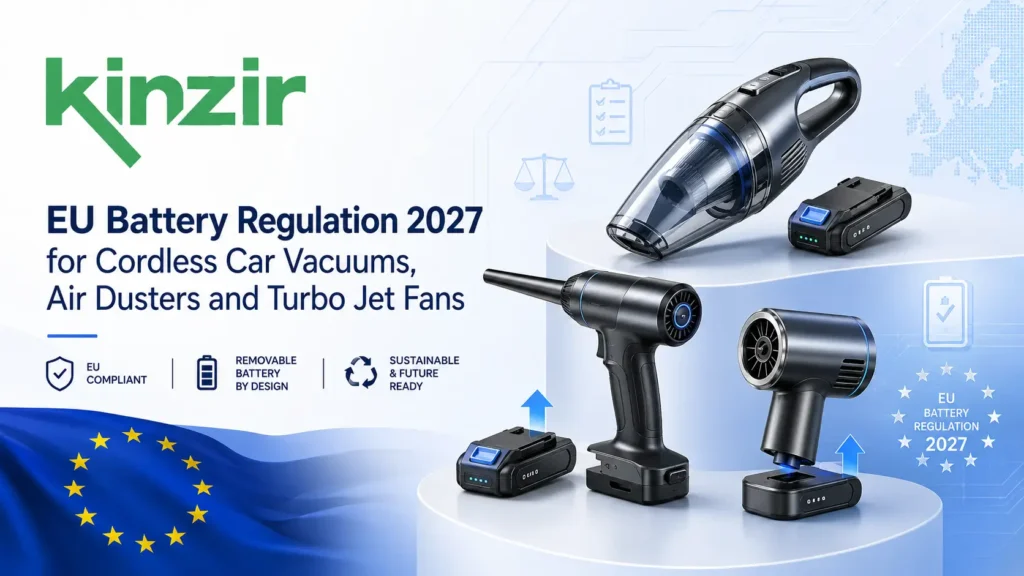
The EU Battery Regulation 2027 will change how cordless car vacuums, electric air dusters and mini turbo jet fans are designed, labelled, documented and supported after sale. From 18 February 2027, products incorporating portable batteries must normally let the end user remove and replace the complete battery during the product’s service life. Kinzir has prepared new handheld appliances with removable battery packs that release by hand, giving European importers, distributors and private-label brands a practical route for future product programs.
Regulation (EU) 2023/1542 reaches far beyond a detachable battery. It covers restricted substances, battery conformity, CE marking, labels, QR codes, traceability, producer registration, waste collection and extended producer responsibility. A buyer preparing an EU launch needs to review the battery, the complete appliance, the documents and the spare-parts plan as one project.
What Is Regulation (EU) 2023/1542?
Regulation (EU) 2023/1542 concerns batteries and waste batteries placed on the EU market. Its scope includes batteries sold on their own and batteries incorporated into appliances. It sets requirements for sustainability, safety, labelling, marking, conformity, waste collection and reporting.
A typical rechargeable pack in a handheld car vacuum or electric air duster will usually be treated as a portable battery. The legal definition covers a sealed battery weighing 5 kg or less that is not designed for industrial use and is not an EV, LMT or SLI battery.
This classification matters. Portable batteries follow the end-user removal rule in Article 11. They do not normally require the full battery passport reserved for LMT batteries, electric vehicle batteries and industrial batteries above 2 kWh.
EU Battery Regulation 2027 Timeline
European buyers should treat the regulation as a staged program rather than a single 2027 deadline.
| Date | Requirement |
|---|---|
| 18 August 2024 | Portable batteries became subject to the 0.01% lead limit, apart from the stated temporary zinc-air button-cell exception |
| 18 August 2025 | Separate collection symbol required on batteries |
| From 18 August 2026, or 18 months after the related implementing act enters into force, whichever is later | General battery label and rechargeable portable battery capacity label |
| 18 February 2027 | QR code required on all batteries |
| 18 February 2027 | Portable batteries incorporated into products must normally be removable and replaceable by the end user |
The regulation limits mercury to 0.0005% by weight in batteries and cadmium to 0.002% by weight in portable batteries. The portable battery lead limit is 0.01% by weight from 18 August 2024, subject to the stated zinc-air button-cell transition.
The general information and capacity label dates need precise wording. The law sets the start at 18 August 2026 or 18 months after the relevant implementing act enters into force, whichever date is later. The separate collection symbol has applied since 18 August 2025. The QR code date is fixed at 18 February 2027.
What Does Removable and Replaceable Mean?
Article 11 requires the complete portable battery to be readily removable and replaceable by the end user at any time during the appliance’s service life. The obligation concerns the complete pack, not each cell inside the pack.
A compliant design may use commercially available tools. It cannot require proprietary tools, thermal energy or solvents. A specialised tool is permitted only where it is supplied free with the product. EU guidance places no-tool designs and basic tools within the accepted approach.
Kinzir’s new removable packs can be released by hand. The user does not need to open the motor housing, apply heat, dissolve adhesive or visit a repair centre. This hand-release structure can make replacement faster and easier to explain in manuals, product videos and QR-linked instructions.
A replacement pack must preserve the appliance’s function, performance and safety. Software cannot block a compatible replacement battery.
How Kinzir’s Tool-Free Battery Release Supports Article 11
Kinzir’s removable battery structure is based on a simple user process:
- Switch off the appliance and disconnect the charging cable.
- Press the battery release control or locking clips.
- Remove the complete pack by hand.
- Align the approved replacement pack with the product terminals.
- Push the pack into place until it locks.

The final instruction set for each model should show the release point, correct insertion direction, terminal protection, charging steps and approved replacement pack number. Article 11 requires instructions and safety information for battery use, removal and replacement. The information must remain permanently available online on a public website in a form end users can follow.
A short printed guide can be packed with the appliance. The same content can be hosted online with diagrams, videos, translations, safety warnings and disposal instructions. A QR code can lead users to the correct model page.
Five-Year Spare Battery Availability
A removable design offers little value when no replacement pack is available. The regulation requires that portable batteries incorporated into products remain available as spare parts for at least 5 years after the last unit of the equipment model is placed on the market. Pricing must be reasonable and non-discriminatory for end users and independent professionals.
European brands should set up a spare battery program before the first shipment. The program should cover:
- A separate battery SKU
- Compatible appliance models
- Nominal voltage, rated capacity and watt-hours
- Cell chemistry and cell format
- Connector and terminal layout
- Wholesale and retail pricing
- Spare battery packaging
- Storage and transport instructions
- Warranty period
- Five-year supply policy
- Replacement lead time
Kinzir can pair each removable-battery appliance with an identified replacement pack. This gives distributors a clearer after-sales plan and lets users extend the useful life of the car vacuum or air duster without having to replace the entire machine.
Battery Labels, CE Marking and Traceability
The general battery label under Annex VI includes manufacturer identification, battery category, battery identification, manufacturing location, manufacturing date, weight, capacity, chemistry, certain hazardous substances, suitable extinguishing agent and critical raw materials above the stated concentration.
From 18 August 2025, batteries need the separate collection symbol. Batteries exceeding the stated cadmium or lead marking thresholds need the relevant Cd or Pb chemical symbol. From 18 February 2027, all batteries need a readable QR code. Where the battery is too small for a clear mark, the label or QR code may be placed on the packaging and accompanying documents under the conditions in Article 13.
The battery needs its own conformity process under the Batteries Regulation. The complete cordless appliance may sit under other EU product rules at the same time. A battery CE mark does not replace the conformity work for the finished car vacuum, electric air duster, charger or supplied accessories.
The manufacturer remains responsible for the complete product, including supplied components. A private-label seller may be treated as the manufacturer when a battery is sold under its own name or trademark.
QR Code Versus Battery Passport
A QR code and a battery passport are not the same requirement.
From 18 February 2027, every battery needs a QR code. For a typical portable battery used in a car vacuum or mini turbo jet fan, the code should provide access to the applicable battery label information, the EU Declaration of Conformity and waste battery information.
A full battery passport applies from the same date to LMT batteries, electric vehicle batteries and industrial batteries above 2 kWh. Small portable packs in handheld cleaning appliances do not normally fall into those categories.
For an OEM program, the buyer and manufacturer should agree on four points before mass production:
- Who creates the QR destination page
- Who maintains the online documents
- Whether the QR code is model-specific or batch-specific
- Which languages appear on the page
The information linked through the QR code must remain complete, current and accurate.
Producer Registration and Battery EPR
Product design is one part of market access. A producer must register in each Member State where it makes a battery available on the market for the first time. This covers batteries incorporated into appliances. A registered producer or appointed organisation then carries the relevant extended producer responsibility duties.
EPR duties may include financing collection, transport and treatment of waste batteries, supplying waste information, gathering data and reporting to national authorities. Member State procedures can differ, so an importer selling across several EU markets may need separate registrations or appointed representatives.
The producer definition depends on the supply chain and sales model. A European importer, private-label brand, distance seller or other business that first supplies the battery in a Member State may carry producer duties. Buyers should confirm this role before launch rather than relying on the battery cell supplier.
Importer and Private-Label Responsibilities
EU importers need to verify that the battery carries the required conformity and traceability information, that the manufacturer has completed the required documents and that instructions are supplied in languages accepted by the target Member State.
Importers must keep a copy of the EU Declaration of Conformity for ten years and make technical documentation available to authorities on request.
Distributors must check producer registration, CE marking, labels, required documents and user instructions before making a battery available. Storage and transport conditions must not damage compliance.
Selling a battery or appliance under the importer’s own trademark can shift manufacturer duties to that importer or distributor. OEM buyers should define responsibility for label artwork, test reports, declarations, manuals, QR data, importer details and corrective actions in the purchase agreement.
Battery Compliance Is Separate From Finished-Appliance Compliance
A removable battery does not complete the full EU compliance file for a cordless car vacuum or turbo jet fan. The finished appliance may need assessment under applicable electrical and electronic product rules, including EMC and RoHS. WEEE obligations may apply to the electrical appliance, alongside battery EPR for the incorporated portable battery.
A practical file may include:
- Battery technical documentation
- Battery EU Declaration of Conformity
- Finished-product EU Declaration of Conformity
- EMC test report
- RoHS report
- Product safety assessment
- Charger or adapter documentation
- User manual and battery replacement guide
- Battery and appliance label artwork
- QR code records
- WEEE and battery EPR information
- Batch traceability records
The exact set depends on the product configuration, charging system, target country and sales channel.
Kinzir EU Battery Regulation Upgrade Solution
Kinzir has developed removable-battery structures for cordless car vacuums, electric air dusters and turbo jet fan products. The battery packs can be released by hand, giving the end user direct access to the complete pack without opening the appliance housing.
The current development range includes high-speed BLDC motor designs, 21700 and other lithium-ion cell configurations, multiple speed settings, different runtime levels and separate vacuum or blowing formats. The presentation includes AD80, VC80, AD59, VC59, AD18, AD16R, VC16R and VC23R concepts.
Kinzir’s OEM and ODM support can cover:
- Hand-release battery structure
- Battery pack and spare battery SKU
- Brand logo and laser engraving
- Product colour
- Packaging and carton marks
- Battery label layout
- Batch code and QR code printing
- Multilingual instruction manual
- Removal and replacement guide
- Accessories and nozzle sets
- Product testing and inspection
- Export documents for lithium battery shipping
VC80 Three-in-One Cordless Car Vacuum, Air Duster and Turbo Jet Fan
VC80 combines three common functions in one handheld device:
- Cordless car vacuum for seats, mats, consoles and narrow gaps
- Electric air duster for dashboards, vents, keyboards and equipment
- Turbo jet fan for high-speed blowing and car-drying tasks
The current VC80 concept uses a 28.8 mm BLDC motor rated up to 130,000 rpm, air speed up to 65 m/s, maximum stated motor output of 160 W, two 21700 cells rated at 4,000 mAh each, eight operating levels, 15 to 60 minutes of stated runtime and about four hours of charging time.
Final battery voltage, pack capacity and watt-hour data should appear on the approved model specification and battery label.
VC80 suits brands seeking one product for car interior cleaning, dust blowing, electronics care, light drying and outdoor use. The removable pack can reduce full-unit warranty replacement when battery ageing is the only fault.
AD80 Electric Air Duster and Turbo Jet Fan
AD80 is an electric air duster with turbo jet fan applications. It does not have a vacuum collection function.
Its current concept uses the same 28.8 mm BLDC motor platform, up to 130,000 rpm, air speed up to 65 m/s, maximum stated motor output of 160 W, two 21700 cells, eight operating levels, 15 to 60 minutes of stated runtime and about four hours of charging time.
The stated 2.5 to 7.5 kPa figure should be presented as air pressure or working pressure, not vacuum suction.
Common uses include:
- Blowing dust from car vents and dashboards
- Drying mirrors, grilles and exterior gaps
- Cleaning keyboards, computers and cameras
- Removing debris from workshop surfaces
- Inflating compatible camping items
- Moving light leaves or loose debris
- Supplying air for campsite or barbecue tasks with safe operating distance
AD59 Compact Air Duster and Turbo Jet Fan
AD59 is a compact electric air duster that can be used as a mini turbo jet fan. It has no vacuum function.
The presentation lists a 28.8 mm BLDC motor, up to 130,000 rpm, air speed up to 65 m/s, maximum stated motor output of 160 W, two 21700 cells, eight operating levels, 15 to 60 minutes of runtime, 2.5 to 7.5 kPa air pressure and a four-hour charging time.
AD59 is suited to private-label programs that want a focused blowing product without a dust cup or vacuum air path.
AD18 High-Output Electric Air Duster
AD18 is a larger air duster concept using a 40 mm BLDC motor, an 18 to 21 V system, maximum stated output of 400 W, 90 g thrust, 75,000 rpm and a removable 5S2P 18.5 V battery system. The presentation states about 30 minutes of operation at high speed.
The public specification should show the confirmed pack capacity and watt-hours rather than adding cell mAh values across a series connection. This makes transport classification, replacement ordering and buyer comparison clearer.
VC16R and VC23R Cordless Car Vacuums
VC16R and VC23R are removable-battery cordless car vacuum concepts. The presentation lists:
- 45 mm BLDC motor
- Three output levels at 50 W, 70 W and 90 W
- Motor speeds of 50,000, 60,000 and 70,000 rpm
- Three 2,000 mAh cells
- 8, 12 and 20 kPa suction settings
- 40, 25 and 15 minutes of runtime
- 300 ml dust cup
- About 2.5 hours of charging time
These models target buyers that need stronger car-vacuum suction in a conventional dust-cup format. Their removable packs support easier battery service and future spare-parts sales.
Kinzir Removable-Battery Model Comparison
| Model | Product type | Vacuum function | Turbo jet fan use | Battery access |
| VC80 | Vacuum and air duster combination | Yes | Yes | Hand-release pack |
| AD80 | Electric air duster | No | Yes | Hand-release pack |
| AD59 | Compact electric air duster | No | Yes | Hand-release pack |
| AD18 | High-output electric air duster | No | Yes | Hand-release pack |
| VC16R | Cordless car vacuum | Yes | No | Hand-release pack |
| VC23R | Cordless car vacuum | Yes | No | Hand-release pack |
Fixed Battery Versus Removable Battery
| Buying factor | Fixed battery design | Kinzir removable battery design |
| Article 11 planning | Higher redesign risk for 2027 orders | Prepared for end-user battery removal |
| Removal method | Housing may need disassembly | Complete pack releases by hand |
| Battery ageing | Full appliance may need repair or replacement | User can change the pack |
| Spare-parts sales | Limited | Separate replacement battery opportunity |
| Product service life | Often tied to the original pack | Service life can continue with a new pack |
| Warranty handling | Complete unit may be returned | Battery-only replacement may solve the fault |
| Documentation | Fixed battery safety instructions | Removal, replacement and spare-pack instructions |
| Inventory planning | One appliance SKU | Appliance plus spare battery SKU |
How Kinzir Tests Removable Battery Products
A detachable pack needs secure locking, stable electrical contact and safe operation after repeated removal. Kinzir’s factory information lists insertion and extraction life testing, key life testing, transport vibration testing and electrical endurance checks.
Products pass an eight-hour high-voltage endurance and insulation resistance test, and the company provides a 12-month quality guarantee.
A removable-battery validation plan can include:
- Repeated insertion and extraction
- Locking clip life
- Terminal wear
- Accidental release resistance
- Drop and vibration checks
- Charging temperature checks
- Overcharge and over-discharge protection
- Short-circuit protection
- Runtime verification
- Incorrect insertion prevention
- Pack-to-model compatibility
- Packaging transport checks
Shipping Cordless Appliances and Spare Lithium Batteries
Lithium-ion cells and batteries used for transport must follow the applicable dangerous-goods framework. UN Manual of Tests and Criteria subsection 38.3 contains the test procedures used for lithium cell and battery transport classification.
Buyers should request:
- UN 38.3 test summary
- SDS or MSDS
- Battery specification
- Cell specification
- Nominal voltage
- Rated amp-hours
- Watt-hour rating
- Cell and pack configuration
- Packaging method
- Terminal protection details
- Shipping classification
- Documents for batteries packed with equipment
- Documents for spare batteries shipped separately
Spare batteries may follow different packing and carrier conditions from batteries installed in equipment. The shipping plan should be confirmed before quotation and production scheduling.
EU Buyer Compliance Checklist
Before approving a cordless car vacuum, electric air duster or turbo jet fan for the EU market, request the following items.
Product and Battery Design
- End-user removable complete battery pack
- Hand-release method or accepted tool method
- No heat, solvent or destructive disassembly
- Protected terminals
- Correct insertion control
- Compatible replacement pack
- Product performance maintained after replacement
Labels and Digital Information
- Battery manufacturer identification
- Battery model and batch traceability
- Capacity, chemistry and manufacturing details
- Separate collection symbol
- Cd or Pb mark where required
- CE marking
- QR code plan
- Public online removal instructions
- Safety, storage and disposal information
- Target-market language versions
Documents
- Battery EU Declaration of Conformity
- Battery technical file
- Finished-product EU Declaration of Conformity
- Test reports for the appliance
- UN 38.3 test summary
- SDS or MSDS
- RoHS documentation
- EMC documentation
- User manual
- Spare battery specification
- Warranty and recall process
Market and After-Sales Duties
- Producer registration in each target Member State
- Battery EPR arrangement
- WEEE registration where applicable
- Waste battery information
- Five-year spare battery plan
- Replacement battery pricing
- Sales and batch records
- Complaint and corrective-action records
When Should Importers Move to a Removable Battery Design?
For many 2027 product launches, the purchasing decision must be made in 2026. Housing changes, mould work, battery connectors, pack locking, sample approval, life testing, document preparation, translations, packaging updates and production all take place before goods enter the EU supply chain.
The legal concept of placing on the market concerns the first supply of a battery on the EU market. Stock supplied to EU distributors before a new requirement applies may fall under the transition described in the regulation. Importers should keep clear batch and entry records for any fixed-battery inventory.
A practical schedule is:
- Review current fixed-battery models.
- Select a removable-battery replacement.
- Confirm pack voltage, capacity, watt-hours and cell configuration.
- Approve the release structure and spare battery SKU.
- Complete sample and life testing.
- Prepare labels, QR pages, manuals and declarations.
- Complete pilot production.
- Move EU orders to the updated version before the applicable deadline.
Are Car Vacuums and Turbo Jet Fans Exempt?
The core Article 11 exemptions cover certain appliances designed mainly for wet environments, specified professional medical devices and cases needing a permanent battery connection for safety or data integrity.
In April 2026, the European Commission opened consultation on proposed extra exemptions for categories such as certain wearables, electric toys and ATEX products. Ordinary cordless car vacuums, electric air dusters and turbo jet fans were not named in that proposal.
As of 5 July 2026, buyers should plan these products around the standard end-user removal rule rather than assume an exemption.
Why Choose Kinzir for EU-Ready Cordless Cleaning Products?
Huizhou Mfine Technology Co., Ltd., owner of the Kinzir brand, manufactures electric air dusters, cordless vacuum cleaners and portable turbo jet fans.
Its factory information lists ISO 9001:2015 certification, five production lines, ten QC staff, in-house laser engraving, OEM and ODM support, electrical endurance testing, vibration testing and a 12-month quality guarantee.
For European buyers, Kinzir can connect product development with practical sourcing work:
- Removable battery product selection
- Cordless vacuum, air duster and combined-function models
- Hand-release battery packs
- Spare battery ordering
- OEM branding and packaging
- Label and QR code printing
- Multilingual manuals
- Inspection and test support
- Lithium battery export documents
- Production planning for 2027 market entry
Frequently Asked Questions
Does the EU Battery Regulation 2027 apply to cordless car vacuums?
A cordless car vacuum usually contains a sealed rechargeable battery under 5 kg, so its pack will commonly fit the portable battery definition. Article 11 normally requires the complete pack to be removable and replaceable by the end user from 18 February 2027.
Does an electric air duster need a removable battery?
An electric air duster incorporating a portable battery is normally covered by the same rule. The complete battery should be removable and replaceable without proprietary tools, heat or solvents.
Can screws be used for battery removal?
Yes. Commercially available tools can be used. A no-tool hand-release pack gives the user a simpler process and avoids tool availability questions.
Do turbo jet fan batteries need a battery passport?
Typical portable batteries in handheld turbo jet fans do not normally need the full battery passport. They still need a QR code from 18 February 2027.
What should the battery QR code contain?
For portable batteries outside the passport categories, the QR code provides access to applicable label information, the EU Declaration of Conformity and waste prevention and management information.
How long must replacement batteries be available?
Replacement packs must remain available for at least five years after the last unit of the equipment model is placed on the market.
Can software reject a replacement battery?
The regulation states that software must not impede replacement with another compatible battery or compatible key components.
Who handles battery EPR for an OEM product?
The responsible producer depends on who first makes the battery available in each Member State and how the sales chain is structured. The producer must register and meet the applicable EPR duties, either directly or through an appointed organisation or representative where permitted.
Does battery CE marking cover the complete car vacuum?
No. Battery conformity and finished-appliance conformity are separate. The complete product may need its own technical file, declaration, testing and markings under every applicable EU rule.
What is the main advantage of Kinzir’s removable battery structure?
Each confirmed Kinzir pack can be released by hand. The design supports faster replacement, easier after-sales service, separate spare-pack sales and planning for Article 11.
Request a Kinzir EU Battery Upgrade Proposal
European importers, wholesalers, retailers and private-label brands can request a model comparison, removable battery sample, OEM quotation, battery specification, spare-parts plan, packaging proposal and available compliance documents.
When requesting a quotation, provide the target model, order quantity, destination country, branding method, packaging type, charger requirements, required certificates and planned launch date. Kinzir can then match the appliance, removable pack and documentation plan to the project.
Regulatory note: This article provides general product compliance information. Final obligations depend on the exact product, battery, economic operator role, target Member State and current implementing measures.
References
- European Parliament and Council of the European Union. “Regulation (EU) 2023/1542 Concerning Batteries and Waste Batteries.” Official Journal of the European Union, 12 July 2023. Consolidated text updated 31 July 2025. View the official regulation on EUR-Lex
- European Commission. “Commission Guidelines to Facilitate the Harmonised Application of Provisions on the Removability and Replaceability of Portable Batteries and LMT Batteries in Regulation (EU) 2023/1542.” Commission Notice C/2025/214, 10 January 2025. View the official guidance on EUR-Lex
- European Commission. “New Law on More Sustainable, Circular and Safe Batteries Enters into Force.” Directorate-General for Environment, 17 August 2023. View the European Commission announcement
- European Commission. “Commission Seeks Views on Battery Removability Exemptions.” Directorate-General for Environment, 28 April 2026. View the official consultation announcement
- United Nations Economic Commission for Europe. Manual of Tests and Criteria, Eighth Revised Edition. Subsection 38.3, Lithium Metal and Lithium-Ion Batteries. United Nations, 2023. View the official UNECE manual
- European Parliament and Council of the European Union. “Directive 2014/30/EU on Electromagnetic Compatibility.” Official Journal of the European Union, 26 February 2014. View the EMC Directive on EUR-Lex
- European Parliament and Council of the European Union. “Directive 2011/65/EU on the Restriction of Certain Hazardous Substances in Electrical and Electronic Equipment.” Official Journal of the European Union, 8 June 2011. View the RoHS Directive on EUR-Lex
- European Parliament and Council of the European Union. “Directive 2012/19/EU on Waste Electrical and Electronic Equipment.” Official Journal of the European Union, 4 July 2012. View the WEEE Directive on EUR-Lex
- European Union. “CE Marking: EU Requirements and Product Compliance.” Your Europe. Last checked 9 January 2026. View the official CE marking guidance
- European Union. “Preparing Technical Documentation for EU Product Compliance.” Your Europe. View the official technical documentation guidance
- European Union. “Signing an EU Declaration of Conformity.” Your Europe. View the official Declaration of Conformity guidance
- European Union. “WEEE Responsibilities for Manufacturers and Producers.” Your Europe. View the official WEEE registration guidance
All online sources were accessed on 5 July 2026.


