
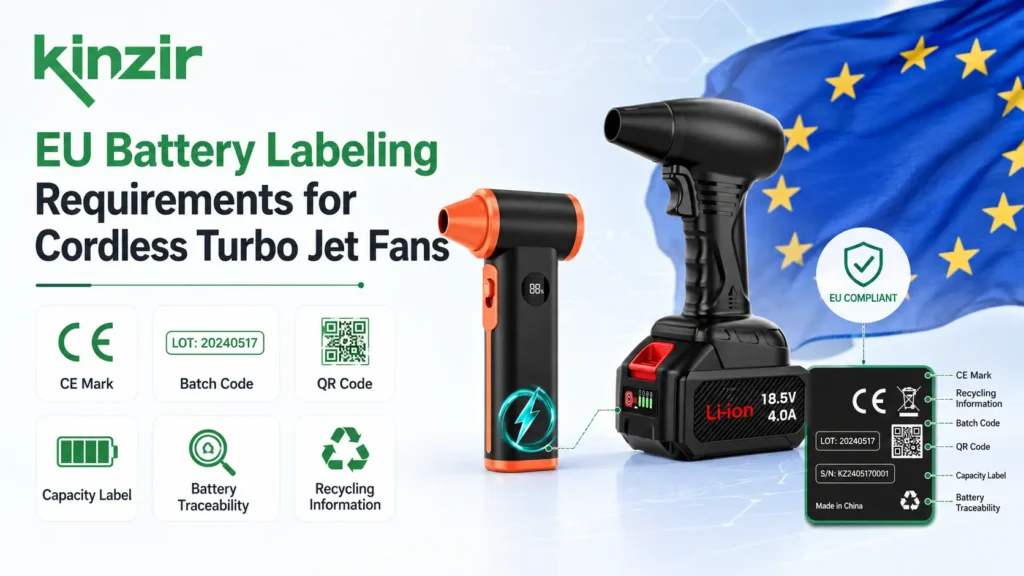
EU battery labeling requirements are changing how cordless turbo jet fans, electric air dusters, and cordless car vacuums are designed, labeled, documented, and sold in Europe. Under Regulation (EU) 2023/1542, batteries need clearer physical labels, CE marking, traceability information, waste collection symbols, and QR codes. For B2B buyers, this means the battery label is now part of EU market access, not just a small sticker on the pack. (EUR-Lex)
For Kinzir buyers, this topic connects directly with EU Battery Regulation 2027 for cordless car vacuums, air dusters and turbo jet fans, removable battery turbo jet fan, and Kinzir removable battery air dusters and turbo jet fans for EU 2027.
Quick Answer: What Battery Labels Are Needed for EU Turbo Jet Fans?
For a cordless turbo jet fan, mini air blower, electric air duster, or car vacuum battery sold in the EU, buyers should check these label items:
- CE mark on the battery, packaging, or documents when direct marking is not possible
- Battery model or identification code
- Manufacturer identification
- Batch code or lot number for traceability
- Battery category and chemistry
- Capacity information
- Rated voltage and Wh value where useful
- Separate collection symbol
- Cd or Pb mark when legal thresholds are exceeded
- QR code from 18 February 2027
- Safety and waste-battery information connected to the product documents
Article 13 of Regulation (EU) 2023/1542 covers battery labeling and marking, including general battery information, capacity information for rechargeable portable batteries, separate collection symbols, and QR codes. (EUR-Lex)
Why Battery Labeling Matters for Cordless Air Dusters and Turbo Jet Fans
Battery labeling helps importers, distributors, online platforms, repair teams, and market surveillance authorities identify the battery behind the product.
For a wholesale mini turbo jet fan, the battery label can answer key questions:
- Who made the battery pack?
- Which model and batch does it belong to?
- What is the rated capacity?
- Is it linked to the correct EU Declaration of Conformity?
- Can the battery be traced during warranty service?
- Does the QR code lead to the right information page?
- Is the label ready for EU retail, Amazon, and distributor review?
For buyers comparing wholesale mini turbo jet fans, battery labeling should be checked with runtime, battery structure, airflow, certificates, and spare battery plans.
EU Battery Regulation 2023/1542: Labeling Scope for Portable Batteries
Regulation (EU) 2023/1542 applies to batteries placed on the EU market, including batteries sold separately and batteries built into appliances. This includes the portable rechargeable lithium-ion battery packs used in cordless turbo jet fans, electric air dusters, and car vacuum cleaners. (EUR-Lex)
Most Kinzir cordless air blowers and compact car vacuums use portable rechargeable batteries. That makes the Article 13 labeling rules and Article 20 CE marking rules directly relevant for EU product planning. (EUR-Lex)
Article 13 Battery Label: General Battery Information
Article 13 requires batteries to bear a label containing the general information listed in Annex VI, Part A. For cordless products, that information may include:
- Manufacturer identification
- Battery category
- Battery identification
- Place of manufacture
- Manufacturing date
- Weight
- Capacity
- Chemistry
- Hazardous substances other than mercury, cadmium, or lead
- Critical raw materials above stated concentration levels
- Suitable extinguishing agent
The regulation states that labeling requirements apply from 18 August 2026 or 18 months after the relevant implementing act enters into force, whichever is later. (EUR-Lex)
For turbo jet fan projects, this means the battery label should be planned during sample approval. Waiting until mass production can create rework, packaging changes, and shipment delays.
CE Mark on Battery Packs: What EU Buyers Should Check
The CE mark indicates that the battery has undergone the required conformity assessment under EU law. Article 20 of Regulation (EU) 2023/1542 says the CE marking must be visible, legible, and permanent on the battery. When this is not possible due to the battery’s nature or size, the CE mark can be affixed to the packaging and accompanying documents. (EUR-Lex)
For a turbo jet fan battery pack, the buyer should check:
- Is the CE mark placed on the battery pack where space allows?
- Is the mark clean and easy to read?
- Is the EU Declaration of Conformity available?
- Does the DoC match the correct battery model?
- Is the battery label consistent with the user manual and packaging?
- Is the battery pack covered by the right test reports?
A CE mark printed without the correct technical file can pose a risk to importers. The label, EU Declaration of Conformity, product model, and battery model should match.
Batch Code and Battery Traceability
The EU regulation requires battery identification, manufacturer information, and other label details. A batch code or lot number is a practical way to connect each battery pack to its production record. (EUR-Lex)
For B2B projects, a batch code helps with:
- Warranty claims
- Spare battery matching
- Product recalls
- Factory quality records
- Retailer audits
- Amazon or marketplace checks
- Battery transport documents
- After-sales service
A good battery label should make the battery easy to trace without opening the product housing. For removable-battery turbo jet fans, the batch code should remain visible after the pack is removed.
QR Code Requirements From 18 February 2027
From 18 February 2027, all batteries must carry a QR code under Article 13. For most portable batteries used in cordless turbo jet fans and car vacuums, the QR code should lead to battery label information, the EU Declaration of Conformity, waste battery information, and other required records. (EUR-Lex)
The QR code should be:
- High contrast
- Easy to scan with an ordinary phone
- Linked to the correct battery model
- Updated when documents change
- Placed where it will not wear off too easily
- Consistent with the product label and packaging
A QR code that leads only to a homepage is weak. It should lead users and authorities to battery-specific information.
QR Code vs Battery Passport: Do Turbo Jet Fans Need Both?
Many buyers confuse the QR code with the battery passport. They are related, but they are not the same.
From 18 February 2027, all batteries need a QR code. The full battery passport applies to light means of transport batteries, electric vehicle batteries, and industrial batteries above 2 kWh. Most mini turbo jet fan batteries are portable batteries far below 2 kWh, so they usually need the QR code but not the full battery passport. (EUR-Lex)
For a cordless turbo jet fan, the practical task is clear: prepare a QR code system that links to accurate battery documents and waste-battery information.
Separate Collection Symbol and Cd, Pb Marks
All batteries must carry the separate collection symbol from 18 August 2025. This symbol tells users that batteries should not be discarded with mixed household waste. (EUR-Lex)
The battery must carry the chemical symbol:
- Cd if cadmium exceeds the stated threshold
- Pb if lead exceeds the stated threshold
For Kinzir’s EU upgrade direction, the PPT lists low-mercury, cadmium-free material selection as part of the EU Battery Regulation solution, with the CE label, batch code, and QR code already printed on the samples.
Capacity Label for Rechargeable Portable Batteries
Rechargeable portable batteries need capacity information under Article 13. This matters for cordless air dusters and turbo jet fans, since buyers often compare models by mAh, voltage, Wh, and runtime. (EUR-Lex)
For a product page, mAh alone is not enough. A better technical label or specification sheet should include:
- Rated capacity in mAh or Ah
- Rated voltage
- Energy in Wh
- Cell configuration
- Charging input
- Battery chemistry
- Working time by speed level
For example, the Kinzir AD47 Mini Turbo Jet Fan is listed with a 10,000 mAh battery and a 150,000 RPM BLDC motor. Its larger battery format makes traceability, spare pack matching, and label consistency more valuable for wholesale projects. (Kinzir AD47 Mini Turbo Jet Fan)
Label Placement for Small Turbo Jet Fan Batteries
Battery labels should stay readable during normal use, charging, storage, and replacement. For compact battery packs, space can be limited. The regulation allows certain information to be placed on packaging and accompanying documents when the nature or size of the battery makes direct marking unsuitable. (EUR-Lex)
For turbo jet fans, good placement options include:
- Flat side of the removable battery pack
- Battery base side panel
- Battery bottom label area
- Product packaging
- User manual
- QR-linked information page
Avoid placing QR codes or batch codes on curved, high-friction, or textured areas where printing may become hard to scan.
Importer and Distributor Checks Before EU Shipment
EU importers and distributors should not depend only on supplier promises. Regulation (EU) 2023/1542 sets duties for economic operators, including checks around conformity, CE marking, labels, required documents, and safety information. (EUR-Lex)
Before shipping cordless turbo jet fans to Europe, buyers should request:
- Battery label artwork
- Battery pack photos
- CE mark location
- Batch code format
- QR code test scan
- EU Declaration of Conformity
- Battery specification sheet
- Technical file summary
- User manual and safety instructions
- Waste-battery information
- UN38.3 test summary
- MSDS
- Packaging label plan
This should be part of sample approval, not only pre-shipment inspection.
Kinzir EU Battery Labeling Upgrade Solutions
Kinzir’s EU Battery Regulation upgrade plan for car vacuums, air dusters, and turbo jet fans includes CE marking, batch codes, and QR codes on battery samples. The PPT lists low-mercury, cadmium-free material choices, same or better capacity and cycle life, plus overcharge, short-circuit, and temperature protection.
The same PPT lists Mfine’s in-house design, mold, assembly, and battery pack capabilities, with support for ISO9001, BSCI, CE, RoHS, REACH, FCC, PSE, UKCA, UN38.3, and MSDS.
Kinzir supports OEM and wholesale buyers with:
- Battery label planning
- Removable battery structure
- QR code preparation
- Battery pack assembly
- Batch code traceability
- Safety protection design
- EU market product upgrades
- Product documentation support
Buyers can start from the Kinzir EU 2027 removable battery product guide and the EU Battery Regulation 2027 guide.
Product Examples: Turbo Jet Fan Battery Labeling in Practice
Kinzir AD46 Turbo Jet Fan: Removable Battery Pack
The Kinzir AD46 Turbo Jet Fan uses a 150,000-RPM brushless motor and is rated for 42 m/s wind speed and 16 kPa wind pressure. Kinzir’s specification guide describes the AD46 as using a removable 4,000mAh lithium battery, which gives buyers more flexibility for battery replacement, regional packaging, and future product updates. (Kinzir Air Duster)
For this type of product, the battery label should clearly show the pack model, capacity, voltage, CE mark, traceability code, and QR code when the 2027 rule applies.
Kinzir AD47 Mini Turbo Jet Fan: 10,000mAh Battery Pack
The Kinzir AD47 Mini Turbo Jet Fan is listed as an upgraded version of AD46 with a 10,000mAh battery pack and a 150,000 RPM BLDC motor. It is designed for car drying, seasonal cleaning, and other high-airflow tasks. (Kinzir Air Duster)
For a large removable pack, buyers should pay extra attention to batch traceability, spare-battery labeling, carton marking, and QR-linked documentation.
Kinzir AD61 Battery Powered Leaf Blower: External Battery Platform
The Kinzir AD61 Battery-Powered Leaf Blower features a removable battery platform and is equipped with a BLDC motor rated at 35,000 RPM. It supports leaf clearing, car snow removal, pet drying, and indoor dust cleaning. (Kinzir AD61 Battery-powered leaf blower)
For external battery platforms, the battery label should stay readable after repeated insertion and removal.
AD80 and AD59 Turbo Jet Fan Upgrade Direction
Kinzir’s upgrade PPT lists AD80 and AD59 turbo jet fans with a 28.8mm BLDC motor, 130,000 RPM, 65 m/s wind speed, 160W maximum power, two 4,000mAh 21700 cells, 15 to 60 minutes of working time, and a four-hour charging time.
For these newer designs, battery label planning should be handled together with capacity claims, working time claims, charging time, and EU documentation.
EU Battery Labeling Checklist for Buyers
| Label or Document Item | What to Check |
|---|---|
| CE mark | Visible, legible, permanent, or placed on packaging and documents when direct marking is unsuitable |
| Battery model | Separate from the product model when needed |
| Batch code | Clear lot number for traceability |
| Manufacturer info | Name, registered trade name, or trademark |
| Battery category | Portable rechargeable battery classification where applicable |
| Capacity | mAh or Ah, plus voltage and Wh where useful |
| Chemistry | Lithium-ion or other chemistry stated correctly |
| Manufacturing date | Month and year or clear coded format |
| Separate collection symbol | Required from 18 August 2025 |
| Cd or Pb mark | Required when thresholds are exceeded |
| QR code | Required from 18 February 2027 |
| QR landing page | Battery-specific information, DoC, safety and waste details |
| EU DoC | Matches battery model and product model |
| Shipping documents | UN38.3, MSDS, and transport records |
| User instructions | Safe charging, use, replacement, and disposal |
Common Battery Labeling Mistakes
Using Only a Product Label
A product label on the fan body is not always enough. The battery pack may need its own label, mainly for removable battery products.
No Batch Code
Without a batch code, warranty handling and recall control become harder. A batch code is one of the simplest ways to support traceability.
QR Code Links to the Wrong Page
A QR code should not lead to a general homepage. It should open battery-specific information.
CE Mark Without Matching Documents
The CE mark should correspond to a valid conformity file. Buyers should ask for the EU Declaration of Conformity and battery test documents.
Capacity Claim Does Not Match the Battery Pack
mAh, voltage, Wh, and cell configuration should match the real battery design. Wrong capacity claims can create compliance and customer-service problems.
Label Is Too Small to Scan
A QR code that cannot be scanned by a normal phone creates risk. Test it after printing, shrink wrapping, and packing.
How to Build a QR Code Landing Page for Turbo Jet Fan Batteries
A practical QR code page for a cordless turbo jet fan battery should include:
- Battery model
- Product model compatibility
- Rated capacity
- Rated voltage
- Battery chemistry
- Manufacturer or responsible operator information
- Batch code explanation
- EU Declaration of Conformity download
- Safe charging instructions
- Safe replacement instructions
- Waste battery disposal guidance
- Recycling symbol explanation
- Contact information for after-sales support
The page should remain live and up to date throughout the product service period. If the battery model changes, the QR code page should reflect the correct version.
Battery Labeling and Removable Battery Design Work Together
Battery labeling and removable battery design should be planned together. A removable battery makes the label easier to access, scan, and check during after-sales service.
For EU 2027 planning, see Kinzir’s guide on removable battery turbo jet fan. It explains why battery access, replacement, spare packs, safety instructions, and QR codes are now part of the same compliance conversation.
Build EU-Ready Cordless Products With Kinzir
Kinzir helps wholesale buyers develop EU-ready cordless turbo jet fans, electric air dusters, and car vacuum cleaners with removable battery packs, battery labels, batch codes, QR code labeling, safety protection, and export documentation.
Kinzir’s factory background includes electronic product manufacturing, electric air dusters, vacuum cleaners, mini portable turbo jet fans, R&D support, five production lines, QC staff, testing equipment, OEM/ODM service, and certifications such as CE, RoHS, FCC, PSE, UKCA, and CA65 across applicable products.
To compare suitable models, visit:
- Wholesale Mini Turbo Jet Fans
- Kinzir AD46 Turbo Jet Fan
- Kinzir AD47 Mini Turbo Jet Fan
- Kinzir AD61 Battery Powered Leaf Blower
- Kinzir Removable Battery Air Dusters and Turbo Jet Fans for EU 2027
FAQs About EU Battery Labeling Requirements
Do turbo jet fan batteries need a CE mark in the EU?
Yes. Batteries covered by Regulation (EU) 2023/1542 need CE marking before being placed on the EU market. The CE mark should be visible, legible, and permanent on the battery, or placed on packaging and documents when direct marking is unsuitable. (EUR-Lex)
Is a batch code required on every battery?
The regulation addresses battery and manufacturer identification. A batch code is a practical traceability method for production control, warranty service, and recall handling. (EUR-Lex)
When does the QR code become mandatory for batteries?
All batteries must carry a QR code from 18 February 2027. (EUR-Lex)
Does a mini turbo jet fan battery need a full battery passport?
Most mini turbo jet fan batteries are portable batteries below 2 kWh. They usually need a QR code, but not the full battery passport. The full passport applies to LMT, EV, and industrial batteries with capacities above 2 kWh. (EUR-Lex)
Can the CE mark and QR code be printed on packaging?
Yes, when direct marking on the battery is not possible or suitable due to battery size or nature, certain marking can be placed on packaging and accompanying documents. (EUR-Lex)
What should a QR code link to?
For a typical portable battery, the QR code should link to required battery label information, EU Declaration of Conformity, and waste-battery information. (EUR-Lex)
Should the removable battery have its own label?
Yes. A removable battery pack should be identifiable on its own, with the battery model, capacity, traceability code, and required regulatory markings.
What documents should EU importers request?
Importers should request the EU Declaration of Conformity, technical documentation, battery specification, safety instructions, label artwork, QR code content, UN38.3, MSDS, and packaging plan.
Is mAh enough on the label?
No. mAh is useful, but voltage and Wh help buyers compare battery energy more accurately. The specification sheet should explain cell configuration and working time.
Can Kinzir support EU battery labeling upgrades?
Yes. Kinzir’s upgrade plan includes CE marking, batch codes, QR codes on battery samples, safer materials, battery-protection design, and in-house battery-pack support.
Reference
- Regulation (EU) 2023/1542 on batteries and waste batteries, EUR-Lex
Main authority source for Article 13 battery labeling, Article 20 CE marking, QR code rules, and economic operator duties. (EUR-Lex) - Sustainability Rules for Batteries and Waste Batteries, EUR-Lex Summary
Plain EU summary of labeling, QR code, and battery passport timing. (EUR-Lex) - European Commission Batteries and Waste Batteries Page
EU policy page for battery sustainability, waste batteries, implementation context, and future regulatory updates. (EUR-Lex) - Kinzir EU Battery Regulation 2027 Guide
Internal guide covering EU 2027 planning for cordless car vacuums, air dusters, and turbo jet fans. (Kinzir Air Duster) - Kinzir Removable Battery Air Dusters and Turbo Jet Fans for EU 2027
Internal product guide for removable-battery models and EU market preparation. (Kinzir Air Duster)


