
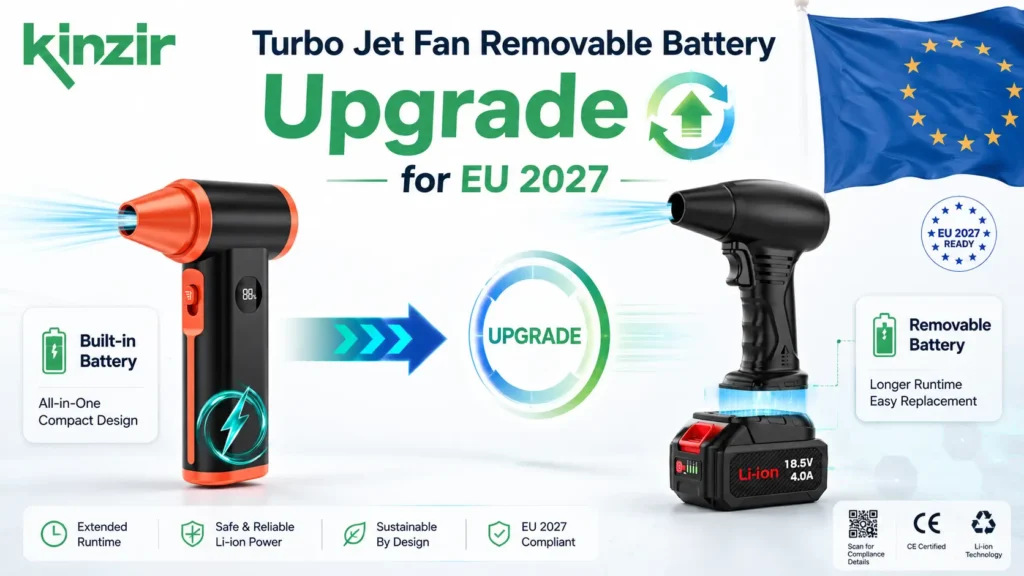
A turbo jet fan removable battery upgrade is now a practical project for brands selling cordless turbo jet fans, electric air dusters, and cordless car vacuums in Europe. From 18 February 2027, many portable batteries built into appliances must be readily removable and replaceable by end users. For built-in battery turbo jet fan models, this can mean changes to the battery compartment, detachable battery base, terminals, connectors, PCB, battery management system, tooling, labels, QR codes, and replacement instructions. (EUR-Lex)
Kinzir has already built a full EU 2027 topic hub for this direction, including EU Battery Regulation 2027 for cordless car vacuums, air dusters and turbo jet fans, removable battery turbo jet fan, and Kinzir removable battery air dusters and turbo jet fans for EU 2027.
Why Turbo Jet Fan Removable Battery Upgrade Matters for EU 2027
The EU Battery Regulation 2023/1542 changes the design, labeling, documentation, collection, recycling, and product service life of batteries. For cordless turbo jet fans, the most direct product-design issue is battery removability and replaceability.
A sealed built-in battery model may still look clean and compact, but it can pose an EU market risk if the user cannot safely remove the entire battery pack. A removable battery structure helps buyers prepare for:
- EU 2027 battery replacement rules
- Longer product service life
- Easier repair and battery recycling
- Spare battery sales
- Better after-sales handling
- Clear battery traceability
- CE label, batch code, and QR code planning
Kinzir’s post-show report noted rising buyer interest in removable battery designs, with AD61, AD46, AD47, and AD59 becoming key discussion points for Europe’s upcoming battery rules, easier maintenance, longer product life, and lower e-waste concerns. See Kinzir’s 2026 trade show report for market context.
What Built-In Battery Turbo Jet Fans Need to Change
A built-in battery is not automatically a failed design. The issue is whether the entire battery pack can be safely removed and replaced.
A built-in battery turbo jet fan may need changes in three areas:
- Mechanical structure: Battery door, compartment, screws, latch, base, shell design.
- Electrical system: Terminals, connector, PCB, charging path, battery detection, BMS.
- Compliance system: Battery label, CE mark, batch code, QR code, replacement guide, spare pack plan.
For a deeper buyer-focused explanation, read Can a Built-In Battery Turbo Jet Fan Still Be Sold in Europe After 2027?.
From Sealed Battery Housing to Serviceable Battery Access
Many compact mini turbo jet fans place the lithium battery inside the handle or body. This structure can be upgraded without turning every model into a large tool-style blower.
Common upgrade paths include:
- Screw-access battery compartment
- Removable battery cover
- Slide-in internal battery pack
- Detachable battery base
- External tool battery platform
- SKD battery module for local assembly
The key is simple. The user should be able to remove the battery pack without breaking the fan, damaging the battery, or using heat, solvents, or forced cutting. The European Commission guidance supports battery removal with no tool, commonly available tools, or a special tool supplied free with the product. (EUR-Lex)
Battery Compartment Redesign for Compact Turbo Jet Fans
Screw-Access Battery Compartment
A screw-access compartment is a good choice when the brand wants to keep the product compact.
For this design, the housing should include:
- Standard screws
- Strong screw bosses
- A flat battery pack holder
- Internal connector access
- Clear battery direction marking
- No sharp edges near the battery
- Space for the battery label
- Manual instructions for replacement
This design can keep the product small and still give the end user a clear service path.
Snap-Fit or Slide Cover Design
A snap-fit cover can reduce tool use, but the structure must be tested carefully.
The cover should:
- Stay locked during high-speed operation
- Avoid accidental opening
- Open without cracking
- Keep the battery pack fixed
- Leave space for wires and connectors
- Resist wear after repeated access
For mini turbo jet fans used in cars, garages, workshops, and outdoor cleaning, vibration and impact can be frequent. The cover and latch must stay stable during daily use.
Heat and Internal Space Planning
Turbo jet fans use high-speed BLDC motors. Battery placement should not block airflow or place cells too close to motor heat.
Engineers should review:
- Motor heat path
- PCB position
- Air duct layout
- Cable routing
- Battery insulation
- Thermal gap
- Vent design
- Shell thickness
- Cell protection
Kinzir’s turbo jet fan specifications guide explains how RPM, airflow, voltage, battery capacity, and motor design affect product performance.
Detachable Battery Base for Removable Battery Turbo Jet Fans
A detachable battery base is often the clearest solution for a high-output turbo-jet fan with a removable battery upgrade.
This structure is suitable for:
- Car drying
- Light snow removal
- Leaf clearing
- Workshop dust removal
- Garage cleaning
- Outdoor camping tasks
- Commercial cleaning use
- Long jobs with spare batteries
The user removes the empty battery and installs a charged pack. This reduces downtime and makes the product easier to service.
Kinzir AD46 Removable Battery Turbo Jet Fan
The Kinzir AD46 removable battery turbo jet fan is a compact 150,000 RPM model for car drying, snow, leaves, and dust removal. Kinzir’s specification guide lists the AD46 with a removable 4,000mAh battery, making it a useful example of a compact removable battery platform.
Kinzir AD47 Mini Turbo Jet Fan With 10,000mAh Battery
The Kinzir AD47 mini turbo jet fan with 10,000mAh battery uses a larger detachable battery pack and a 150,000 RPM BLDC motor. Kinzir describes AD47 as an upgraded version of AD46, with a 10,000mAh 5S2P battery pack and CE, FCC, and RoHS certification listed on the product page. (Kinzir Air Duster)
Kinzir AD61 Battery Powered Leaf Blower
The Kinzir AD61 battery powered leaf blower uses a larger external battery style for wider outdoor work. This type of platform offers buyers more room for battery labels, QR codes, pack locking, and spare-battery sales.
Battery Terminals and Connectors for Removable Battery Packs
A removable battery system depends on reliable terminals and connectors. A poor connector can cause heat, unstable operation, voltage drop, or shutdown during full-speed use.
Terminal Contact Design
For turbo jet fan battery terminals, check:
- Low contact resistance
- Correct contact pressure
- Protected metal surfaces
- Anti-reverse structure
- Firm pack positioning
- Wear resistance after repeated insertion
- Stable output under vibration
- Suitable current rating for the BLDC motor
High-speed brushless motors can draw large current during startup and maximum airflow. The battery connector needs to match the motor, controller, and discharge rate.
Connector Safety and Anti-Reverse Design
The battery pack should not be easy to insert the wrong way. The connector shape, rail direction, and latch structure should guide the user.
Useful design points include:
- Directional rails
- Offset terminals
- Locking grooves
- Insulated connector pocket
- Red and black wire separation
- Strain relief
- Heat-resistant wire gauge
Kinzir’s AD47 SKD cordless mini turbo blower features key components such as screws, connecting lines, a detachable battery, and a 150,000 RPM BLDC motor for bulk buyers. The SKD format can help importers plan local assembly and service access.
Release Latches for Removable Battery Turbo Jet Fans
The release latch controls user experience and safety. It must be easy to use but not easy to release by accident.
Common latch options include:
- One-button release
- Dual-side latch
- Slide lock
- Screw lock
- Tool-assisted lock
- Push-and-slide pack rail
A good release latch should:
- Hold the battery during high-speed motor operation
- Resist transport vibration
- Avoid accidental release during handling
- Allow simple battery removal
- Survive repeated insertion and extraction
- Stay firm after long use
Kinzir’s factory background includes insertion and extraction life test machines, key life test machines, double-arm test machines, and transportation vibration testing machines, which are directly relevant to latch and battery-based testing.
PCB Changes for a Turbo Jet Fan Removable Battery Upgrade
A built-in battery model often charges through the fan body. A removable-battery upgrade may change the charging path and battery-detection logic.
Charging Circuit Changes
Possible charging designs include:
- Charging through the fan body
- Charging directly through the battery pack
- Separate desktop charger
- USB-C charging on the pack
- USB-C charging on the product
- Charging dock for spare packs
The PCB should match the selected charging method. If a spare battery can charge outside the fan, the battery pack may need its own charging circuit or a charger made for that pack.
Battery Detection and Power Path
A removable battery system may need:
- Battery presence detection
- Low-voltage cutoff
- Over-current response
- Temperature signal input
- Battery ID detection
- Motor controller matching
- Display calibration
- Charging status display
For fans with a digital screen, the battery percentage display should be recalibrated after changing voltage, capacity, or pack structure.
Firmware and Display Updates
Some turbo jet fans display battery level, gear speed, charging status, or error warnings. After a battery upgrade, the firmware may need to update:
- Battery percentage curve
- Low battery warning
- Overheat warning
- Charging animation
- Battery fault code
- Pack removal warning
Small display details can reduce user confusion and after-sales questions.
Battery Management System for High-Speed Turbo Jet Fans
A battery management system, or protection board, is central to battery safety.
For a turbo jet fan removable battery upgrade, the BMS should support:
- Overcharge protection
- Over-discharge protection
- Short-circuit protection
- Over-current protection
- Temperature protection
- Cell balancing where needed
- Safe charging control
- Safe discharge under high load
Kinzir’s EU upgrade deck lists overcharge, short circuit, and temperature protection as part of the new sample upgrades. It also lists CE mark, batch code, and QR code on battery samples.
High-output turbo jet fans require this level of protection, as users may run them at full speed for car drying, wet leaf blowing, or outdoor cleaning. Heat, current draw, and repeated starts can stress weak battery packs.
New Molds and Tooling for Built-In Battery Redesign
A real turbo-jet fan removable-battery upgrade often requires new molds. The housing must give enough room for the pack, latch, terminals, label, wires, and heat control.
Housing Redesign Items
New tooling may cover:
- Battery cover shape
- Battery compartment depth
- Screw boss position
- Latch opening
- Battery rail
- Terminal seat
- Connector pocket
- Shock ribs
- Label area
- QR code flat zone
- Grip shape
- Shell strength
The battery label should have a flat area where CE mark, batch code, capacity, and QR code can remain readable.
Tooling Approval and Sample Review
The Mfine upgrade PPT identifies technical decisions, product design, and tooling approval as part of the project team’s work. It also lists in-house design, mold, assembly, and battery pack capabilities, with ISO 9001 and BSCI factory certifications.
Before mass production, buyers should review:
- Battery fit
- Latch feel
- Battery removal force
- Pack stability
- Terminal contact
- Label position
- QR code scan result
- Housing gap
- Heat rise
- Charging test
- Drop and vibration result
Drop and Vibration Testing for Removable Battery Products
A removable battery design adds moving parts. That means more testing is needed.
What to Test
For removable battery turbo jet fans, test:
- Product drop with battery installed
- Battery pack drop
- Transport vibration
- Battery insertion and extraction life
- Latch life
- Terminal wear
- Charging cycle
- High-speed operation
- Heat rise
- Short-circuit response
- Over-current protection
- Battery pack retention after impact
The goal is not just a removable battery. The goal is a battery that stays safe and stable across normal use, shipping, charging, and replacement.
Battery Labels, Batch Codes and QR Codes
EU 2027 planning is not only about the shell. Battery labels and digital information need early planning.
What to Add on the Battery Pack
A removable battery pack should include:
- CE mark
- Battery model
- Batch code or lot number
- Rated capacity
- Rated voltage
- Battery chemistry
- Separate collection symbol
- QR code from 2027
- Manufacturer identification
- Safety warning
- Compatible model information where useful
Kinzir’s guide to EU battery labeling requirements for cordless turbo jet fans covers CE mark, batch code, QR code, capacity label, battery traceability, and recycling information in more detail.
QR Code Page Planning
The QR code should lead to battery-related information, not a general homepage.
A practical QR code page can include:
- Battery model
- Compatible turbo jet fan models
- EU Declaration of Conformity
- Battery capacity and voltage
- Battery chemistry
- Replacement instructions
- Safety warnings
- Waste battery handling
- Recycling information
- Contact information
From 18 February 2027, all batteries must carry a QR code under the EU Battery Regulation. For typical portable batteries used in turbo jet fans, the QR code normally connects to required label, conformity, and waste information. (EUR-Lex)
Replacement Instructions for End Users
A removable design needs clear instructions. If users cannot understand the steps, the product can still fail in the market.
What the Manual Should Show
The manual should include:
- Tool needed
- Battery removal steps
- Battery installation steps
- Compatible battery model
- Charging instructions
- Safety warnings
- Disposal instructions
- QR code to online guide
- Contact channel for spare batteries
Use short steps and diagrams. Name the battery model clearly. Tell users not to use swollen, damaged, wet, or overheated packs.
Spare Battery Planning
A removable-battery product requires a spare-battery supply plan.
Buyers should confirm:
- Battery model stability
- Pack MOQ
- Spare battery carton marking
- Battery label consistency
- Charger compatibility
- Warranty policy
- Storage instructions
- Shipping documents
- After-sales parts pricing
A removable battery without a stable replacement pack creates avoidable warranty issues.
Kinzir Upgrade Models From the EU 2027 PPT
The Mfine and Kinzir EU Battery Regulation upgrade deck lists new designs and upgrade paths for car vacuums, air dusters, and turbo jet fans.
AD80 Turbo Jet Fan Upgrade
The PPT shows AD51 or VC51 upgraded to AD80. AD80 is listed with a 28.8mm BLDC motor, 130,000 RPM motor speed, 65 m/s wind speed, 160W maximum rating, two 4,000 mAh 21700 cells, 15 to 60 minutes of working time, and a four-hour charging time.
AD59 Turbo Jet Fan Upgrade
The PPT shows AD57 upgraded to AD59. AD59 is listed with the same 28.8mm BLDC motor, 130,000 RPM motor speed, 65 m/s wind speed, 160W maximum rating, two 4,000mAh 21700 cells, 15 to 60 minutes working time, and four-hour charging time.
AD18 Air Duster Upgrade
The PPT shows AD17 upgraded to AD18. AD18 is listed with a 40mm BLDC motor, 18V to 21V platform, 400W maximum rating, 75,000 RPM wind speed, removable battery, and 30 minutes high-speed working time.
These upgrade paths show how battery structure, motor, runtime, labels, safety protection, and product housing need to move together.
Kinzir Factory Support for OEM Removable Battery Upgrades
Kinzir and Mfine support OEM and wholesale buyers with product design, mold, assembly, and battery pack work. The EU upgrade deck lists 100 employees, 6 R&D staff, 6 QC staff, an 8,000 m² factory area, a monthly capacity of 100,000 units, and in-house design, mold, assembly, and battery pack capabilities. It also lists ISO9001, BSCI, CE, RoHS, REACH, FCC, PSE, UKCA, UN38.3, and MSDS support.
Kinzir’s product background also includes five production lines, QC inspection, testing equipment, OEM/ODM support, and a 12-month quality guarantee.
For product selection, start with:
- Wholesale mini turbo jet fans
- Kinzir AD46 removable battery turbo jet fan
- Kinzir AD47 mini turbo jet fan with 10,000mAh battery
- Kinzir AD61 battery powered leaf blower
- Kinzir AD47 SKD cordless mini turbo blower
Turbo Jet Fan Removable Battery Upgrade Checklist
| Upgrade Area | What Buyers Should Check |
|---|---|
| Battery compartment | End-user access, no destructive opening, safe battery removal |
| Battery base | Slide rail, locking groove, direction control, pack stability |
| Terminals | Low resistance, current rating, contact pressure, wear resistance |
| Connectors | Anti-reverse design, strain relief, proper wire gauge |
| Release latch | No accidental release, easy removal, life tested |
| PCB | Charging path, battery detection, low-voltage cutoff, display logic |
| BMS | Overcharge, over-discharge, short-circuit, temperature protection |
| Tooling | New mold, screw bosses, battery rail, flat label area |
| Testing | Drop, vibration, insertion, latch, terminal, heat and charging tests |
| Labels | CE mark, batch code, QR code, capacity, voltage, chemistry |
| Instructions | Tool list, replacement steps, safety warnings, recycling instructions |
| Spare parts | Stable replacement battery model and supply plan |
Common Mistakes in Removable Battery Redesign
Treating the Battery Base as a Cosmetic Part
The base is a safety and performance part. It carries current, locks the pack, supports the grip, and protects the terminals.
Keeping the Same PCB Without Review
A built-in battery PCB may not fit a removable pack. Charging, battery detection, display, and safety logic may need updates.
No Flat Area for Battery Labels
QR codes and batch codes need readable space. Curved or textured surfaces can make scanning difficult.
Weak Latch Design
A loose latch can create noise, unstable contact, or pack movement during high-speed operation.
No Spare Battery Plan
A removable battery model needs stable replacement packs. The battery model should not change every few months.
No Real Drop and Vibration Testing
A sample that works on the desk may fail in transport or daily use. Battery pack retention and contact stability must be tested.
FAQs About Turbo Jet Fan Removable Battery Upgrade
What is a turbo jet fan removable battery upgrade?
It is the redesign of a built-in battery turbo jet fan so the complete battery pack can be safely removed and replaced. It can include a new battery compartment, detachable battery base, terminals, connectors, PCB changes, BMS, labels, QR codes, and replacement instructions.
Is a removable battery required for turbo jet fans in Europe?
From 18 February 2027, many portable batteries incorporated into appliances must be readily removable and replaceable by end users. Turbo jet fans that use portable rechargeable batteries should be reviewed under this rule. (EUR-Lex)
Can a built-in battery turbo jet fan be upgraded?
Yes. Common upgrade routes include a screw-access battery compartment, a replaceable internal battery pack, or a detachable battery base.
Does the upgrade require a new mold?
Often yes. Battery access, latch design, terminal position, pack rails, label space, and housing strength may require new tooling.
What PCB changes may be needed?
A removable-battery upgrade may require battery detection, charging-circuit changes, low-voltage cutoff, temperature input, display calibration, and motor-controller matching.
What should the BMS protect?
The BMS should protect against overcharge, over-discharge, over-current, short circuit, and abnormal temperature.
What labels are needed on the battery?
Buyers should plan CE mark, battery model, batch code, capacity, voltage, chemistry, separate collection symbol, QR code, and safety information.
What tests should be done after the upgrade?
Test drop, vibration, insertion and extraction, latch life, terminal wear, charging, heat rise, full-speed operation, and protection functions.
Which Kinzir models can buyers review?
Start with AD46, AD47, AD61, AD59, AD80, and AD18. For sourcing, visit the wholesale mini turbo jet fans page.
Can Kinzir support OEM removable battery upgrades?
Yes. Kinzir and Mfine support OEM buyers with product design, mold, assembly, battery pack work, labeling preparation, safety testing, and EU 2027 upgrade planning.
Upgrade Your Built-In Battery Turbo Jet Fan for EU 2027 With Kinzir
A turbo jet fan removable battery upgrade is not a small housing change. It affects battery access, tooling, terminals, PCB, BMS, safety testing, labels, QR codes, user instructions, spare battery supply, and export documents.
Kinzir helps wholesale buyers and OEM brands upgrade built-in battery turbo jet fans, electric air dusters, and cordless car vacuums for the EU 2027 market. To start model selection, visit Wholesale Mini Turbo Jet Fans or review Kinzir removable battery air dusters and turbo jet fans for EU 2027.
Reference Section
- Regulation (EU) 2023/1542 on batteries and waste batteries
Official EU regulation covering battery design, removability, replaceability, labeling, QR codes, collection, recycling, and battery waste obligations. (EUR-Lex) - European Commission Notice C/2025/214 on battery removability and replaceability
Official guidance for the harmonised application of rules on removable and replaceable portable batteries and LMT batteries. (EUR-Lex) - European Commission Batteries and Waste Batteries Page
EU policy page covering the Batteries Regulation, derogations, and implementation background. (Environment) - EUR-Lex Summary: Sustainability rules for batteries and waste batteries
Plain EU summary of sustainability, harmful substances, collection, reuse, and recycling goals under Regulation (EU) 2023/1542. (EUR-Lex) - Kinzir EU Battery Regulation 2027 for Cordless Car Vacuums, Air Dusters and Turbo Jet Fans
Internal guide for EU 2027 compliance planning.
https://www.kinzirairduster.com/eu-battery-regulation-2027/ - Kinzir Removable Battery Air Dusters and Turbo Jet Fans for EU 2027
Product solution guide for removable battery models.
https://www.kinzirairduster.com/kinzir-removable-battery-air-dusters-eu-2027/ - Kinzir Removable Battery Turbo Jet Fan: Is It Better?
Internal comparison article for removable vs built-in battery structures.
https://www.kinzirairduster.com/removable-battery-turbo-jet-fan/ - Kinzir Turbo Jet Fan Specifications: RPM, CFM, Air Speed and Pressure
Technical guide for motor speed, voltage, battery capacity, airflow, and pressure.
https://www.kinzirairduster.com/turbo-jet-fan-specifications/ - Kinzir Mini Turbo Jet Fan Battery Life, Runtime and Charging
Internal guide for battery capacity, runtime, charging, and removable battery formats.
https://www.kinzirairduster.com/mini-turbo-jet-fan-battery-life/ - Mfine EU Battery Regulation Upgrade Solution PPT
Internal upgrade deck covering battery labels, QR codes, removable structures, battery safety protection, product upgrade models, factory capacity, in-house mold, assembly, and battery pack support.


