
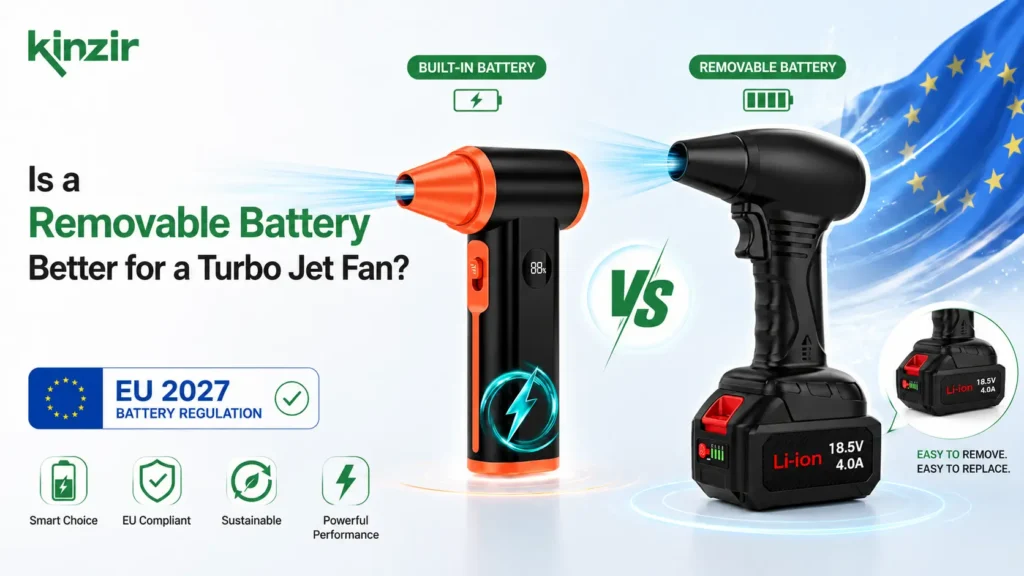
Is a Removable Battery Better for a Turbo Jet Fan? For runtime, maintenance, battery replacement and product service life, the answer is often yes. For European buyers, the choice is moving beyond product preference. A Removable Battery Turbo Jet Fan is becoming the practical design route for EU sales since Article 11 of the EU Battery Regulation requires most portable batteries incorporated into appliances to be readily removable and replaceable by end users from 18 February 2027. Limited exemptions exist, but a normal cordless turbo jet fan is unlikely to fall within the main exempt product groups. (EUR-Lex)
This means European distributors, Amazon sellers, retail brands and OEM buyers need to review their turbo jet fan battery structure before placing 2027 orders. Motor speed, airflow and battery capacity still matter, but battery access, spare-pack supply, labelling, QR codes, safety instructions and technical documentation now need equal attention.
Quick Answer: Is a Removable Battery Better?
A removable battery is usually better for a turbo jet fan used for:
- European Union sales from February 2027
- Car detailing and repeated cleaning
- Long outdoor jobs
- Commercial workshops
- Spare-battery retail programs
- Easier product repair
- Lower long-term replacement cost
- Longer usable product life
A built-in battery can still offer a smaller body, lower weight and lower initial production cost. Its main weakness is serviceability. Once battery capacity falls, the owner may need to replace the complete fan or send it to a repair centre.
For products sold in the EU, a sealed built-in pack that cannot be removed by the end user may fail to meet Article 11 after the requirement takes effect, unless the product qualifies for a stated exemption. (EUR-Lex)
A Removable Battery Is More Than a Product Feature in Europe
The EU Battery Regulation, formally Regulation (EU) 2023/1542, applies to batteries sold separately and batteries incorporated into products. It covers battery safety, restricted substances, labelling, conformity, collection, recycling, replacement and supply-chain responsibilities. (EUR-Lex)
For turbo jet fan brands, the most direct product-design rule is Article 11.
From 18 February 2027, a company placing a product with a portable battery on the EU market must make the complete battery readily removable and replaceable by the end user throughout the product’s lifetime. The rule applies to the complete battery pack rather than the individual lithium cells inside it. (EUR-Lex)
A removable battery turbo jet fan is no longer just a higher-spec option for EU buyers. For most models within the portable-battery category, it becomes part of market-access planning.
What Does “Readily Removable and Replaceable” Mean?
The law sets a practical standard. It is not enough to place a battery behind a glued housing and call it replaceable.
A portable battery is considered readily removable when an adult end user can take it out:
- With no tool
- With tools commonly available to consumers
- With a special tool supplied free with the product
The removal process should not require proprietary tools, heat, solvents or destructive disassembly. The user must be able to install another compatible battery without harming the fan, the battery, its operation, performance or safety. (EUR-Lex)
For a turbo jet fan, a suitable structure may use:
- A slide-out battery base
- A release latch
- A screw-secured battery compartment opened with a common screwdriver
- A detachable external battery pack
- A compatible tool-battery interface
The product must come with clear battery removal, replacement and safety instructions. Those instructions must remain permanently available on a public website in language that end users can follow. (EUR-Lex)
Spare Batteries Must Remain Available
Product design is only one part of Article 11. The manufacturer, importer or responsible economic operator must keep compatible batteries available as spare parts for at least five years after the last unit of that product model is placed on the market.
The replacement battery must be offered to end users and independent repair professionals at a reasonable, non-discriminatory price. Software cannot be used to prevent a compatible replacement battery from working. (EUR-Lex)
This creates several practical responsibilities for turbo jet fan brands:
- Assign a stable battery model number.
- Keep the battery connector and housing format consistent.
- Maintain spare-pack inventory.
- Publish replacement instructions.
- Plan battery warranty and traceability.
- Avoid software locks that reject compatible packs.
- Keep battery safety documents available.
Changing the battery connector every season may create compliance and after-sales problems. A longer platform cycle can make spare-parts management easier.
Does Every Turbo Jet Fan Need an End-User-Removable Battery?
Article 11 contains limited exemptions. Certain products used mainly around regular water splashing, water streams or immersion may have a battery replaceable by an independent professional when end-user removal would create a safety risk. Certain medical products receive similar treatment. Products that need a permanent battery connection for safety or data integrity can fall under another exemption. (EUR-Lex)
A standard handheld turbo jet fan used for car drying, keyboard cleaning, leaf clearing or household dust removal does not appear to match the main exemption categories. This is a practical reading of the regulation rather than a formal product ruling. Each importer should confirm product classification, intended use and technical construction with its EU compliance adviser.
Water resistance alone does not automatically create an exemption. The product needs to meet the conditions described in Article 11, and the exception must be needed for user and appliance safety. (EUR-Lex)
Removable Battery vs Built-In Battery Turbo Jet Fan
| Comparison Point | Removable Battery | Built-In Battery |
|---|---|---|
| EU 2027 preparation | Direct route for Article 11 design | May need housing and battery redesign |
| Runtime | Empty pack can be exchanged | Fan must stop for charging |
| Product service life | Worn pack can be replaced | Battery failure may end product use |
| After-sales service | Replace the battery separately | May require full-unit repair |
| Spare-part sales | Creates repeat battery orders | Limited spare-part opportunity |
| Initial production cost | Higher battery housing and connector cost | Often lower |
| Product weight | Battery base may add weight | Can be lighter and slimmer |
| Water and dust sealing | Requires careful connector design | Easier to seal inside housing |
| User convenience | Fast exchange during long jobs | Simple daily charging |
| Recycling | Battery can be separated from the fan | Product disassembly may be needed |
The Main Benefits of a Removable Battery Turbo Jet Fan
Longer Total Working Time
A removable battery does not always increase the runtime of one pack. It increases total working time by letting the user exchange an empty battery for a charged one.
This is useful for:
- Drying several vehicles
- Cleaning garages and workshops
- Removing leaves or light snow
- Cleaning computer equipment in batches
- Mobile car-detailing services
- Camping and outdoor work
A fan may run for 10 to 30 minutes per battery at a high setting, yet two or three charged packs can keep the job moving without a long charging break.
Lower Long-Term Replacement Cost
Lithium-ion batteries lose capacity with age and charge cycles. The motor and housing may still work correctly when the battery runtime becomes too short.
With a detachable pack, the owner replaces the battery rather than the whole fan. This reduces product waste and gives buyers a clearer reason to keep the device longer.
The European Commission identifies longer product life, reuse and reduced post-consumer waste as key reasons for the replaceability rule. (Environment)
Easier Warranty Service
Battery complaints are common in cordless products. A removable pack lets the seller test or replace the battery without collecting the complete turbo jet fan.
For international distributors, shipping a replacement battery still requires lithium-battery transport procedures, but the seller may avoid returning the entire device.
Spare-Battery Revenue
Retailers can sell the main fan with one pack, then offer:
- Replacement batteries
- High-capacity battery options
- Battery and charger bundles
- Two-pack professional kits
- Regional charger options
This gives brands a stronger accessory program and extends the customer relationship beyond the first fan purchase.
Better Product Repairability
Article 11 supports a wider shift toward products that can stay in service after battery wear. A replaceable battery can reduce electronic waste and make repairs more practical for consumers and independent service companies.
Are There Disadvantages?
A removable battery design needs more engineering work than a sealed internal pack.
Higher Component Cost
A detachable system may need:
- Battery housing
- Release latch
- Contact terminals
- Protective connector design
- Separate charging circuit or charger
- Battery management system
- Extra drop and vibration testing
These parts raise tooling and assembly cost.
Added Size and Weight
A battery base can make a small turbo jet fan less compact. Brands need to balance operating time, cell quantity, voltage, handling and retail positioning.
Connector Wear
Battery terminals and latches need repeated insertion testing. Loose contacts can cause unstable operation, heat or shutdown.
Kinzir uses insertion and extraction testing, key-life testing, vibration testing and production-line quality checks across its cordless product manufacturing program.
Water and Dust Protection
A removable pack creates a joint between the fan and battery. The connector, latch and battery casing need suitable sealing for the stated use environment.
A car-drying fan should not be marketed as waterproof without test data supporting that claim.
EU Battery Regulation Requirements Beyond Removability
Removability receives much attention, but it is one part of the EU framework.
Restricted Substances
The regulation restricts mercury, cadmium and lead in batteries:
- Mercury: no more than 0.0005% by weight
- Cadmium in portable batteries: no more than 0.002% by weight
- Lead in portable batteries: no more than 0.01% by weight from 18 August 2024, apart from the stated zinc-air button-cell transition
(EUR-Lex)
Battery suppliers need material declarations, test data and traceable cell sources to support these limits.
CE Marking and EU Declaration of Conformity
The battery itself falls under the regulation’s conformity system. The CE marking must be visible, legible and permanent on the battery. When battery size or construction makes this impractical, the marking can be placed on packaging and accompanying documents.
The manufacturer must complete the applicable conformity assessment and issue an EU Declaration of Conformity before placing the battery on the market. (EUR-Lex)
Separate Collection Symbol
From 18 August 2025, batteries must carry the separate-collection symbol. Batteries exceeding stated cadmium or lead levels need the related Cd or Pb chemical symbol. (EUR-Lex)
General Battery Labels
Rechargeable portable batteries will need capacity information, plus general battery information under Article 13. The starting date is 18 August 2026 or 18 months after the related implementing act enters into force, whichever is later. (EUR-Lex)
The general information includes items such as:
- Manufacturer identification
- Battery category
- Manufacturing location
- Manufacturing date
- Weight
- Capacity
- Chemistry
- Certain hazardous substances
- Suitable extinguishing agent
- Critical raw materials above the stated concentration
(EUR-Lex)
QR Code From February 2027
From 18 February 2027, all batteries must carry a QR code. For ordinary portable batteries, the QR code gives access to applicable label details, the EU Declaration of Conformity, waste-management information and other required records. (EUR-Lex)
Does a Turbo Jet Fan Battery Need a Battery Passport?
Many summaries state that all batteries need a battery passport in 2027. That is not accurate.
Under Article 77, the battery passport applies from 18 February 2027 to:
- Light means of transport batteries
- Electric vehicle batteries
- Industrial batteries above 2 kWh
A typical mini turbo jet fan uses a portable battery far below 2 kWh. It will normally need a QR code, but not the full Article 77 battery passport. (EUR-Lex)
This distinction matters for importers. A QR code is mandatory across battery categories, but the data depth behind that QR code differs by battery category.
What About Battery Supply-Chain Due Diligence?
The regulation creates due-diligence duties covering the sourcing, processing and trading of cobalt, natural graphite, lithium and nickel.
Regulation (EU) 2025/1561 moved the application date from 18 August 2025 to 18 August 2027. The duties include risk-management policies, third-party verification and records for operators within scope. (EUR-Lex)
This chapter does not apply to an economic operator with net turnover below €40 million in the stated financial period when its consolidated group does not exceed that threshold. Smaller importers may still need supplier data to support product conformity, retailer requests and customer audits, even when the formal due-diligence chapter does not apply directly to them. (EUR-Lex)
EU Battery Regulation Timeline for Turbo Jet Fan Buyers
| Date | Main Requirement Relevant to Turbo Jet Fans |
|---|---|
| 18 August 2024 | Portable battery lead restriction applies |
| 18 August 2025 | Separate-collection symbol required |
| 18 August 2026 or later conditional date | General battery and capacity labelling |
| 18 February 2027 | End-user removability and replaceability rules apply |
| 18 February 2027 | QR code required on all batteries |
| 18 February 2027 | Battery passport starts for LMT, EV and industrial batteries above 2 kWh |
| 18 August 2027 | Battery due-diligence duties begin for economic operators within scope |
The dates and product scope should be checked during each project, since implementing acts, guidance and product-specific interpretations can affect the final compliance plan. (EUR-Lex)
Kinzir Upgrade Solutions for Turbo Jet Fans and Car Vacuums
Kinzir and Mfine Technology have prepared removable-battery upgrade programs for cordless car vacuums, air dusters and turbo jet fans intended for the European market.
The June 2026 upgrade plan covers:
- User-removable battery structures
- CE marking on battery packs
- Batch identification
- QR-code preparation
- Low-mercury and cadmium-free material selection
- Overcharge protection
- Short-circuit protection
- Temperature protection
- In-house battery-pack assembly
- UN38.3 and MSDS support for battery transport
The proposed product paths include upgraded car vacuum platforms and turbo jet fan models such as AD80, AD59 and AD18, with removable battery structures planned around existing cordless product families.
European buyers can read the detailed Kinzir guide to removable-battery air dusters and turbo jet fans for EU 2027. (Kinzir Air Duster)
Kinzir has a separate overview of the EU Battery Regulation for cordless car vacuum cleaners, covering battery access and labelling preparation for vacuum projects. (Kinzir Air Duster)
Kinzir Removable Battery Turbo Jet Fan Options
Kinzir AD46
The Kinzir AD46 turbo jet fan uses a detachable battery-base structure. Its compact high-speed format is suited to car drying, dust removal, leaves and light snow.
Kinzir AD47
The Kinzir AD47 mini turbo jet fan is an upgraded large-battery model with a removable base and a 150,000 RPM BLDC motor. Kinzir lists a 10,000mAh battery configuration for this model. (Kinzir Air Duster)
Kinzir AD61
The Kinzir AD61 removable-battery leaf blower uses an 18.5V detachable battery platform. Its wider blower structure suits garages, vehicles, leaves, snow and light outdoor cleaning. (Kinzir Air Duster)
Buyers can compare more options in Kinzir’s wholesale mini turbo jet fan range. (Kinzir Air Duster)
For motor speed, airflow, pressure and battery-interface differences, see Turbo Jet Fan Specifications Explained. (Kinzir Air Duster)
What Should European Buyers Ask Their Supplier?
Before approving a 2027 turbo jet fan project, request the following:
- Is the complete battery removable by an adult end user?
- Which tools are needed?
- Can the battery be replaced without damaging the fan?
- Will spare packs remain available for at least five years?
- Is the battery model number printed clearly?
- Is a replacement guide available online?
- Does the battery carry the required CE marking?
- Is the EU Declaration of Conformity ready?
- Does the pack meet mercury, cadmium and lead limits?
- Is the separate-collection symbol present?
- Is the QR-code information system ready for February 2027?
- Are UN38.3, MSDS and cell specifications available?
- Has the latch passed repeated insertion testing?
- Has the pack passed drop, vibration, short-circuit and temperature testing?
- Who is responsible for EU producer registration and waste-battery obligations?
A removable battery housing alone does not prove full EU compliance. The battery, fan, documentation, labels, spare-parts plan and responsible economic-operator arrangements must work together.
FAQs
Is a removable battery required for turbo jet fans in the EU?
For most turbo jet fans containing portable batteries, the battery must be readily removable and replaceable by the end user from 18 February 2027. Limited exemptions apply to certain wet appliances, medical products and products requiring permanent connections for safety or data integrity. (EUR-Lex)
Can a screwdriver be required?
Yes. A commercially available screwdriver can be acceptable. A proprietary tool should not be required unless it is supplied free with the product. Heat and solvents should not be needed for battery removal. (EUR-Lex)
Can the battery be located inside a screwed compartment?
Yes, provided the user can open the compartment with commonly available tools and replace the complete battery safely without damaging the fan.
Does the battery need to slide off without tools?
No. Tool-free removal is convenient, but Article 11 permits commonly available tools.
Must a replacement battery have the same capacity?
The replacement needs to be compatible and must not affect operation, performance or safety. Brands should define approved voltage, connector, discharge rate, cell type and protection requirements.
How long must spare batteries be sold?
At least five years after the last unit of the equipment model is placed on the market. (EUR-Lex)
Does every turbo jet fan need a battery passport?
No. A typical portable turbo jet fan battery normally needs the 2027 QR code, but the full battery passport is intended for LMT batteries, electric vehicle batteries and industrial batteries above 2 kWh. (EUR-Lex)
Is a removable battery always better outside Europe?
It is better for long jobs, repairability, spare-pack sales and product service life. A built-in battery may remain suitable for very small, lightweight products sold in markets without end-user replacement rules.
Can a removable battery increase safety risks?
Poorly designed contacts, latches or battery-management circuits can create risks. A qualified system needs polarity protection, short-circuit protection, overcharge protection, temperature control and mechanical testing.
Can existing built-in-battery models be upgraded?
Many models can be redesigned with a removable battery compartment or detachable base. The process may require new tooling, contact terminals, PCB changes, safety testing, instructions, labels and packaging updates.
Final Verdict
A removable battery is better for many turbo jet fan users since it reduces charging downtime, extends product life and makes battery replacement easier.
For the European market, the answer is stronger. From 18 February 2027, most cordless turbo jet fans containing portable batteries will need an end-user-removable and replaceable battery design under Article 11 of Regulation (EU) 2023/1542.
Brands planning EU sales should move before the deadline. Product redesign, tooling, battery testing, spare-pack inventory, online instructions, labels and QR-code systems take time to complete.
EU Authority References
- Regulation (EU) 2023/1542 concerning batteries and waste batteries (EUR-Lex)
- European Commission Guidelines on Battery Removability and Replaceability (EUR-Lex)
- European Commission Batteries and Waste Batteries Overview (Environment)
- Regulation (EU) 2025/1561 on Battery Due Diligence Dates (EUR-Lex)
- European Commission Announcement on Sustainable and Circular Batteries (Environment)


