
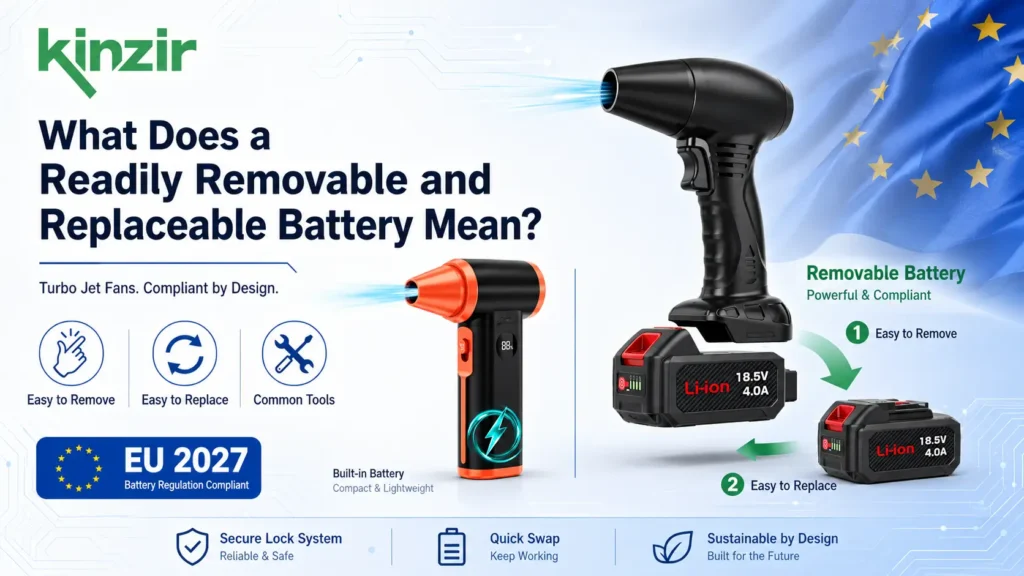
What does a readily removable and replaceable battery mean under EU Battery Law for turbo jet fans? It means the complete battery pack inside a cordless turbo jet fan should be removable and replaceable by the end user without damaging the fan, destroying the battery, or creating a safety risk. From 18 February 2027, this point becomes a direct product-design issue for many cordless appliances sold in Europe, including turbo jet fans, electric air dusters, and cordless car vacuums.
For buyers who need the wider background, Kinzir has covered the full topic in the guide to EU Battery Regulation 2027 for cordless car vacuums, air dusters and turbo jet fans. This article focuses on one practical question: what “readily removable and replaceable” means for a handheld turbo jet fan.
Quick Answer: Readily Removable and Replaceable Battery
A readily removable and replaceable battery should meet four basic conditions:
- The end user can safely remove the entire battery pack.
- The process does not break the product housing.
- The user can install a compatible replacement battery.
- The fan can still work safely after replacement.
The battery does not always need to pop out with one click. EU guidance allows removal with no tool, common tools, or a special tool supplied free with the product. The key point is safe user access.
Why This Matters for Turbo Jet Fans After 2027
Most mini turbo jet fans use rechargeable lithium battery packs. Some models use a built-in battery hidden inside the handle or main body. Some models use a removable battery base, like a cordless tool.
Before 2027, many buyers mainly compare RPM, wind speed, battery capacity, runtime, and charging time. After the EU rule applies, battery access becomes just as relevant.
A sealed battery design may create risk for:
- EU importers
- Amazon sellers
- Retail chains
- Private-label brands
- OEM buyers
- After-sales teams
- Product compliance managers
A turbo-jet fan can deliver strong airflow and good runtime, but if the battery cannot be safely replaced, it may not align with the EU 2027 design direction.
Built-In Battery vs Readily Removable Battery
A built-in battery is not always a problem. A non-replaceable battery is the problem.
A built-in battery turbo jet fan may still work for Europe if the battery pack can be accessed and replaced safely. For example, the product may use a screw-access battery cover, a connector-based battery pack, and clear instructions.
A risky design may include:
- Glued battery chamber
- Ultrasonic-welded battery housing
- Battery pack fixed with permanent adhesive
- Loose cells soldered in a way users cannot replace safely
- Battery access that breaks the shell
- No replacement battery model
- No battery removal instructions
For a deeper comparison, read Kinzir’s article on whether a built-in battery turbo jet fan can still be sold in Europe after 2027.
What Tools Can Be Used for Battery Removal?
A readily removable battery does not always mean tool-free removal.
For turbo jet fans, battery access may be acceptable when the user can remove the battery with:
- No tool
- A normal screwdriver
- Common pliers or similar consumer tools
- A special tool supplied free with the product
The design should not require heat, solvent, cutting, drilling, or forced opening. It should not put the user in direct contact with unsafe battery parts.
For a compact fan, a screw-access battery door may be more realistic than a slide-out battery. For a larger turbo jet fan, a removable battery base is often easier for users.
What Does Replaceable Mean?
“Replaceable” means more than taking the old battery out.
A replacement battery should be available, compatible, and safe to install. After replacement, the turbo jet fan should still work as intended.
For a turbo jet fan battery pack, buyers should check:
- Same rated voltage
- Correct battery connector
- Correct discharge capability
- Matching battery shape and lock structure
- Proper protection board
- Clear battery model number
- Spare battery supply plan
- Safe charging compatibility
If users can remove the battery but cannot buy a matching pack, the product is weak from a compliance and after-sales viewpoint.
Complete Battery Pack, Not Loose Cells
For turbo jet fans, the replaceable part should normally be the complete battery pack, not individual bare lithium cells.
A good battery pack should include:
- Lithium cells
- Battery management or protection board
- Insulated housing
- Connector or terminals
- Battery label
- Safety markings
- Batch code
- Capacity information
This approach is safer for end users and easier for brands to manage across EU sales, warranty service, and spare battery programs.
Common Turbo Jet Fan Battery Designs
1. Fully Removable Battery Base
This is the clearest structure. The user presses a latch and removes the battery pack from the base of the fan.
This format is practical for:
- Car drying
- Outdoor cleaning
- Leaves
- Light snow
- Workshop cleaning
- Long jobs with spare packs
Kinzir offers removable-battery models such as the AD46 Turbo Jet Fan and the AD47 Mini Turbo Jet Fan. The AD61 Battery-Powered Leaf Blower uses a larger external battery for higher-demand applications.
2. Screw-Access Built-In Battery
This design retains the compact shape of a built-in battery fan while providing access via screws.
This can be useful for small air dusters and mini turbo jet fans where a slide-out battery base would make the product too bulky.
3. Service Cover With Internal Battery Pack
A removable cover can give access to a labeled battery pack inside the handle. The user removes the old pack and installs the new one through a connector.
This structure needs strong design control. The battery should not be loose after replacement, and the connector should not be easy to reverse.
4. Non-Serviceable Sealed Battery
This is the highest-risk structure for EU 2027. If the user cannot remove the complete battery pack without damaging the fan, the design may need an upgrade.
What Should the User Manual Include?
A product can have a good battery structure but still fail in practice if the instructions are poor.
For a turbo jet fan with a replaceable battery, the manual should include:
- Battery removal steps
- Battery replacement steps
- Tool list
- Safety warnings
- Compatible battery model
- Charging instructions
- Disposal guidance
- QR code or web link for updated instructions
- Contact details for replacement battery purchase
The instructions should be clear enough for a normal adult user. Short diagrams help more than long text.
Readily Removable Battery and EU Battery Labeling
Battery access and battery labeling should be planned together.
A removable or replaceable battery pack should carry clear label information, such as:
- CE mark
- Battery model
- Batch code
- Capacity label
- Rated voltage
- QR code from 2027
- Recycling symbol
- Manufacturer or responsible operator information
Kinzir has covered this topic in the article on EU Battery Labeling Requirements for Cordless Turbo Jet Fans. The label helps buyers, repair teams, and end users identify the correct replacement pack.
Removable Battery Turbo Jet Fan: Buyer Benefits
A removable battery is more than a legal response. It can improve the user experience and after-sales value.
Main benefits include:
- Faster battery swap
- Longer working time with spare packs
- Easier warranty service
- Lower product waste
- Better spare-part sales
- Clear battery traceability
- Better repairability
- Stronger fit for EU 2027 planning
Kinzir’s guide on removable battery turbo jet fans explains the product and market value in more detail.
Can a Built-In Battery Turbo Jet Fan Still Be Compliant?
Yes, if the built-in pack is still accessible and replaceable by the end user.
A built-in battery design can be improved through:
- Common screw access
- Battery pack connector
- Labeled replacement pack
- Non-destructive opening process
- Clear replacement guide
- Safe battery insulation
- Spare battery availability
- QR-linked battery documents
This lets a brand keep a compact fan shape and still prepare for EU battery rules.
What Should EU Buyers Ask a Turbo Jet Fan Supplier?
Before approving a 2027 EU project, ask these questions:
- Can the end user remove the complete battery pack?
- What tool is needed?
- Is the tool common, or is it supplied free?
- Does removal damage the fan body?
- Is the battery fixed with screws, a latch, or adhesive?
- Is the pack connected through a safe connector?
- Is the replacement battery model clearly printed?
- Can spare batteries be supplied for the product lifetime?
- Is there a battery replacement guide?
- Is the guide included in the manual and available online?
- Does the battery label include CE mark, batch code, capacity, and QR code planning?
- Are UN38.3 and MSDS documents available for lithium battery shipping?
- Has the latch or connector passed insertion and extraction testing?
- Has the battery structure passed vibration and drop testing?
- Does the product remain safe after battery replacement?
This checklist should be reviewed during sample approval, not after mass production.
Kinzir EU 2027 Upgrade Solutions for Turbo Jet Fans
Kinzir and Mfine have prepared EU Battery Regulation upgrade solutions for car vacuums, air dusters, and turbo jet fans. The upgrade plan includes a CE label, batch code, QR code on the battery, low-mercury and cadmium-free material planning, and user-removable battery structures for 2027. It also lists overcharge, short-circuit, and temperature protection for new samples.
Kinzir’s product development support includes in-house design, mold, assembly, and battery pack capability, with ISO9001, BSCI, CE, RoHS, REACH, FCC, PSE, UKCA, UN38.3, and MSDS support listed in the factory profile.
For model selection, buyers can start from:
- Wholesale Mini Turbo Jet Fans
- Kinzir Removable Battery Air Dusters and Turbo Jet Fans for EU 2027
- Kinzir AD46 Turbo Jet Fan
- Kinzir AD47 Mini Turbo Jet Fan
- Kinzir AD61 Battery Powered Leaf Blower
Readily Removable and Replaceable Battery Checklist
| Check Item | What It Means for Turbo Jet Fans |
|---|---|
| User access | The end user can open the battery area safely |
| Tool method | No tool, common tool, or free supplied special tool |
| No damage | The fan and battery are not destroyed during removal |
| Complete pack | The replaceable part is the full battery pack |
| Safe connector | The pack can be disconnected without unsafe cell handling |
| Spare battery | A compatible pack can be supplied |
| Clear marking | Battery model, voltage, capacity, and batch code are visible |
| Label planning | CE mark, recycling symbol, and QR code planning are included |
| Manual | Replacement steps are clear and available |
| Safety | The fan works safely after battery replacement |
Common Mistakes to Avoid
Mistake 1: Calling a Battery “Replaceable” Without a Spare Pack
If the buyer cannot purchase a compatible replacement battery, the design is incomplete.
Mistake 2: Using Adhesive as the Main Battery Fixing Method
Adhesive can make battery access harder and increase safety risk during removal.
Mistake 3: Making the User Handle Loose Cells
For turbo jet fans, replacing a protected battery pack is safer than asking users to handle bare cells.
Mistake 4: No Online Replacement Instructions
A printed manual can be lost. A QR-linked online guide helps users and service teams.
Mistake 5: Treating Battery Access as a Late-Stage Change
Battery structure affects tooling, housing, PCB layout, terminals, labels, packaging, safety testing, and spare-part planning.
Final Answer
A readily removable and replaceable battery under EU Battery Law means the end user can remove the complete battery pack from a turbo jet fan and install a compatible replacement without damaging the product or creating a safety risk.
For turbo jet fans, this usually means one of three design paths:
- A removable battery base
- A screw-access battery compartment
- A replaceable internal battery pack with safe connector and instructions
A sealed, glued, non-serviceable battery structure poses a risk for EU sales after 18 February 2027. Buyers planning Europe-bound turbo jet fan projects should confirm battery access, spare battery supply, safety testing, labels, QR code planning, and replacement instructions before tooling and mass production.
References
- Regulation (EU) 2023/1542 on batteries and waste batteries
Official EU regulation covering the battery lifecycle, including replaceability, labeling, QR code, collection, recycling, and product obligations. (EUR-Lex) - European Commission Batteries and Waste Batteries Page
EU policy page explaining the new Batteries Regulation, its objectives, derogations, and implementation. (Environment) - Commission Notice C/2025/214 on Removability and Replaceability
Official Commission guidance for the harmonized application of rules on removable and replaceable portable batteries and LMT batteries. (EUR-Lex)


