
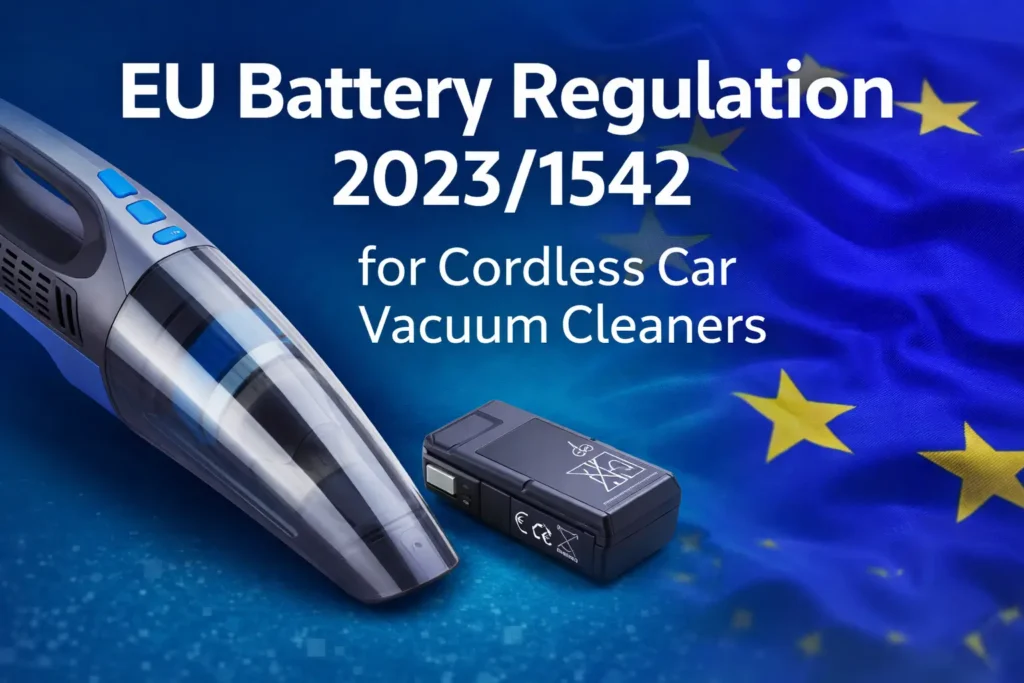
The European Union has implemented new battery regulations that significantly impact the design, labeling, and documentation of battery-powered products. Under EU Battery Regulation 2023/1542, manufacturers of cordless devices, such as car vacuum cleaners, must ensure batteries are removable and replaceable by end users. The regulation also sets strict requirements for labeling, documentation, and digital product passports. These changes will affect your product development timelines, design specifications, and market access throughout the EU.

If you manufacture or import cordless car vacuum cleaners into the EU, compliance with these requirements is mandatory. The regulation sets specific deadlines for each obligation, with some already in effect and others taking effect through 2027. Failure to meet these deadlines will prevent your products from entering the EU market.
Your design team must adapt product architecture for removable batteries while maintaining performance and durability. You will also need systems for battery labeling, technical documentation, and digital product passports. This article outlines each requirement, details the compliance timeline, and offers a practical checklist to support your compliance efforts.
Overview Of EU Battery Regulation 2023 1542
Regulation (EU) 2023/1542 establishes comprehensive requirements for batteries throughout their lifecycle. The eu batteries regulation introduces strict sustainability, battery labelling, and battery due diligence obligations. These rules affect manufacturers, importers, and distributors across all battery categories.
Background And Replacement Of Directive 2006/66/EC
Regulation (EU) 2023/1542 entered into force on August 17, 2023, replacing Directive 2006/66/EC. This shift supports the European Green Deal and the transition toward climate neutrality. The previous directive failed to address modern battery technologies and growing environmental concerns.
The new regulation reflects the EU’s circular economy ambitions and responds to the rapid expansion of electric vehicles and battery energy storage systems. As global battery demand continues to rise, this framework ensures that the battery supply chain remains sustainable and secure. Performing thorough battery due diligence helps identify risks related to raw material extraction. It also introduces mandatory due diligence requirements for economic operators. Unlike the directive it replaces, this regulation applies directly across all member states without requiring national transposition. This creates uniform standards and eliminates discrepancies between countries.
Scope Of The Regulation And Battery Categories
The regulation applies to all batteries placed on the EU market, regardless of their origin or manufacturing location. You must comply if you manufacture, import, distribute, or place batteries within the European Economic Area.
The regulation defines five primary battery categories:
- Portable batteries: Sealed batteries under 5 kg not designed for industrial use
- Starting, lighting, and ignition (SLI) batteries: Commonly known as automotive batteries used in internal combustion engine vehicles
- Light means of transport (LMT) batteries: For e-bikes, e-scooters, and similar vehicles
- Electric vehicle (EV) batteries: Traction batteries for road vehicles
- Industrial batteries: All batteries not covered by other categories, including stationary battery energy storage systems, often referred to as bess units
Each category has specific requirements regarding battery labelling, performance, and recycled content targets. These measures aim to improve recycling efficiency across the continent while supporting climate neutrality. Manufacturers must also provide declarations on the batteries’ carbon footprint.
Definition Of Portable Batteries And Relevance To Cordless Car Vacuum Cleaners
Portable batteries are defined as any sealed battery weighing 5 kg or less. This definition impacts the management of batteries and waste batteries in consumer products. It directly influences the rules for portable electronic device batteries for EU compliance.
Cordless car vacuum cleaners typically contain portable batteries under this definition. If your vacuum’s battery weighs less than 5 kg and remains sealed, you must meet all requirements for portable batteries. These include removability and replaceability standards, labeling obligations, and collection targets.
The regulation requires that portable batteries in appliances be removable and replaceable by the end-user with commercially available tools by 2027. This means your cordless vacuum design must allow consumers to replace batteries without specialized equipment or manufacturer intervention.
Key Compliance Timeline Milestones (2025, 2026, 2027)
Your compliance obligations phase in gradually through multiple deadlines:
| Date | Requirement |
|---|---|
| August 18, 2025 | Extended producer responsibility schemes operational; due diligence policies required for high-risk batteries |
| February 18, 2026 | Carbon footprint declarations mandatory for EV, LMT, and rechargeable industrial batteries above 2 kWh |
| August 18, 2026 | Labeling requirements for capacity, performance, and durability take effect |
| February 18, 2027 | Minimum recycled content requirements begin for cobalt, lead, lithium, and nickel |
| August 18, 2027 | Portable batteries must be removable and replaceable by end-users |
You should now assess your current products against these deadlines. The 2027 removability requirement particularly affects product design cycles, requiring significant lead time for engineering changes and testing.
Who Must Comply With The Regulation

The EU Battery Regulation establishes clear compliance obligations across the entire supply chain. These rules support the EU goal of zero pollution from production to disposal. Your responsibilities depend on your role in bringing batteries to the EU market.
Manufacturers Placing Products On The EU Market
You are considered a manufacturer under the regulation if you produce batteries or have batteries designed, manufactured, and marketed under your name or trademark. This applies whether you operate within the EU or outside its borders. Every waste management operator handling these products must also adhere to specific treatment and reporting standards.
Article 38 manufacturer obligations EU battery rules require you to ensure products meet all essential requirements before market placement. You must establish technical documentation, implement conformity assessment procedures, and maintain records for ten years after the battery is placed on the market.
Your compliance responsibilities include affixing the CE marking, preparing the EU declaration of conformity, and ensuring batteries carry required labels and information. If you manufacture batteries outside the EU and sell them directly to EU customers, you assume full manufacturer responsibilities under the regulation.
Importers And Distributors
As an importer, you bring batteries from non-EU countries into the European market. You must verify that manufacturers have completed the required conformity assessments and that products are properly documented, carry CE marking, and are labeled.
You are responsible for ensuring the manufacturer’s name and contact details appear on the battery or packaging. If you cannot verify compliance, you cannot place the product on the EU market.
Distributors make batteries available on the market after importers or manufacturers have introduced them. Your obligations include verifying the presence of CE marking, ensuring that required documentation accompanies products, and ensuring that storage and transport conditions don’t compromise compliance. You must act when you become aware of non-compliant products.
Private Label Brands And Amazon Sellers
If you sell batteries under your own brand name through Amazon or other platforms, you assume manufacturer responsibilities regardless of who physically produced the items. Private-label battery compliance with EU requirements applies fully to your operations.
Amazon EU battery requirements affect sellers using Fulfillment by Amazon (FBA) or selling directly to EU customers. You must provide compliance documentation, declarations of conformity, and technical files upon request.
Online marketplace sellers cannot avoid compliance by claiming they are merely resellers. If you control the product specification or branding, you are the manufacturer under the regulation.
Responsibilities For Product Conformity, Documentation, And Labeling
Your conformity obligations require maintaining comprehensive technical documentation covering battery design, manufacturing processes, and compliance testing results. This documentation must remain accessible for ten years.
You must prepare an EU declaration of conformity stating which regulatory requirements the battery meets. This declaration identifies you as the responsible economic operator and specifies the battery model.
Required labeling elements include:
- CE marking with an appropriate size and visibility
- Capacity information in ampere-hours or watt-hours
- Separate collection symbol (crossed-out wheeled bin)
- Carbon footprint declaration for relevant battery categories
- QR code linking to digital product passport information
You must ensure all markings are visible, legible, and indelible throughout the battery’s expected lifetime. Labels must appear on both the battery itself and its packaging, where technically feasible.
Why Cordless Car Vacuum Cleaners Are Directly Affected

Cordless car vacuum cleaners fall squarely within the scope of the EU Battery Regulation due to their reliance on rechargeable lithium-ion batteries and their classification as portable appliances. These handheld devices must now meet stringent requirements for battery removability, labeling, and performance documentation.
Use Of Rechargeable Portable Lithium Batteries
Your cordless car vacuum cleaner uses rechargeable lithium-ion batteries, which are regulated under the EU Battery Regulation. These power sources classify the device as a battery-containing appliance subject to compliance requirements.
The regulation mandates that any appliance using portable batteries must meet performance and safety standards. You’ll find that lithium-ion battery EU compliance extends to capacity declarations, carbon footprint documentation, and responsible sourcing requirements. Manufacturers must provide detailed information about the battery’s composition, capacity rating, and expected lifespan.
Battery performance data must be accessible through digital product passports. Your device’s documentation should include charging cycles, energy efficiency metrics, and recycling instructions.
Classification As Appliances Incorporating Portable Batteries
The EU defines your handheld vacuum cleaner as an appliance incorporating a portable battery if the battery weighs less than 5kg and isn’t designed for industrial use. This classification directly determines your device’s compliance obligations.
As of 2027, the EU requirements for removable battery vacuum cleaners mandate that consumers can remove and replace batteries using commonly available tools. This marks a significant shift from devices with permanently sealed battery compartments. Your handheld vacuum cleaner’s compliance with EU standards depends on meeting these removability standards.
The regulation distinguishes between portable and industrial batteries based on weight and application. Since car vacuum cleaners are consumer products with batteries typically under 1kg, they’re firmly categorized as portable battery appliances.
Design Impact For Handheld Cleaning Devices
Electric cleaning devices battery regulation forces manufacturers to redesign vacuum housings for user-accessible battery compartments. You’ll notice updated models feature tool-assisted battery removal rather than sealed units.
Design changes include standardized labeling of the battery compartment, QR codes linking to dismantling instructions, and physical access panels. Your device must include clear symbols indicating battery type, capacity, and proper disposal methods.
Manufacturers now prioritize modular construction where battery packs detach without damaging the housing. This affects product durability, weight distribution, and waterproofing capabilities in handheld cleaning devices.
Removable And Replaceable Battery Requirements (Article 11)
Article 11 establishes mandatory requirements for design for removability. It requires portable batteries to be removable and replaceable by end-users, fundamentally changing how manufacturers design consumer electronics. The regulation sets clear definitions and timelines while providing specific exceptions for certain product categories.
Core Requirement
Under Article 11 of the EU battery removability rules, you must ensure that the portable batteries in your appliances are removable and replaceable by the end-user at any time during the product’s lifespan. This requirement applies from August 18, 2027.
The regulation specifies that you cannot use permanent welding, adhesive, or other techniques that prevent battery removal without specialized tools. Your products must allow consumers to remove the battery using commercially available tools without requiring proprietary equipment.
If you manufacture smartphones, tablets, or similar devices, you need to redesign products currently using glued or welded batteries. The replaceable battery EU law requires that replacement batteries remain available for at least 5 years after the last unit of your product model is placed on the market.
Definition Of “Readily Removable”
The regulation defines “readily removable” with specific technical criteria. You can remove a battery without damaging the appliance or battery when:
- You can access the battery with commercially available tools
- You don’t need specialized tools that only the manufacturer provides
- You don’t need proprietary tools, thermal energy, or solvents
- The operation doesn’t require specialized technical skills
Your product design must allow battery removal using basic tools like screwdrivers, pliers, or tweezers that consumers can purchase in regular shops. You cannot implement designs requiring heat guns, specialized prying tools, or techniques that risk damaging the device casing.
Instructions And Information Requirements
You must provide clear instructions for battery removal and replacement with every product. These instructions need to be available in printed form inside the packaging and digitally through a publicly accessible website.
Your documentation must include:
- Step-by-step removal procedures with illustrations or diagrams
- Type and number of tools required for the operation
- Safety warnings about electrical risks or proper handling
- Information on obtaining replacement batteries from you or authorized dealers
You need to design your instruction materials for average consumers without technical training. The EU requirements for portable battery removability emphasize accessibility for all users, not just technically skilled individuals.
Exceptions And Limitations
The regulation provides specific exemptions from the Article 11 battery removability requirements. You can use non-removable batteries in products designed for use in wet conditions regularly or throughout their entire lifetime.
Products must meet an IP67 rating or higher to qualify for this exception. You need to demonstrate that wet-condition exposure is a primary use case, not occasional or accidental exposure.
Medical devices also receive partial exemptions based on safety and reliability requirements. If you manufacture such devices, you should verify whether your specific product category qualifies for exemption under the delegated acts.
Impact On Product Design
You need to rethink your product architecture to accommodate removable battery compartments. This affects device thickness, internal component layout, and sealing methods for water resistance.
Your engineering teams must develop new fastening mechanisms, battery-housing designs, and contact systems that maintain reliability across multiple battery replacement cycles. You cannot rely on adhesive bonding as a primary structural element if it prevents battery access.
If you previously achieved slim profiles by integrating the battery into the device structure, you’ll need alternative approaches. Your designs must balance the removability requirement with maintaining product durability, aesthetics, and performance standards that consumers expect.
Battery Labeling And Marking Requirements (Article 13)
The EU Battery Regulation establishes comprehensive labeling standards that manufacturers must follow to ensure consumers and waste handlers can identify battery specifications and disposal requirements. These requirements include capacity information, collection symbols, chemical warnings, and digital identifiers.
General Labeling Requirements
Article 13 mandates that all batteries placed on the EU market must display clear, legible, and indelible labels. You must ensure labels remain visible throughout the battery’s lifetime under normal conditions of use. The regulation applies to portable batteries, LMT batteries, EV batteries, and industrial batteries.
Labels must appear directly on the battery. If the battery size makes direct labeling impractical, you can place labels on the packaging instead. The minimum font size and visibility standards apply to ensure readability.
You bear responsibility for compliance whether you are the manufacturer, importer, or distributor placing batteries on the EU market.
Capacity Label
You must display the battery capacity prominently on all portable and LMT batteries. The capacity appears in watt-hours (Wh) for most battery types. For batteries that are not rechargeable or are primarily used in a non-rechargeable manner, you can display capacity in ampere-hours (Ah) instead.
The capacity label must be clearly visible and legible to end-users at the point of sale. You should express the value as a numerical figure followed by the appropriate unit symbol (Wh or Ah).
For rechargeable batteries, the stated capacity must represent the rated capacity as determined under specified test conditions. This ensures consumers can accurately compare different battery products.
Separate Collection Symbol
Your batteries must display the crossed-out wheeled bin symbol to indicate they require separate collection and cannot be disposed of as unsorted municipal waste. This battery recycling symbol appears on all battery types covered by the regulation.
The symbol must have minimum dimensions to ensure visibility. If your battery is smaller than a specified threshold, you can place the symbol on the packaging rather than on the battery itself.
The separate collection symbol alerts consumers and waste management facilities that the battery contains materials that require proper recycling processes.
Chemical Content Marking
When your batteries contain more than 0.002% cadmium (Cd) or more than 0.004% lead (Pb), you must add the relevant chemical symbol beneath the separate collection symbol. This chemical labeling requirement helps waste handlers identify batteries that require special handling procedures.
The chemical symbols Cd or Pb must appear in a font covering at least one-quarter of the area of the crossed-out wheeled bin symbol. Multiple symbols appear when batteries exceed thresholds for multiple heavy metals.
This marking ensures proper sorting and processing during recycling operations, as batteries containing these substances require specialized treatment methods.
QR Code Requirement (From 2027)
Starting in 2027, you must include a QR code on your batteries to provide access to the battery passport and additional product information. The QR code links to a digital record containing detailed data about the battery’s composition, performance, and sustainability characteristics.
You must ensure the QR code remains scannable throughout the battery’s lifetime. The code provides access to information about the battery’s manufacturing, capacity, expected lifetime, and recycling instructions.
This digital identifier enables better traceability throughout the battery lifecycle. End-users, repairers, and recyclers can scan the code to access technical documentation and sustainability information required under the regulation’s transparency provisions.
Battery Passport And Digital Information (Article 77)
Article 77 establishes a mandatory digital battery passport that provides comprehensive lifecycle information through standardized electronic records. You must ensure your batteries include accessible digital documentation that meets specific technical and informational requirements.
QR Code Links To Battery Data System
The EU mandates that you affix a QR code to each battery placed on the market. This code must remain accessible and scannable throughout the battery’s operational life. You scan the code to access the battery’s digital passport stored in a centralized data system.
The QR code serves as the primary access point for all stakeholders in the battery value chain. You must ensure the code links directly to a secure, continuously updated database containing the battery’s complete information profile. The code must be durable, legible, and positioned where it remains visible during normal use.
Your QR code implementation must follow standardized formatting protocols to ensure interoperability across different scanning devices and platforms.
Manufacturer And Model Information
You must provide detailed manufacturer identification, including company name, registration number, and contact information, within the digital passport. The EU Battery Passport Regulation requires specific product identifiers, such as the model number, batch or serial number, and manufacturing date and location.
Your documentation must include technical specifications covering battery capacity, voltage, chemistry type, and expected performance parameters. You need to clearly declare the battery category and intended application.
The manufacturer information section must remain accurate and up to date if ownership or company details change. You bear responsibility for maintaining data integrity throughout the battery’s lifecycle.
Compliance And Safety Data
You must document all compliance certifications and test results demonstrating conformity with EU safety standards. This includes proof of conformity assessments, notified body certifications, and declarations of compliance with applicable regulations.
Your safety data must specify handling instructions, hazard warnings, and emergency response procedures. You need to include information about substances of concern, their concentrations, and associated risks. The battery traceability requirements EU mandate clear documentation of any recalls, safety incidents, or modifications affecting product safety.
You must provide test reports validating performance claims and safety characteristics. This data enables market surveillance authorities to verify compliance efficiently.
Lifecycle And Recycling Information
You must disclose the battery’s carbon footprint, calculated using a standardized methodology, for each lifecycle stage. Your documentation includes information on expected lifespan, degradation rates, and conditions affecting longevity.
The passport must contain detailed end-of-life instructions specifying proper collection, dismantling, and recycling procedures. You need to identify recyclable materials, their locations within the battery, and recommended recovery processes.
You must provide information on recycled content percentages for key materials, such as cobalt, lithium, nickel, and lead. Your data should indicate the collection and recycling facilities available in relevant markets. This information helps every waste management operator process batteries correctly. It also supports preparation for repurposing and other circular economy objectives.
Supports Traceability And Transparency Across Supply Chain
The digital passport enables you to track batteries from raw material extraction through manufacturing, use, and recycling. You gain visibility into material sourcing, production locations, and custody transfers throughout the supply chain.
Your battery traceability requirements and EU compliance depend on maintaining accurate records at each stage of the supply chain. The system allows downstream users, repairers, and recyclers to access the information they need for their operations.
You can verify due diligence claims and sustainability assertions through the transparent data structure. The passport supports second-life applications by providing potential buyers with verified performance history and remaining capacity data. This traceability mechanism strengthens accountability and enables informed decision-making across all stakeholder groups.
Compliance Timeline For Manufacturers
The EU Battery Regulation establishes phased deadlines starting in 2025, with requirements becoming progressively stricter through 2027. Manufacturers must implement separate collection symbols, capacity labeling, removability standards, and digital product passports according to specific dates.
2025: Separate Collection Symbol Mandatory
As of January 1, 2025, you must display the separate collection symbol on all batteries placed on the EU market. This symbol indicates that batteries should not be disposed of as unsorted municipal waste.
The symbol must be visible, legible, and indelible. For batteries larger than 5 cm on each external side, you must ensure the symbol covers at least 3% of the battery’s largest surface area.
If your batteries are smaller than 5 cm, you can print the symbol on the packaging or documentation instead. The regulation specifies exact design requirements for the crossed-out wheeled bin symbol to ensure consistency across all battery products.
2026: Capacity And Labeling Requirements Enforced
Starting January 1, 2026, you must provide detailed labeling on your batteries. This includes the battery capacity, performance indicators, and minimum durability information.
Required label information includes:
- Rated capacity in ampere-hours (Ah) or watt-hours (Wh)
- Battery composition and chemical designation
- Manufacturing date or batch number
- Hazardous substance content warnings
You must also declare the expected battery life under specific reference conditions. For portable batteries of general use, specify the minimum number of charge-discharge cycles required before capacity falls below 80% of the rated capacity. The labels must remain legible throughout the battery’s lifetime.
2027: Removable Battery Requirement Applies
From January 1, 2027, portable batteries in appliances must be designed so they can be removed and replaced with readily available tools. Users should not require specialized equipment or proprietary tools to access batteries.
Your product design must allow end users to safely remove batteries without damaging the appliance or the batteries. This requirement specifically targets smartphones, tablets, and similar consumer electronics where batteries have traditionally been permanently integrated.
You can request exemptions only if removability compromises essential safety or performance features. Documentation proving technical necessity must accompany any exemption request to EU authorities.
2027: QR Code And Digital Data Access Required
By January 1, 2027, you must affix a QR code to each battery or its packaging that links to the battery’s digital product passport. This passport provides comprehensive information accessible to regulators, recyclers, and consumers.
The digital passport must contain:
- Manufacturing details and supply chain information
- Carbon footprint data for the battery lifecycle
- Recycled content percentages
- Dismantling and recycling instructions
- Safety handling procedures
You must host this information on a secure, publicly accessible platform that remains available throughout the battery’s life and for 15 years after. The QR code must meet ISO/IEC 18004 or equivalent standards and maintain functionality despite normal wear during product use.
Technical Documentation And Conformity Requirements
Battery manufacturers and economic operators must prepare comprehensive technical documentation and undergo conformity assessment procedures before placing batteries on the EU market. These requirements establish the foundation for CE marking and ensure batteries meet all applicable regulatory standards.
Technical Documentation And Conformity Assessment Required
You must compile detailed technical documentation that demonstrates your battery products comply with all requirements of the EU Battery Regulation. This documentation includes design specifications, manufacturing processes, risk assessments, and test reports verifying performance and safety standards.
The conformity assessment process varies based on battery type and category. You can use internal production control (Module A) for most general-purpose batteries, verifying compliance through your own technical documentation. For rechargeable industrial batteries, light-mobility transport (LMT) batteries, and electric vehicle batteries, you must follow more stringent procedures.
Your technical documentation must contain:
- Battery specifications – capacity, power, voltage, chemistry
- Bill of materials – complete component and substance listings
- Manufacturing information – production methods and quality controls
- Test results – safety, performance, and durability assessments
- Carbon footprint calculations – lifecycle greenhouse gas emissions
- Due diligence documentation – supply chain risk assessments
CE Marking And EU Declaration Of Conformity
You must affix CE marking to your battery products before placing them on the EU market. The CE marking indicates your batteries meet all applicable EU legislation requirements and have undergone the necessary conformity assessment procedures.
You need to draw up an EU Declaration of Conformity that accompanies your batteries. This declaration formally states that your products fulfill all relevant regulatory requirements under the Battery Regulation and other applicable EU directives.
The CE marking must be visible, legible, and indelible on the battery or its label. If this is not possible due to the battery’s nature, you can place the marking on the packaging and accompanying documentation instead.
Record Retention For At Least 10 Years
You must keep your technical documentation and EU Declaration of Conformity for at least 10 years after placing the battery on the market. This retention period applies to manufacturers, authorized representatives, and importers who bear responsibility for compliance verification.
Your records must remain accessible to market surveillance authorities upon request. You need to provide this documentation within a reasonable timeframe when authorities conduct inspections or investigations.
If you are an importer or distributor, you must retain copies of the Declaration of Conformity and ensure technical documentation can be made available to competent authorities.
Product Identification, Traceability, And Manufacturer Details Required
You must assign a unique identifier to each battery or batch that enables traceability throughout the supply chain. This identification system enables authorities and end users to track batteries from production through end-of-life management.
Your batteries must display the following information:
- Manufacturer name and registered trade name or trademark
- Manufacturer postal address (single contact point)
- Battery model identifier or type reference
- Manufacturing date or batch number
- Importer details (if applicable)
You need to ensure this information appears on the battery itself or its label. When physical marking is impractical, you can provide details on packaging and accompanying documentation. The information must remain legible throughout the battery’s expected lifetime.
Design Challenges For Cordless Car Vacuum Manufacturers
The EU Battery Regulation forces cordless car vacuum manufacturers to reconsider fundamental design choices, particularly around battery accessibility and product architecture. These requirements create technical and financial pressures across multiple areas of product development.
Compact Design Vs Removable Battery Structure
Your current sealed battery designs maximize space efficiency and enable sleeker product designs. The regulation requires batteries to be removable and replaceable by end users, which demands significant structural changes to your vacuum housing.
You must now incorporate battery compartments with secure latching mechanisms and proper sealing. This adds bulk to products where every millimeter counts for handheld usability. The battery compartment requires dedicated space for access panels, retention clips, and electrical contacts that sealed designs integrate directly into the chassis.
Your engineering teams face the challenge of maintaining ergonomic grip areas while accommodating battery doors. The weight distribution changes when batteries become modular units rather than cells fitted into optimized internal spaces. You need to redesign the airflow paths and motor placement to accommodate the new battery architecture.
Waterproof And Durability Constraints
Sealed battery configurations provide superior protection against moisture and debris intrusion. Your removable battery designs must maintain IP ratings while introducing potential failure points at every access panel and electrical contact.
You need gaskets, seals, and precise fit tolerances at the battery compartment interfaces. These components add complexity and potential warranty issues if users don’t properly secure battery covers after replacement. Dust and liquid ingress becomes more likely with user-accessible components compared to factory-sealed assemblies.
The electrical contacts exposed during battery removal require corrosion-resistant materials and protective design features. You must account for repeated insertion and removal cycles that gradually wear contact surfaces and sealing components.
Increased Production And Tooling Cost
Your manufacturing processes require substantial retooling to produce battery compartments and access mechanisms. The injection molds for housings with removable battery structures cost more than simpler sealed designs due to undercuts, snap-fit features, and multi-part assemblies.
You face higher per-unit costs due to additional components such as battery doors, springs, latches, and sealing elements. Assembly line processes become more complex with extra steps for installing retention mechanisms and testing battery compartment functionality. Quality control procedures must verify proper sealing and electrical contact integrity for each unit.
Balancing Safety, User Access, And Performance
Your battery management systems must protect lithium cells while allowing non-expert users to handle them safely. You need to design protection circuits that prevent short circuits when batteries are outside the device and ensure proper polarity during installation.
The regulation requires easy removal without specialized tools, but you must prevent accidental battery ejection during vacuum operation. Your locking mechanisms need sufficient security without being too difficult for users with limited hand strength. Contact design must provide a reliable electrical connection despite manufacturing tolerances and user handling variations.
Compliance Checklist For Cordless Car Vacuum Cleaners
Cordless car vacuum cleaners fall within the scope of the EU Battery Regulation due to their rechargeable lithium-ion batteries. Manufacturers must address removability requirements, labeling standards, and documentation obligations to legally sell these products in the EU market.
Battery is removable by the end user
Your cordless car vacuum cleaner must allow end users to remove the battery without specialized technical knowledge. The regulation requires that consumers can extract the battery themselves for replacement or disposal purposes.
This requirement applies to portable batteries in appliances, which include most cordless vacuum cleaners. You need to design your product so that the battery compartment is accessible through standard methods. The removal process should not require permanent damage to the device housing or battery casing.
You must verify that your design allows battery extraction by an average consumer following the provided instructions. Test this with non-technical users during product development. If your current design uses permanent adhesives or welded components to secure the battery, you need to redesign the assembly mechanism.
No Specialized Tools Required
Your product must not require specialized or proprietary tools for battery removal. The regulation permits the use of commonly available tools that consumers typically own or can easily obtain.
Acceptable tools include:
- Standard screwdrivers (Phillips, flathead)
- Hex keys in common sizes
- Standard pliers
- Basic wrenches
Prohibited tools include:
- Custom-designed extraction tools
- Proprietary screwdriver bits
- Tools requiring calibration
- Professional-grade equipment
You can use standard screws to secure the battery compartment, but you cannot use specialized security screws that require uncommon bits. The tools needed must be clearly identified in your instruction materials.
Clear Instructions Provided (Offline And Online)
You must provide comprehensive battery removal instructions in both physical and digital formats. These instructions need to be clear, accurate, and accessible to end users throughout the product’s lifetime.
Your printed manual must include step-by-step battery removal procedures with visual aids. Use diagrams or photographs to illustrate each step. Include battery safety instructions EU guidelines require, such as warnings about short-circuiting risks and proper handling procedures.
Online instructions must be permanently accessible through your website or product support portal. You need to maintain these digital resources for the product’s expected lifetime plus at least five years. Include the same safety warnings and removal steps as the printed version, with the option to provide video tutorials for additional clarity.
Battery Labeled With Capacity And Symbols
Your battery must display specific information directly on its surface or on a permanently attached label. The capacity marking must be expressed in watt-hours (Wh) for easy comparison.
Required label elements:
- Battery capacity in Wh
- Crossed-out wheeled bin symbol
- Chemical symbols if cadmium, lead, or mercury exceed threshold levels
- Manufacturer identification
The capacity information helps consumers make informed purchasing decisions and understand replacement options. Your label must remain legible throughout the battery’s expected service life. Use durable printing methods or labels that resist wear from normal handling and environmental conditions.
The crossed-out wheeled bin symbol indicates the battery requires separate collection and cannot be disposed of with general household waste. This symbol must meet the size requirements specified in the regulation based on battery dimensions.
QR Code Included For Traceability
You must affix a QR code to each battery or its label that links to the battery’s digital product passport. This code enables tracking throughout the battery’s lifecycle and provides access to detailed product information.
The QR code must link to a functioning URL containing the battery passport data. Your system needs to maintain this digital information from the date of market entry through the battery’s end of life. The linked information must include manufacturing details, chemical composition, capacity specifications, and expected performance parameters.
The QR code size depends on the battery dimensions, but it must be large enough for standard smartphone cameras to read easily. Position the code on a flat surface where it remains accessible even when the battery is installed in the vacuum cleaner.
Technical Documentation Completed
Your technical documentation must demonstrate compliance with all applicable battery regulation requirements. This documentation stays with you but must be available for regulatory authorities upon request.
Prepare a technical file containing design specifications, safety assessments, test reports, and conformity declarations. Include documentation showing how your product meets removability requirements and labeling standards. Your file should contain battery safety instructions EU authorities expect, covering proper handling, storage, and disposal procedures.
Maintain records of your supply chain, including details of battery manufacturers and component sourcing. Document your due diligence procedures for responsible sourcing of raw materials. Keep this documentation updated and accessible for at least ten years after the last unit enters the market.
CE Marking And Declaration Of Conformity Ready
You must prepare your EU Declaration of Conformity before placing cordless car vacuum cleaners on the market. This document confirms your product meets all applicable EU regulations, including battery requirements.
The declaration must identify your product specifically, list all relevant regulations, and include your company details as the manufacturer or authorized representative. You need to sign this document and take full responsibility for compliance. Keep the original declaration accessible and provide copies to distributors and authorities upon request.
Your CE marking must be visible on the product or packaging. The marking indicates conformity with EU legislation and allows free movement within the EU market. Place the marking on the vacuum cleaner body where it remains visible during normal use, or on the packaging if product size makes direct marking impractical.
Common Non-Compliance Risks
Battery manufacturers and importers frequently encounter specific technical and documentation issues that result in regulatory violations. These risks span from design choices that prevent end-user access to incomplete digital tracking systems.
Fully Sealed Battery Design
The EU Battery Regulation requires that portable batteries in appliances be removable and replaceable by the end-user without specialized tools. Many products currently on the market use adhesives, welding, or proprietary fasteners that effectively seal batteries into devices.
Your product fails compliance if users cannot remove the battery with common household tools. This includes designs that require heat guns, specialized pry tools, or that risk damaging the device during removal.
Common violations include:
- Batteries glued directly to the device chassis
- Battery compartments requiring soldering to access
- Designs using proprietary screws or clips
- Cases that break or crack during battery removal attempts
By January 2027, redesign new products to allow battery replacement with standard tools. The regulation does not exempt premium devices or products where waterproofing is claimed as a necessity.
Hidden Or Glued Battery Modules
Individual battery cells within modules must remain accessible for repair and replacement purposes. Many manufacturers currently encapsulate cells in hard plastic shells or potting compounds that make separation impossible without destroying the cells.
Your battery modules violate requirements if the cells are permanently bonded together or embedded in materials that prevent disassembly. This applies to power tool batteries, e-bike batteries, and other portable battery packs.
The regulation distinguishes between mechanical fastening and permanent bonding methods. You may use screws, clips, or brackets to hold cells together, but epoxies, ultrasonic welding, and similar permanent methods create compliance risks. This requirement supports repair operations and material recovery during recycling.
Missing Labeling Or Incorrect Symbols
Your batteries must display specific markings directly on the battery casing or on an attached label. Required information includes capacity in Wh or Ah, chemical composition symbols, the crossed-out wheelie bin symbol, and manufacturer identification.
Mandatory label elements:
| Element | Requirement |
|---|---|
| Capacity | Visible without magnification, in watt-hours or ampere-hours |
| Chemistry | Li-ion, NiMH, Pb, etc. using standard abbreviations |
| Waste symbol | Crossed-out wheeled bin minimum 3% of battery surface |
| Manufacturer | Name or trademark and contact information |
Font sizes below 1mm height fail legibility standards for batteries over 50mm in any dimension. You cannot place required markings only on packaging or instruction manuals. The symbols must withstand normal use conditions without fading or wearing off during the battery’s expected lifetime.
No QR Code Or Digital Traceability
Starting in 2027, your batteries above 2 kWh must include a QR code linking to a Battery Digital Product Passport. The passport contains manufacturing data, chemical composition, carbon footprint, and end-of-life instructions.
Your QR code must remain scannable throughout the battery’s life and link to actively maintained data. Static labels or codes that direct users to non-functional websites create compliance failures. The passport system requires backend infrastructure to host and update battery information.
You must register your batteries in the EU battery database and maintain accurate records of material sourcing and production parameters. Missing or incomplete digital documentation prevents your products from entering the EU market after the implementation deadline.
Lack Of Documentation And Testing
You must maintain technical documentation proving your batteries meet safety, performance, and sustainability requirements. This includes test reports for durability cycles, capacity retention, safety standards compliance, and carbon footprint calculations.
Your documentation package should contain third-party test certificates from accredited laboratories. Self-certification without supporting test data leaves you vulnerable during market surveillance inspections. Authorities can demand proof of compliance at any time and impose penalties for missing records.
Critical documentation:
- IEC 62133 or equivalent safety test reports
- Cycle life testing at specified charge/discharge rates
- Carbon footprint study following EU methodology
- Due diligence documentation for raw material sourcing
- Conformity assessment records
Test reports must be less than five years old for established battery chemistries. You need updated testing for any significant design changes or material substitutions.
How OEM Manufacturers Can Support Compliance
OEM manufacturers play a direct role in helping battery-dependent products meet EU Battery Regulation requirements through design modifications, pre-certified components, and integrated documentation systems. Your partnership with an OEM can streamline compliance by addressing regulatory requirements at the manufacturing stage rather than through costly post-production adjustments.
Design Support For Removable Battery Structure
Your OEM can engineer product housings and battery compartments that align with the EU’s removability requirements. This includes designing enclosures with accessible fastening mechanisms using standard tools, eliminating adhesives or welded components that prevent end-users from replacing batteries independently.
The design phase should incorporate specifications for tool-based disassembly without specialized equipment. Your manufacturer can provide CAD models and prototypes that demonstrate compliance with Article 11 removability standards. These designs typically feature modular compartments with screw-based access panels or clip mechanisms rated for multiple open-close cycles.
OEMs familiar with the regulation can also recommend materials and structural approaches that balance product durability with disassembly requirements. This prevents situations where compliance modifications weaken product integrity or increase production costs.
Pre-Compliant Battery Modules And Housings
Pre-certified battery modules from your OEM arrive with documentation proving compliance with EU performance, safety, and due diligence requirements. These modules include the required QR codes, regulatory labels, and carbon footprint declarations already integrated into the battery housing.
Your manufacturer maintains an OEM battery compliance checklist covering due diligence documentation, chemistry specifications, carbon footprint calculations, and recycled content verification. Each battery shipment includes certificates of conformity and third-party test reports for parameters such as capacity, durability, and compliance with EN 62133 or IEC 62619 safety standards.
This approach eliminates your need to coordinate separate compliance testing or certification processes. The modules slot directly into your products with pre-validated regulatory status, reducing time-to-market and compliance risk.
Labeling And Packaging Integration
Your OEM handles the physical integration of mandatory labels directly onto battery surfaces and product packaging. This includes QR codes linking to the Battery Passport, hazard symbols, separate collection markings, and capacity ratings as specified in Articles 13 and 77.
The labels use durable materials resistant to the product’s operating environment—heat-resistant adhesives for high-temperature applications or water-resistant printing for outdoor equipment. Your manufacturer ensures label placement meets visibility and permanence requirements throughout the product’s expected lifespan.
Packaging materials arrive with the waste collection symbol and any required producer responsibility information pre-printed. Your OEM coordinates with label suppliers to maintain updated regulatory text in all required EU languages.
Documentation And Certification Assistance
Your manufacturer compiles technical documentation packages containing battery specifications, safety data sheets, test reports, and declaration of conformity documents. These packages match the specific requirements of EU market surveillance authorities and facilitate customs clearance.
The documentation includes supply chain due diligence records tracing raw material origins, particularly for cobalt, lithium, nickel, and natural graphite as mandated by Article 39. Your OEM maintains relationships with upstream suppliers to verify ethical sourcing and provide the required risk assessments.
You receive organized digital files structured in accordance with EU compliance frameworks, including carbon footprint declarations calculated in accordance with the methodology in Annex II. This documentation supports your obligations under extended producer responsibility schemes and simplifies audits or regulatory inquiries.
OEM And Private Label Customization Support
Your manufacturer adapts compliance features to meet private-label requirements while maintaining regulatory compliance. This includes integrating your branding onto battery labels alongside mandatory regulatory information and customizing QR code destinations to your product databases.
Custom battery configurations receive the same compliance verification as standard modules. Your OEM adjusts capacity ratings, connector types, and physical dimensions while ensuring modified designs still meet removability, safety, and performance standards.
Private label partnerships include ongoing regulatory monitoring, with your manufacturer alerting you to regulation updates affecting your product line. This proactive approach prevents compliance gaps as EU requirements evolve through 2027 and beyond.
Conclusion
The EU Battery Regulation establishes mandatory requirements that affect product design, supply chain documentation, and end-of-life management across all battery-powered products sold in European markets. Companies that integrate these requirements early gain competitive advantages through reduced compliance costs and faster market access.
EU Battery Regulation Is Reshaping Product Design And Compliance
The regulation mandates specific design requirements that directly impact how you engineer battery-powered products. You must ensure that batteries meet minimum recycled-content thresholds, achieve specified collection and recycling rates, and include digital product passports containing detailed lifecycle information.
Your product development cycle now requires documentation of carbon footprint calculations, material sourcing verification, and due diligence reporting throughout the supply chain. These requirements apply whether you manufacture consumer electronics, electric vehicles, industrial equipment, or portable power tools.
The regulation eliminates certain hazardous substances and sets performance standards for battery durability, removability, and replaceability. You need to design products that allow end users or independent operators to remove and replace batteries without specialized tools across many product categories.
Early Adaptation Reduces Cost And Risk
Starting compliance efforts now reduces expenses compared to last-minute implementation. You avoid costs associated with product redesigns, supply chain disruptions, and delayed market launches by integrating requirements during the initial development phases.
Early adopters benefit from improved supplier relationships as component manufacturers prioritize customers with clear compliance roadmaps. You gain negotiating leverage and avoid supply shortages that emerge when multiple companies simultaneously demand compliant materials.
Proactive compliance reduces regulatory penalties, market access restrictions, and reputational damage. You maintain continuous sales in EU markets while competitors face potential product recalls or import blocks due to non-compliance.
Choosing The Right OEM Partner Improves Speed To Market
Your OEM partner’s existing compliance infrastructure directly affects your time-to-market. Partnerships with established battery passport systems, recycled-content sourcing networks, and carbon footprint calculation methodologies accelerate your product launch timeline.
Evaluate potential partners based on their regulatory expertise, testing certifications, and supply chain transparency capabilities. You need partners who maintain documentation systems that satisfy EU auditing requirements and provide verifiable chain-of-custody records.
The right manufacturing partner provides design guidance to prevent costly specification changes late in development. They identify compliance gaps during prototyping phases and suggest alternative materials or configurations that meet regulatory standards without compromising product performance.
Frequently Asked Questions
The EU Battery Regulation introduces comprehensive requirements for manufacturers, covering product design, documentation, supply chain transparency, and end-of-life management. These rules apply to all batteries placed on the EU market, affecting both domestic producers and international suppliers.
What are the major requirements for battery manufacturers under the new EU battery regulation?
You must ensure your batteries meet specific sustainability and safety standards throughout their lifecycle. The regulation requires you to include minimum levels of recycled content in new batteries to meet recycled content targets. These start with 12% recycled cobalt, 4% recycled lithium, and 4% recycled nickel by 2031.
You need to implement a Battery Management System for most industrial and electric vehicle batteries. Your batteries must also achieve minimum collection and recycling efficiency targets. For portable batteries, you must reach a 63% collection rate by 2027 and 73% by 2030.
Carbon footprint declarations for electric vehicle batteries, rechargeable industrial batteries, and LMT batteries above 2 kWh become mandatory from August 2024. You must provide a digital battery passport for these categories by 2027, containing information about battery composition, components, and supply chain data.
How will the EU battery regulation affect the import and export of batteries?
You cannot place batteries on the EU market unless they comply with all applicable requirements, regardless of where they were manufactured. Your imported batteries must meet the same standards as those produced within the EU, including labeling, documentation, and performance criteria.
You must appoint an authorized representative within the EU if you’re based outside the union and want to sell batteries in the market. This representative becomes responsible for ensuring your batteries comply with the regulation.
The shipment of waste batteries from the EU to non-OECD countries is strictly controlled. You can only export battery waste to OECD countries if the receiving facility operates under environmentally sound management conditions.
What are the implications of the EU battery regulation on electric vehicle battery recycling?
You must meet specific material recovery targets when recycling electric vehicle batteries. The recovery of materials must reach high efficiency levels for critical elements. By 2027, you must meet specific material recovery rates. You need to recover 90% of cobalt, copper, and nickel, and 50% of lithium from waste batteries. These material recovery rates increase to 95% and 80%, respectively, by 2031. Recyclers must track the input fraction of waste and the resulting output fraction of secondary raw materials.
You are required to design electric vehicle batteries with removability and replaceability in mind. This enables easier repair and extends battery life. End-of-life electric vehicle batteries must be collected rather than discarded.
Your recycling operations must prioritize preparing batteries for re-use, repurposing, and remanufacturing before material recovery. You need to establish collection schemes that achieve 51% collection of LMT batteries by 2028 and 61% by 2031.
What documentation and certifications will be required for compliance with the EU Battery Regulation?
You must prepare a technical documentation file demonstrating compliance with all applicable requirements before placing batteries on the market. This file includes risk assessments, test reports, and proof of conformity with safety and sustainability standards.
You need to issue an EU declaration of conformity for your batteries. This document confirms that your batteries meet all regulatory requirements and must be made available to market surveillance authorities upon request.
You must maintain a conformity assessment body certificate for batteries in certain categories. Industrial batteries above 2 kWh and electric vehicle batteries require third-party verification of compliance. Your documentation must remain available for 10 years after the battery is placed on the market.
Digital battery passports become mandatory for your electric vehicle, rechargeable industrial, and LMT batteries above 2 kWh from February 2027. You need to ensure these passports contain accurate, up-to-date information accessible through QR codes.
How does the EU battery regulation address the sourcing of raw materials and the battery supply chain?
You must implement due diligence policies for your battery supply chain that address social and environmental risks. These policies apply to the sourcing of cobalt, natural graphite, lithium, and nickel starting January 2026.
You need to identify, prevent, and address adverse impacts in your battery supply chain. This is a core part of the new due diligence requirements. This includes human rights violations, environmental damage, and governance issues in regions where raw materials are extracted. Your due diligence must extend to smelters, refiners, and direct suppliers.
You are required to publicly report on your due diligence policies and findings annually. Your report must detail risks identified, mitigation measures taken, and how you verified the effectiveness of these measures. Third-party verification of your due diligence becomes necessary for large companies.
What are the deadlines for compliance with the different aspects of the EU battery regulation?
The regulation entered into force on August 17, 2023, with requirements phasing in over several years. You must comply with carbon footprint declaration requirements for relevant battery categories starting August 18, 2024.
You need to meet due diligence obligations for supply chain management beginning January 18, 2026. Digital battery passports become mandatory for your applicable batteries on February 18, 2027.
Recycled content requirements take effect from August 18, 2031 for the first targets, with increased percentages required from 2036. Collection rate targets begin in 2025 for portable batteries and 2028 for LMT batteries. Recovery efficiency targets begin to apply in 2025, with stricter thresholds in 2027 and 2031.
References:


