
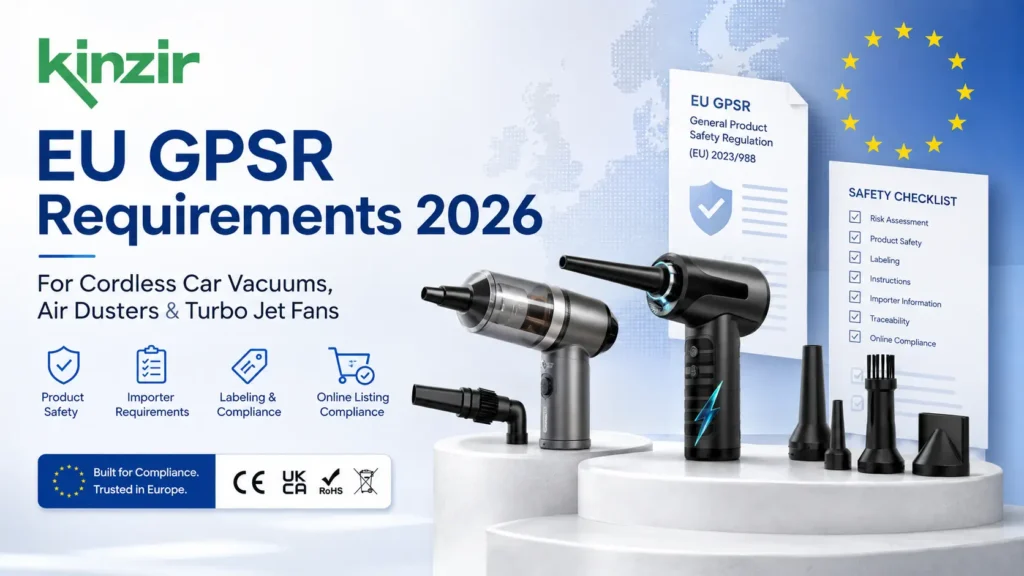
EU GPSR Requirements affect consumer products sold in the European Union, including many cordless car vacuums, electric air dusters and mini turbo jet fans. Regulation (EU) 2023/988, the General Product Safety Regulation, has applied since 13 December 2024. It covers product safety, distance sales, product identification, safety information, accident reporting, recalls, and several supply chain responsibilities. The current consolidated text is dated 29 May 2026. (Eur-Lex)
There is one point that buyers of cordless electronics need to get right from the start. GPSR does not sit atop every existing EU rule in exactly the same way. Cordless electrical products can already fall under EU harmonisation legislation such as the EMC Directive and RoHS. Where a specific EU law covers a particular safety risk, GPSR fills the gaps rather than duplicating that rule. For products covered by Union harmonisation legislation, GPSR provisions on distance sales, product accidents, Safety Gate, the Safety Business Gateway and consumer remedies remain particularly relevant, but GPSR Chapter III Section 1 does not apply in the same way. (Eur-Lex)
That distinction makes this article different from a generic GPSR checklist.
For a Kinzir importer, the practical job is to identify the complete legal route for the finished product, then make sure the physical product, technical file, battery, labels, user manual and online listing all describe the same final configuration.
EU GPSR Requirements 2026 at a Glance
For cordless electrical products, think of GPSR as a single layer within a larger EU product-compliance file.
| Area | What an EU Buyer Should Review |
|---|---|
| Product scope | Is the product intended for consumers or likely to be used by consumers? |
| Applicable EU laws | GPSR plus EMC, RoHS, Battery Regulation, WEEE and other relevant rules |
| Product safety | Normal use, foreseeable misuse and risks not covered by sector-specific legislation |
| Product identification | Model, type, batch, serial number or another traceable identifier under the applicable rules |
| Manufacturer details | Legal manufacturer identity and contact information |
| EU economic operator | Importer, authorised representative or other qualifying EU operator, depending on the legal route |
| Responsible Person information | Required in online offers where the manufacturer is outside the EU |
| Instructions | Safe-use information in languages required by the destination Member State |
| Online listings | Manufacturer, EU Responsible Person, product identification, image, warnings and safety information |
| Supply-chain records | Product, supplier, component and customer traceability where required |
| Complaints | A process for receiving and reviewing product-safety complaints |
| Accidents | Qualifying accidents reported through the Safety Business Gateway |
| Corrective action | Product correction, withdrawal or recall where a dangerous product is found |
| Consumer remedies | Repair, replacement or refund rules for product safety recalls |
| Related compliance | Battery Regulation, WEEE, UN38.3 transport documents and relevant CE legislation |
The biggest mistake is treating GPSR as a standalone certificate. It is a legal framework that works together with other EU product legislation. (Eur-Lex)
GPSR Scope and the 2026 Update
What does GPSR stand for?
GPSR means General Product Safety Regulation.
Its full name is Regulation (EU) 2023/988 on general product safety. It replaced the former General Product Safety Directive and applies to consumer products placed or made available on the EU market from 13 December 2024. The Regulation defines a product broadly enough to include an item intended for consumers or one likely to be used by consumers under reasonably foreseeable conditions, even when consumer use was not the original intention. (Eur-Lex)
This matters for cordless cleaning equipment. A compact air blower sold through automotive, computer or tool channels can still fall within the consumer-product framework if ordinary consumers are expected to use it.
Why does 2026 belong in the title?
The GPSR itself did not begin in 2026. The application date was 13 December 2024.
The year 2026 is useful for two reasons.
First, EUR-Lex lists the current consolidated GPSR version as 29 May 2026. (Eur-Lex)
Second, Commission Implementing Decision (EU) 2026/901, adopted on 17 April 2026 and published on 27 April 2026, updated the European standards referenced in support of GPSR and repealed the previous 2019 standards decision. (Eur-Lex)
That does not mean Decision 2026/901 contains a dedicated standard for every cordless vacuum or turbo jet fan. It means businesses working under GPSR should use the current standards framework and check whether a referenced standard covers their product or a particular risk.
GPSR and EU Harmonisation Legislation for Cordless Electronics
This is the part many GPSR summaries miss.
Article 2 says GPSR applies where EU law does not already contain specific provisions with the same product-safety objective. Where another EU law already regulates a particular safety risk, GPSR applies to the aspects or risks not covered by that law. (Eur-Lex)
For products already subject to Union harmonisation legislation, the Commission’s 2025 business guidance separates the GPSR provisions that remain applicable from those that do not.
For such products, GPSR Chapter III Section 2 remains relevant. That includes Article 19 distance sales, Article 20 accident reporting and Article 21 electronic information. Online marketplace requirements, Safety Gate, Safety Business Gateway and consumer recall/remedy provisions remain relevant too. GPSR Chapter III Section 1, which contains Articles 9 to 18, does not apply to these harmonised products in the same way. (Eur-Lex)
For a Kinzir buyer, that means you should not automatically create a file called “GPSR Article 9 Certificate” for a cordless vacuum and assume the work is finished.
You need to first identify which EU legislation applies to the finished product.
A typical cordless car vacuum, air duster or turbo jet fan may need review against several areas:
| Framework | Main Subject |
|---|---|
| GPSR, Regulation (EU) 2023/988 | General consumer safety, distance sales, accidents, recalls, consumer information |
| EMC Directive 2014/30/EU | Electromagnetic compatibility |
| RoHS Directive 2011/65/EU | Restricted substances in electrical and electronic equipment |
| Regulation (EU) 2023/1542 | Batteries and waste batteries |
| WEEE Directive 2012/19/EU | Electrical equipment at end of life |
| Regulation (EU) 2019/1020 | Market surveillance and EU-established economic operator for covered harmonised products |
| RED 2014/53/EU | Relevant where radio or wireless functions are built into the product |
| Low Voltage Directive 2014/35/EU | Relevant where the product or supplied equipment falls within its voltage scope |
A CE mark does not remove the GPSR duties that still apply. GPSR does not replace the product-specific CE route either.
For the end-of-life electrical side, see Kinzir’s EU WEEE Requirements for Cordless Car Vacuums, Air Dusters and Turbo Jet Fans.
For battery-specific EU rules, see the EU Battery Regulation 2027 guide.
GPSR Coverage of Kinzir Product Categories
Does GPSR apply to cordless car vacuums?
A cordless car vacuum sold to consumers is a consumer product. It can contain a rechargeable lithium-ion battery, BLDC motor, control PCB, charging circuit, dust cup, filter, electrical contacts and several attachments.
Its compliance route is not GPSR alone. Electrical and battery legislation can cover parts of the safety assessment, with GPSR acting as the horizontal safety net for gaps and continuing to regulate areas such as online offers, accident reporting and consumer recall rights where applicable. (Eur-Lex)
For current product structures, browse Kinzir’s cordless car vacuum cleaners.
Buyers planning to use replaceable-battery models can review OEM removable-battery car vacuums.
Does GPSR apply to electric air dusters?
Rechargeable electric air dusters can be consumer products under the same GPSR definition.
Their product-safety review may involve the battery, charging circuit, motor temperature, air inlet, nozzle attachment, concentrated airflow and foreseeable use around computers, household equipment and car interiors.
Kinzir’s current cordless electric air duster range covers models with different motor, battery and nozzle configurations.
A claim such as “safe for sensitive electronics” or “ESD-safe” needs its own support. A normal air-duster compliance file should not include unsupported claims simply because the product has passed other electrical tests.
Does GPSR apply to mini turbo jet fans?
Mini turbo jet fans can operate at very high motor speeds and high battery discharge rates. Kinzir models cover high-speed BLDC platforms used for car drying, dust removal and outdoor cleaning.
Safety assessment can involve the impeller enclosure, air inlet, nozzle retention, motor temperature, controller temperature, battery discharge, removable battery lock and foreseeable misuse.
For the engineering side, read Turbo Jet Fan Specifications Explained: RPM, CFM, Air Speed and Pressure.
For product options, browse Kinzir mini turbo jet fans.
The GPSR Meaning of a Safe Product
GPSR defines a safe product as one that presents no risk, or only the minimum risk compatible with its use, under normal or reasonably foreseeable conditions.
Article 6 looks beyond laboratory test results. Product design, technical features, composition, packaging, instructions, maintenance, interaction with other products, presentation, warnings and the types of consumers using the product can all form part of the assessment. Vulnerable users such as children, older people and people with disabilities are part of that analysis. (Eur-Lex)
For a cordless cleaning product, safety work should start with the way people actually use it.
A user may accidentally block the intake. A child may press a trigger. A customer may fit the wrong replacement battery. An air-duster nozzle may be used close to someone’s eyes. A vacuum filter may become badly clogged. A removable battery may be inserted repeatedly over several years.
Testing only one new sample under ideal conditions can miss these situations.
European Standards and Presumption of Safety
GPSR Article 7 creates a presumption of safety for risks covered by relevant European standards whose references have been published in the Official Journal.
Commission Implementing Decision (EU) 2026/901 is the current 2026 decision publishing standards drafted in support of GPSR. A product conforming to a referenced standard can benefit from a presumption of conformity with the general safety requirement for the risks that standard covers. (Eur-Lex)
The phrase for the risks covered matters.
A standard can address one area without addressing the complete product. A standard covering mechanical stability does not automatically prove battery safety. A standard relating to one product class does not become applicable just because the equipment is electrically powered.
For cordless products already covered by harmonisation legislation, the relevant harmonised standards under those specific laws remain central for the risks those laws regulate. The GPSR standards route becomes relevant to the parts of the safety assessment that GPSR actually covers.
The product file should state which standards were used and which risks those standards address.
GPSR Certificate, Registration and Marking
Is there a GPSR certificate?
There is no single universal GPSR certificate that a manufacturer can purchase and use as a substitute for the legal process.
For a product within the full GPSR manufacturer route, Article 9 calls for an internal risk analysis and technical documentation. For products under Union harmonisation legislation, product-specific conformity documentation comes from the relevant legislation, with GPSR continuing to apply to the areas left in scope. (Eur-Lex)
A third-party laboratory can issue test reports. A consultant can help prepare a risk assessment. An authorised representative can perform tasks under a written mandate.
None of those documents is a universal “GPSR certificate.”
Is GPSR registration required before sale?
GPSR does not create one standard pre-market product registration portal for every consumer product.
The Safety Business Gateway is not a routine registration database where every vacuum, air duster or turbo jet fan must be registered before sale. It is used by businesses when specified dangerous-product and accident notification duties arise. (Eur-Lex)
Is there a GPSR logo?
GPSR does not create a dedicated product logo comparable with the CE mark or the WEEE crossed-out wheeled bin.
Physical markings and contact information come from GPSR where its provisions apply and from other relevant EU legislation for harmonised products.
Manufacturer and Private-Label Roles
Who is the manufacturer?
GPSR defines a manufacturer as a person or company that manufactures a product, has a product designed or manufactured, and markets it under that person’s name or trademark. (Eur-Lex)
This matters for private-label sourcing.
Suppose Kinzir manufactures a turbo jet fan, then a European brand places the product on the market under its own name and trademark.
The brand should not assume that Kinzir remains the only legal manufacturer simply because Kinzir operates the physical production line. The branding and contractual structure can change the legal role. Article 13 treats a person placing a product on the market under that person’s name or trademark as the manufacturer for GPSR purposes where that provision applies. (Eur-Lex)
The role should be settled before the rating label, packaging, user manual and technical documentation are approved.
When can a product modification change the manufacturer role?
Substantial modification can shift manufacturer obligations to the company that makes or commissions the modification.
For an OEM or ODM cordless product, changes worth reviewing include a new battery architecture, higher motor speed, new BMS, different PCB, new charging system, changed housing, new airflow path or firmware changes that affect safety.
The question is not whether the modified version looks different. The question is whether the change affects safety or introduces a new risk not present in the original assessment.
For battery changes, Kinzir has separate technical guides on 18650 vs 21700 batteries and the 5S2P battery pack configuration.
Risk Analysis and Technical Documentation
Here another distinction matters.
For products that fall fully under GPSR manufacturer obligations, Article 9 requires an internal risk analysis and technical documentation that include a product description and characteristics relevant to safety. Where risks call for more detail, the file can include the identified risks, the methods used to remove or reduce them, test reports and relevant standards. The file must be kept up to date and retained for 10 years. (Eur-Lex)
For cordless electronics already subject to Union harmonisation legislation, GPSR Chapter III Section 1 does not apply in the same manner. The applicable technical file and conformity-assessment duties come from the relevant harmonisation legislation. GPSR still fills safety gaps and keeps distance-sale, accident-reporting, marketplace and consumer-remedy requirements in play. (Eur-Lex)
For an importer, the practical result is similar: you need a coherent technical file for the actual product.
A folder containing one RoHS report, one battery report and one CE logo file is not enough if none of the documents can be matched to the final model.
A useful product file links the following information together:
| File Area | Example Content |
|---|---|
| Product identity | Model, SKU, photos, dimensions, product version |
| Electrical system | Motor, PCB, battery voltage, current, charger |
| Battery | Cell model, pack model, BMS, Wh, transport documentation |
| Safety assessment | Known hazards, foreseeable use, misuse, risk-control measures |
| Testing | Relevant electrical, mechanical, battery and thermal test reports |
| Standards | Standards or test methods used |
| Labels | Product, importer, EU economic operator and warning artwork |
| Instructions | Approved multilingual user manual |
| Production | Golden sample, BOM revision, inspection specification |
| Change control | Record of battery, motor, PCB, housing or firmware changes |
This approach is useful whether the legal source of the technical documentation is GPSR or a product-specific harmonisation law.
Product Identification and Traceability
For products under the full GPSR manufacturer route, Article 9 requires a type, batch, serial number or another identifier that lets the product be traced. The information normally belongs on the product. Packaging or accompanying documents can be used where the product’s size or nature does not permit product marking. (Eur-Lex)
A private-label turbo jet fan could use a structure such as:
| Field | Example |
|---|---|
| Brand | ABC Car Care |
| Model | AD80-EU |
| SKU | ABC-AD80-BK |
| Batch | 20260801 |
| Product version | V2 |
| Battery model | BP80-21700 |
The exact fields depend on the product and the applicable legislation. The goal is simple: when a safety complaint arrives six months later, the company should be able to identify which production batch, battery configuration and customer shipment are involved.
This becomes more valuable for removable-battery products where one fan model can later be sold with several battery revisions.
Supply-Chain Traceability Records
The current consolidated GPSR contains detailed traceability provisions.
Economic operators can be asked for information identifying the product, corrective measures, suppliers and customers. Certain information must remain available for 10 years, and relevant supplier, component and embedded software traceability information under Article 15 must remain available for six years. (Eur-Lex)
For a cordless product, useful traceability records can connect the finished SKU with its battery supplier, cell model, motor version, PCB revision, product batch and EU customer.
This is one area where a factory’s production records matter long after the container leaves China.
Manufacturer, Importer and EU Economic Operator Details
Contact information is a major part of GPSR discussions, but buyers need to separate the different legal routes.
For products under the full GPSR manufacturer route, Article 9 requires the manufacturer’s name or trademark, postal address and electronic address on the product, or where that cannot be done, on the packaging or an accompanying document. Importers have comparable identification duties under Article 11 where that Article applies. (Eur-Lex)
For harmonised products, comparable manufacturer and importer markings may come from the specific harmonisation legislation rather than GPSR Article 9 or 11.
What counts as an electronic address?
The Commission’s 2025 business guidance explains that the electronic contact route needs to give the consumer a direct and practical way to reach the business. An email address can work. A website contact section that supports direct communication can work too. A homepage with no clear contact route should not be treated as a substitute for a usable electronic address. (Eur-Lex)
This is worth checking before artwork is printed.
EU Responsible Person for Chinese-Made Products
The term “GPSR Responsible Person” is one of the most-searched terms in the Regulation, and it requires careful use for electrical products.
Article 16 says a product within that GPSR route cannot be placed on the EU market without an economic operator established in the Union responsible for the stated tasks. That operator can be an EU manufacturer, importer, authorized representative or, in defined circumstances, a fulfillment service provider. (Eur-Lex)
For products already covered by certain Union harmonisation legislation, the EU-established operator can instead come from Article 4 of Regulation (EU) 2019/1020. That Article expressly covers RoHS, EMC, the Battery Regulation and several other harmonization laws. It provides the same broad categories of EU-established operator: manufacturer, importer, authorized representative or fulfillment service provider where no other qualifying operator exists. (Eur-Lex)
This makes the result very relevant to Kinzir products, even where GPSR Article 16 itself is not the legal source.
Is the Responsible Person the same as an authorized representative?
No.
An authorized representative is an EU-established person or company with a written mandate from the manufacturer to perform named tasks.
The Responsible Person or responsible economic operator refers to the EU-established entity responsible for the required market surveillance tasks under the applicable legal route.
An authorised representative can perform that role where the conditions are met, but the terms are not interchangeable. (Eur-Lex)
Can Kinzir be the EU Responsible Person?
Kinzir’s manufacturing entity is based in China, so it does not meet the EU establishment condition.
Kinzir can supply manufacturer-side product information, technical specifications, test documentation, labels, manuals and OEM production records. The EU buyer still needs to identify the qualifying EU economic operator for the final stage of the supply chain.
Physical Responsible Person Information
For the Article 16 GPSR route, the EU Responsible Person’s name, trade name or trademark, postal address and electronic address must appear on the product, packaging, parcel or an accompanying document. (Eur-Lex)
For a product that uses Regulation (EU) 2019/1020 Article 4 instead, the Article 4 economic operator’s name and contact details, including postal address, must similarly be indicated on the product, packaging, parcel, or accompanying document. (Eur-Lex)
This should be settled during artwork approval.
Leaving the EU operator blank until goods arrive at the warehouse creates unnecessary relabelling work.
QR Codes and Digital Information
GPSR permits economic operators to provide certain information in digital format in addition to physical information.
Article 21 does not turn a QR code into a blanket replacement for physical information required by Articles 9, 11 or 16. The digital route is supplementary. (Eur-Lex)
That distinction becomes more relevant as the EU Battery Regulation introduces separate QR code requirements for batteries.
A buyer should not combine the battery QR code, GPSR contact information, WEEE marking, and CE information into a single generic “EU compliance QR code” and assume that physical marking is no longer needed.
Instructions and Safety Information
For the full GPSR route, clear instructions and safety information are needed in a language consumers can easily understand, as determined by the Member State, when such information is needed for safe use. (Eur-Lex)
Cordless car vacuums, air dusters and turbo jet fans are simple to operate, but their batteries, charging systems and high-speed motors can make safety information useful.
The exact manual should be based on the real risk assessment. Topics that may deserve coverage include charging input, battery installation, replacement battery compatibility, damaged battery handling, air inlet blockage, filter cleaning, water exposure, nozzle attachment, storage temperature, and safe use of concentrated airflow.
The wording should come from the validated product, not from a generic manual used for several unrelated models.
Multilingual Manuals for EU Markets
There is no single “English is enough everywhere in the EU” rule.
The required safety information must be available in a language consumers can easily understand, with the Member State determining the language requirement. (Eur-Lex)
For OEM projects covering several EU markets, one commercial solution is a common retail box paired with a multilingual user manual.
That can reduce the number of printed packaging versions without weakening the safety-information file.
Packaging splits can affect factory quantities too. Kinzir’s OEM Turbo Jet Fan MOQ guide explains how multiple packaging languages, colors and SKUs can change production planning.
GPSR Online and Distance-Sale Requirements
This is one of the clearest GPSR duties that remains highly relevant to harmonised cordless electrical products.
Article 19 states that an online or distance-sale product offer must clearly and visibly present specified product safety information. (Eur-Lex)
The online offer needs the following information:
| Article 19 Information | What It Means for a Product Listing |
|---|---|
| Manufacturer | Name, registered trade name or trademark |
| Manufacturer contact | Postal and electronic address |
| EU Responsible Person | Name, postal and electronic address where manufacturer is outside the EU |
| Product identity | Product picture, type and other product identifier |
| Warnings | Safety information required on the product, packaging or accompanying document |
| Language | Safety information understandable in the destination market |
A compliant label inside the physical retail box does not replace Article 19 online information.
For Amazon, Shopify, a distributor website or a brand’s own ecommerce store, the listing itself needs to carry or clearly present the required information.
Amazon and Marketplace Sales
The GPSR creates separate duties for online marketplace providers and for the traders selling through those marketplaces.
Article 22 requires online marketplace interfaces to enable traders to submit manufacturer information, EU Responsible Person information, product identification, and safety warnings, and to display or make that data easily accessible to consumers. (Eur-Lex)
Amazon providing a GPSR data field does not make Amazon the manufacturer, importer or Responsible Person for your product automatically.
The seller still needs the correct legal information.
For an OEM buyer, this means the physical product data and Amazon listing data should be prepared from the same approved source file.
A good workflow is:
approved product specification → approved label → approved manual → approved online listing
This reduces mismatches between the product customers receive and the information shown online.
Direct Sales From China to EU Consumers
GPSR treats an online offer as made available on the EU market when it targets EU consumers.
The Commission’s business guidance points to factors such as delivery destinations, languages, payment methods, Member State currency and EU-focused domain names when deciding whether an offer targets consumers in the Union. (Eur-Lex)
A company does not avoid EU product safety rules simply by operating its e-commerce website from outside Europe.
For a Chinese seller sending cordless blowers directly to consumers in Germany, France, or Italy, the EU economic operator and Article 19 issues need to be reviewed before the sales page goes live.
Product Safety Review for Cordless Car Vacuums
A product-safety assessment works better when it is tied to the actual product architecture.
For a cordless car vacuum, a practical review can look like this:
| Area | Questions for the Product Team |
|---|---|
| Battery | Can the pack overheat, short circuit or be replaced with an incompatible pack? |
| Charging | Does the charging input match the validated battery system? |
| Motor | What happens if airflow is blocked? |
| Dust cup | Can it open unexpectedly during use? |
| Filter | Does severe blockage raise motor or battery temperature? |
| Electrical contacts | Can repeated battery removal create loose or high-resistance connections? |
| Nozzles | Can an attachment detach during operation? |
| Liquids | Is the product likely to be used on wet debris despite instructions? |
| User group | Can children operate the product easily? |
| Transport damage | Could a damaged battery enter the consumer supply chain? |
For suction and motor loading, Kinzir’s cordless car vacuum suction guide gives useful technical context.
Product Safety Review for Electric Air Dusters
An air duster creates a different risk profile from a vacuum.
| Area | Questions for the Product Team |
|---|---|
| Airflow | Can concentrated airflow create an eye or debris hazard at close range? |
| Nozzle | Does the nozzle remain attached at maximum speed? |
| Motor | What temperature is reached under continuous high-speed use? |
| Battery | What happens under maximum discharge load? |
| Air inlet | Can hair, fabric or loose objects enter the fan? |
| Electronics cleaning | Are any anti-static or ESD claims supported by testing? |
| Charging | Is the charger or USB-C input correctly specified? |
| Storage | Are high-temperature storage limits clear? |
| Foreseeable misuse | Can users direct the airflow at people or animals? |
A high RPM number is not a complete safety specification. Air speed, pressure, nozzle design, motor load and battery current all affect the finished product.
Product Safety Review for Turbo Jet Fans
Turbo jet fans can combine very high BLDC motor speed with concentrated airflow and high-current batteries.
| Area | Questions for the Product Team |
|---|---|
| Impeller | Is the rotating assembly securely enclosed? |
| Air inlet | Can foreign objects reach the impeller? |
| Nozzle | Does it stay locked at maximum airflow? |
| Motor | Does continuous high-speed use exceed validated temperature limits? |
| Controller | Is overcurrent and thermal protection defined? |
| Battery | Does the pack support the peak current without excessive heat? |
| Removable battery | Does the locking system remain secure after repeated cycles? |
| Contacts | Does contact resistance rise after repeated insertion? |
| Use | Are car drying, outdoor cleaning and electronics use covered by the intended-use review? |
| Replacement pack | Can an incompatible battery be fitted? |
For battery engineering, see Kinzir’s 5S2P battery pack guide.
Product Testing and GPSR
Does GPSR require a GPSR laboratory test?
There is no universal GPSR laboratory test that applies to every consumer product.
For a full GPSR product, test reports can support the internal risk analysis and technical documentation. For harmonised electrical products, the applicable sectoral legislation and its standards define much of the conformity-assessment route. GPSR then covers the risks and obligations that remain in scope. (Eur-Lex)
For a Kinzir-type cordless appliance, the practical test file can include electrical, battery, motor temperature, charging, mechanical, and durability evidence where those tests match the identified risks.
A test should answer a question.
If the concern is battery-contact wear, use an insertion and extraction test.
If the concern is a nozzle detaching under maximum airflow, test nozzle retention.
If the concern is transport damage, use a suitable packaging or vibration test.
Collecting unrelated reports adds paper, not confidence.
Series Production and Factory Quality Control
A compliant pre-production sample does not guarantee that the tenth production batch will match it.
For products subject to the full GPSR manufacturer route, Article 9 requires procedures for series production to remain in line with the general safety requirement. (Eur-Lex)
For harmonised products, comparable production-control duties come from the relevant product legislation and the manufacturer’s quality system.
Either way, an OEM buyer should control changes to the battery, motor, PCB, housing material, software, labels and manual.
Kinzir’s OEM facility is ISO 9001:2015 certified and operates five production lines with a dedicated QC team. Its published factory information lists insertion and extraction life tests, button-life tests, transport vibration testing and product endurance checks. (Kinzir Air Duster)
For detachable battery projects, Kinzir’s OEM detachable battery turbo jet fan guide describes battery insertion, retention, contact-resistance, charging and runtime testing in more detail.
OEM Change Control
One of the easiest ways to break a compliance file is to modify the product after testing and leave the documents unchanged.
Common OEM changes include:
| Change | What Needs Review |
|---|---|
| 18650 to 21700 | Battery dimensions, BMS, runtime, current, transport file |
| Higher battery capacity | Wh, charging, heat, shipping classification |
| 130,000 to 150,000 RPM | Motor, controller, temperature, airflow, runtime |
| New BMS | Protection thresholds and current limits |
| New PCB | EMC, control logic, temperature and safety functions |
| Built-in to removable battery | Contacts, locking, labels, instructions |
| New charger | Electrical compatibility and charging safety |
| New nozzle | Retention and airflow behavior |
| New housing | Airflow, temperature, mechanical protection |
| New firmware | User controls, motor behavior and protective functions |
The technical documentation and online listing should describe the version actually entering the EU market.
For battery transport changes, read Kinzir’s UN38.3 vs MSDS vs IEC 62133 lithium battery shipping guide.
Consumer Complaint Channels and Safety Records
For products subject to full GPSR manufacturer duties, Article 9 requires publicly available channels for consumers to submit complaints and report accidents or safety issues. Examples include a telephone number, electronic address or a dedicated website section. Manufacturers need to investigate safety-related complaints and keep an internal record of complaints, recalls and corrective actions. Personal data in the complaint register may not be kept for more than five years after entry. (Eur-Lex)
Importers have related duties under Article 11. They need to check that a consumer communication channel exists and provide one where it does not. (Eur-Lex)
For a private-label product, the customer service team should know how to distinguish a routine service complaint from a safety complaint.
“Battery lasts 15 minutes instead of 20” is a performance issue.
“Battery became extremely hot and damaged the housing” may be a safety issue that needs escalation.
Safety Gate and Safety Business Gateway
These names are easy to mix up.
Safety Gate is the EU system used for information on dangerous non-food products and alerts.
Safety Business Gateway is the business-facing route used for specified notifications under GPSR.
The Commission’s November 2025 guidance confirms that use of the Safety Business Gateway is mandatory when a business has a GPSR notification duty for a dangerous product or qualifying accident. (Eur-Lex)
It is not a portal for registering every Kinzir vacuum or turbo jet fan before launch.
Dangerous Product Reporting
When a dangerous product is discovered and the relevant GPSR reporting provisions apply, businesses may need to take corrective action, inform consumers and notify the competent market-surveillance authorities through the Safety Business Gateway.
Corrective action can mean fixing the compliance problem, stopping further sale, withdrawing units from the supply chain or recalling units already sold. (Eur-Lex)
For an importer, this is why batch identification matters.
If one battery lot has a problem, traceability can help determine whether the affected population is 500 units or 50,000.
Accident Reporting
Article 20 remains highly relevant to harmonised products.
A manufacturer must report qualifying accidents through the Safety Business Gateway without undue delay after learning of them. The report concerns occurrences connected with product use that result in death or serious adverse effects on health and safety, including serious injuries, illnesses and other harm. Importers and distributors that learn of an accident need to inform the manufacturer. Where the manufacturer is outside the EU, the responsible EU person that learns of the accident must make sure the notification is made. (Eur-Lex)
A sensible internal process separates complaints into levels.
Routine product dissatisfaction goes to customer service.
Potential safety defects go to quality and compliance review.
Serious injury or accident cases need immediate escalation.
Product Recalls and Consumer Remedies
GPSR gives consumers defined rights when a product safety recall takes place.
Recall communication needs to identify the product, describe the hazard clearly, tell consumers what action to take and explain the available remedy. The Regulation contains a structured recall-notice framework. (Eur-Lex)
Article 37 states that the economic operator responsible for a recall normally needs to offer consumers a choice between at least two of three remedies: repair, replacement with a safe product, or an adequate refund. The remedy must be effective, free of charge and timely. (Eur-Lex)
This has a practical connection with removable-battery products.
If a safety issue can be corrected through a safe battery replacement and the recall conditions permit that remedy, a removable pack can make corrective work easier than a sealed design. That does not make every battery replacement a compliant recall remedy automatically. The exact safety issue and official recall process still control the response.
Product Recall Contact Data
GPSR encourages direct consumer communication in a recall.
Where a business already has customer data that can identify who purchased the affected product, Article 35 requires those identifiable consumers to be contacted directly and without undue delay in a safety recall or safety warning. (Eur-Lex)
For ecommerce brands, order history can become part of the product-safety system.
A customer database should not be thought of only as a marketing asset. It can be a recall tool.
GPSR Penalties and Market Surveillance
There is no single flat “EU GPSR fine” that applies identically in every Member State.
Article 44 requires Member States to set their own penalty rules for GPSR infringements. Those penalties must be effective, proportionate and dissuasive. (Eur-Lex)
Market-surveillance authorities can request documents, investigate dangerous products and require corrective action under the relevant EU and national frameworks.
For importers, the safer approach is to build the compliance file before the product is listed rather than trying to reconstruct it after an authority asks for it.
Private-Label Example: China to the EU
Consider a German e-commerce company sourcing 2,000 removable-battery turbo-jet fans from Kinzir.
The product uses a 21700 battery pack, a private-label logo, a custom retail box, and a multilingual manual. It will be sold on Amazon Germany and through the customer’s own website.
Before production, the buyer should identify the EU legislation that applies to the finished model. Since the fan is electrical equipment, the analysis should include the relevant harmonisation laws, Battery Regulation and WEEE, then GPSR for the areas still in scope.
The legal manufacturer and importer roles need to be fixed next. If the product is sold entirely under the German brand’s trademark, the branding structure needs legal review before the label is approved.
The buyer should then freeze the product specification. The approved battery, motor, BMS, PCB, housing, nozzle and charger become the reference configuration.
The technical file should match that configuration. Relevant test evidence, battery records and production specifications need to use the same model and version numbers.
The physical label should carry the information required by the applicable product laws. The EU-established economic operator needs to be identified under the correct legal route.
The manual should contain validated safety information in the languages required for the sales markets.
The Amazon listing then needs Article 19 information: manufacturer identification; the EU Responsible Person information when the manufacturer is outside the EU; a product picture and identifier; and the required warnings and safety information. (Eur-Lex)
Battery market requirements should be reviewed separately through Kinzir’s EU Battery Regulation 2027 guide.
Electrical end-of-life duties sit in the EU WEEE Requirements guide.
International battery transport uses a separate file covered in the UN38.3 vs MSDS vs IEC 62133 guide.
This is what a real EU launch looks like. No single certificate covers it all.
What Kinzir Can Provide to EU OEM Buyers
Kinzir is a brand of Mfine Technology (Huizhou) Co., Ltd., an ISO 9001:2015-certified electronic manufacturer of electric air dusters, cordless car vacuums and mini turbo jet fans. Its current OEM information lists five production lines, a dedicated QC team, custom housing and color work, laser engraving, multilingual manuals and private-label packaging. (Kinzir Air Duster)
For an EU-bound OEM project, Kinzir can support the product side with the final product specification, model identification, product drawings, battery information, available test documentation, product labels, branding artwork, multilingual manual printing, private-label packaging, sample development and production QC records.
For removable-battery projects, buyers can start with existing platforms rather than redesigning the battery system from zero:
OEM detachable battery turbo jet fans
OEM detachable battery electric air dusters
OEM removable battery car vacuums
The EU buyer still needs to confirm the final legal roles, destination-country language rules, Responsible Person or Article 4 economic-operator arrangement, online listing and final compliance file.
GPSR vs EU Battery Regulation
GPSR and Regulation (EU) 2023/1542 address different subjects.
GPSR addresses general consumer product safety, online offers, accidents, recalls, and related consumer protection.
The EU Battery Regulation covers batteries, including conformity assessment, information requirements, producer responsibility, waste batteries, and removable or replaceable portable batteries.
A cordless turbo jet fan can fall under both frameworks.
For the battery-removal side, Kinzir has a separate guide to readily removable and replaceable batteries under EU battery law.
GPSR vs WEEE
GPSR is a product-safety framework.
WEEE is an end-of-life electrical-equipment and producer-responsibility framework.
A WEEE registration number does not demonstrate that a consumer product is safe.
A complete GPSR-related online listing does not replace WEEE producer registration either.
See EU WEEE Requirements for Cordless Cleaning Products for the separate registration, marking, reporting and recycling requirements.
GPSR vs UN38.3
UN38.3 belongs to lithium battery transport.
GPSR deals with consumer products offered and sold in the EU.
A battery can have valid UN38.3 transport documents yet the finished car vacuum still needs the applicable EU product-compliance work.
A GPSR-compliant online listing does not make a battery ready for international air or sea shipping.
Kinzir’s UN38.3 vs MSDS vs IEC 62133 comparison explains that difference.
EU GPSR Compliance Checklist for Cordless Products
A practical pre-launch review can be kept in one table.
| Review Area | Before EU Sale |
|---|---|
| Product scope | Confirm consumer use and applicable GPSR provisions |
| EU legislation | Identify EMC, RoHS, Battery Regulation, WEEE, RED/LVD where relevant |
| Final product version | Freeze motor, battery, BMS, PCB, charger, housing and accessories |
| Safety assessment | Review normal use, foreseeable misuse and safety gaps |
| Technical file | Match tests, specifications and standards to the final product |
| Product identity | Use consistent model, type, batch or serial identifiers |
| Legal manufacturer | Confirm whose name or trademark places the product on the market |
| Importer | Identify the EU importer and applicable contact marking |
| EU operator | Confirm GPSR Responsible Person or Regulation 2019/1020 Article 4 operator |
| Physical label | Verify all required contact, electrical and product information |
| User manual | Validate safety text and destination-market languages |
| Article 19 listing | Add manufacturer, EU operator, product image/identifier and warnings |
| Battery | Check Regulation (EU) 2023/1542 requirements separately |
| WEEE | Review producer registration and WEEE marking separately |
| Shipping | Match UN38.3 and lithium battery documents to the actual battery |
| Production QC | Lock BOM and inspection requirements to the approved sample |
| Traceability | Keep supplier, batch, component and customer records |
| Complaints | Create a product-safety escalation route |
| Accidents | Prepare Safety Business Gateway reporting procedures |
| Recall | Prepare consumer contact, notice and remedy procedures |
Common GPSR Mistakes for Importers and Private-Label Brands
| Mistake | Better Approach |
|---|---|
| Asking the factory for a “GPSR certificate” | Identify the actual legal route and supporting documentation |
| Assuming CE covers every GPSR duty | Review GPSR provisions that remain applicable |
| Applying Article 9 blindly to every harmonised product | Read Article 2 and the Commission’s harmonisation guidance |
| Treating GPSR as product registration | Safety Business Gateway is not routine pre-market registration |
| Missing the EU economic operator | Identify the Article 16 or Regulation 2019/1020 Article 4 route |
| Using an incomplete Amazon listing | Add Article 19 information to the product offer |
| Putting contact information only in a QR code | Keep required physical information under the applicable rule |
| Using one manual for every EU market | Check language requirements in each destination |
| Changing a battery after testing | Review the technical file and transport file |
| Using test reports for another model | Match model, battery, PCB and product version |
| Keeping no batch link | Connect sold units to production and component records |
| Treating WEEE as product-safety proof | Manage WEEE and GPSR as separate compliance areas |
| Treating UN38.3 as finished-product approval | UN38.3 concerns lithium battery transport |
| Having no complaint escalation process | Separate normal service issues from safety incidents |
| Treating Safety Gate and Safety Business Gateway as the same system | Use each system for its proper function |
EU GPSR Requirements FAQs
What are the EU GPSR Requirements in 2026?
GPSR has applied since 13 December 2024. In 2026, businesses should work from the current consolidated text dated 29 May 2026 and current Commission guidance. Requirements relevant to a product can cover general safety, distance sales, online listing information, accident reporting, Safety Business Gateway notifications and consumer recall rights. The exact duties depend on whether the product is already subject to Union harmonisation legislation. (Eur-Lex)
What changed under GPSR in 2026?
The current consolidated version is dated 29 May 2026. Commission Implementing Decision (EU) 2026/901, adopted in April 2026, updated the European standards published in support of GPSR. (Eur-Lex)
When did GPSR become mandatory?
Regulation (EU) 2023/988 became applicable on 13 December 2024. (Eur-Lex)
Does GPSR apply to cordless car vacuums?
Yes, GPSR can apply to consumer cordless car vacuums. Where the product is already subject to specific Union harmonisation legislation, GPSR applies according to Article 2, with some chapters applying only to risks or duties not covered by that sectoral legislation. (Eur-Lex)
Does GPSR apply to electric air dusters?
Rechargeable air dusters intended for consumers can fall within the GPSR product definition. The complete legal route needs to account for applicable electrical and battery legislation too.
Does GPSR apply to turbo jet fans?
Consumer turbo-jet fans fall within the broader consumer-product framework. Their electrical and battery components can trigger other EU laws, so GPSR should be reviewed together with the relevant harmonisation legislation.
Is there a GPSR certificate?
No universal GPSR certificate replaces the business’s legal duties. Test reports and technical documentation support compliance, but no single document covers the entire Regulation.
Is GPSR registration required?
There is no standard pre-market GPSR registration process for every consumer product. The Safety Business Gateway is used for specified dangerous-product and accident notifications, not routine product registration. (Eur-Lex)
Is there a GPSR logo?
No dedicated GPSR product logo exists.
Does CE marking cover GPSR?
No. CE marking is tied to applicable EU harmonisation legislation. GPSR can still apply to uncovered risks and to provisions such as distance sales, accident reporting and consumer remedies. (Eur-Lex)
Does GPSR require a risk assessment?
Article 9 requires an internal risk analysis for products under the full GPSR manufacturer route. Chapter III Section 1 does not apply in the same way to products already subject to specific Union harmonisation legislation. Those products are subject to risk and technical documentation requirements under their applicable sector-specific laws, with GPSR covering the areas that remain in scope. (Eur-Lex)
How long is GPSR technical documentation kept?
Under Article 9, manufacturers in the full GPSR route keep the technical documentation available for 10 years after the product is placed on the market. Importers under Article 11 have a related 10-year document-retention duty. (Eur-Lex)
What is presumption of safety under GPSR?
A product can benefit from a presumption of conformity with the GPSR general safety requirement for risks covered by relevant European standards whose references are published in the Official Journal. Decision (EU) 2026/901 contains the current standards decision. (Eur-Lex)
What is a GPSR Responsible Person?
For products using the GPSR Article 16 route, it is the qualifying EU-established economic operator responsible for specified tasks. For harmonised products covered by Regulation (EU) 2019/1020 Article 4, the EU-established economic operator comes from that Regulation. (Eur-Lex)
Is the Responsible Person the same as an authorised representative?
No. An authorised representative holds a written mandate from a manufacturer. It can become the responsible EU economic operator where the applicable legal conditions are met.
Can an importer be the Responsible Person?
Yes, an EU importer can be the responsible economic operator in many non-EU manufacturer supply chains. (Eur-Lex)
Can a Chinese manufacturer be the EU Responsible Person?
A China-only legal entity is not established in the European Union, so it cannot fill an EU-establishment role on that basis alone.
What information must appear on an online product listing?
Article 19 requires manufacturer identification and contact details, EU Responsible Person details where the manufacturer is outside the EU, product identification including an image and type, plus required warnings and safety information. (Eur-Lex)
Do GPSR warnings need to appear online?
Yes, where warnings or safety information are required on the product, packaging or accompanying documents under GPSR or applicable harmonisation legislation, Article 19 requires that information in the distance-sale offer. (Eur-Lex)
Can a QR code replace GPSR physical labeling?
GPSR Article 21 allows supplementary digital information, but it does not remove the physical-information duties in the provisions it references. (Eur-Lex)
Does the manual need every EU language?
The required language depends on the Member State where the product is made available. The rule is that the consumer must be able to understand the instructions and safety information in the language required by that market. (Eur-Lex)
What is the Safety Business Gateway?
It is the EU business-facing system for specified product-safety notifications, including dangerous-product and accident reporting duties under GPSR. (Eur-Lex)
What is the difference between Safety Gate and Safety Business Gateway?
Safety Gate is the EU dangerous non-food product alert and information system. The Safety Business Gateway is used by businesses for the notifications required from them under GPSR.
When must a product accident be reported?
Qualifying accidents associated with use of the product that result in death or serious adverse effects on health and safety need to be reported without undue delay through the Safety Business Gateway once the responsible party knows about them. (Eur-Lex)
What is the difference between withdrawal and recall?
Withdrawal prevents a product that remains in the supply chain from being made available. Recall seeks the return of a product that has already reached the end user. (Eur-Lex)
What remedies apply in a product safety recall?
GPSR normally gives consumers a choice between at least two options from repair, replacement and an adequate refund, subject to the conditions in Article 37. (Eur-Lex)
What are the penalties for GPSR non-compliance?
Member States set national penalties. GPSR requires those penalties to be effective, proportionate and dissuasive. There is no one universal EU fine for every infringement. (Eur-Lex)
Does GPSR apply to B2B products?
GPSR is aimed at consumer products. A product developed for professional users can still fall within its definition where consumers are likely to use it under reasonably foreseeable conditions. (Eur-Lex)
Does GPSR replace WEEE?
No. GPSR deals with product safety. WEEE deals with waste electrical equipment and producer responsibility.
Does GPSR replace the EU Battery Regulation?
No. Regulation (EU) 2023/1542 contains separate battery rules.
Does UN38.3 prove GPSR compliance?
No. UN38.3 concerns transport testing of lithium batteries. It is not finished-product GPSR approval.
What should an EU importer request from a Chinese OEM factory?
Ask for the final product specification, model and version information, battery specification, available test reports, product drawings, label artwork, instructions, production traceability information and the documents required under the applicable EU harmonization legislation. Then match those records to the final product and the Article 19 online listing.
References
- Regulation (EU) 2023/988 on General Product Safety, current consolidated version dated 29 May 2026. European Parliament and Council of the European Union. Primary source for GPSR scope, product safety, economic operators, distance sales, accident reporting and recalls. Regulation (EU) 2023/988, consolidated text
- Guidelines on the Application of the EU General Product Safety Legislative Framework by Businesses, C/2025/6233. European Commission, 21 November 2025. Detailed business guidance on GPSR scope, harmonization legislation, manufacturers, importers, distributors, Responsible Persons and distance sales. European Commission GPSR business guidelines
- Guidelines for the Practical Implementation of the Safety Business Gateway, C/2025/6238. European Commission, 21 November 2025. Guidance on dangerous-product and accident reporting through the Safety Business Gateway. Safety Business Gateway guidelines
- Commission Implementing Decision (EU) 2026/901 of 17 April 2026 on European standards for products drafted in support of Regulation (EU) 2023/988. European Commission. Current GPSR standards decision, in force from 27 April 2026. Commission Implementing Decision (EU) 2026/901
- Regulation (EU) 2019/1020 on Market Surveillance and Compliance of Products. European Parliament and Council of the European Union. Article 4 covers the EU-established economic operator for products subject to listed Union harmonisation legislation, including RoHS, EMC and Regulation (EU) 2023/1542. Regulation (EU) 2019/1020, consolidated text
- Regulation (EU) 2023/1542 concerning batteries and waste batteries. European Parliament and Council of the European Union. Primary source for battery-specific EU obligations relevant to cordless vacuums, electric air dusters and turbo jet fans. EU Battery Regulation 2023/1542
- Directive 2012/19/EU on Waste Electrical and Electronic Equipment (WEEE). European Parliament and Council of the European Union. Primary source for separate end-of-life electrical equipment requirements. WEEE Directive 2012/19/EU
- Directive 2011/65/EU on the Restriction of Hazardous Substances in Electrical and Electronic Equipment. European Parliament and Council of the European Union. Primary source for RoHS requirements relevant to electrical and electronic equipment. RoHS Directive 2011/65/EU


