
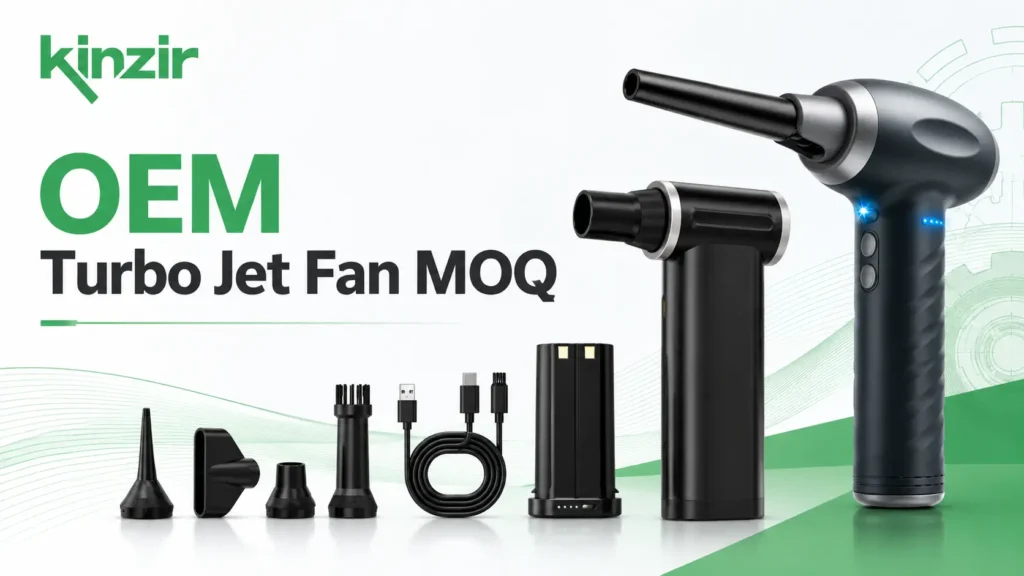
What is a reasonable OEM Turbo Jet Fan MOQ for a private-label order? For many current Kinzir mini turbo jet fan platforms, the listed OEM minimum order quantity is 500 units. Models including the AD46, AD47, AD51, AD71, and AD80 currently show a 500-unit OEM MOQ. A smaller branded run may be possible when the project stays close to an existing product and uses simple customization such as in-house laser engraving.
That does not mean every 500-unit order supports unlimited customization.
Ordering 500 standard black turbo jet fans with a laser-engraved logo is very different from ordering 500 units with a new housing, a custom Pantone color, a new BLDC motor, a custom PCB, a new 21700 battery pack, an exclusive nozzle, and a newly printed retail box.
The finished quantity may be the same. The manufacturing work is not.
For importers, distributors, Amazon brands and private-label buyers, the better question is:
What customization can be completed at the standard MOQ, and which changes create a separate component MOQ, tooling cost or project-specific minimum?
This guide answers that question and explains how turbo jet fan MOQ affects unit cost, battery selection, tooling, packaging, samples, production lead time and repeat orders.
OEM Turbo Jet Fan MOQ at a Glance
Kinzir offers several levels of manufacturing, from standard wholesale products through private-label production and deeper OEM or ODM development.
| Project Type | MOQ Approach | Typical Changes |
|---|---|---|
| Standard wholesale model | Based on available model and stock | No product changes |
| Simple private label | Can be more flexible | Logo, product label |
| Existing Kinzir OEM platform | 500 units on many current models | Branding, packaging, selected options |
| Semi-custom OEM | Project-specific | Color, battery, accessories, controls |
| Full ODM development | Project-specific | New housing, tooling, PCB, structure |
Kinzir’s current OEM page states that the factory supports flexible minimum quantities and uses its own laser engraving equipment for private-label production. The same page identifies five production lines, a dedicated QC team, custom housing, color matching and packaging services.
For buyers who want to compare available product platforms first, browse the Kinzir mini turbo jet fan range before defining the custom specification.
What Does MOQ Mean in Turbo Jet Fan Manufacturing?
MOQ means Minimum Order Quantity, the smallest practical production quantity a manufacturer accepts for a defined product configuration.
A factory MOQ is rarely based on assembly labor alone.
A turbo jet fan contains parts sourced or produced through several processes:
- BLDC motor
- Lithium-ion cells
- Battery pack
- BMS
- PCB
- Plastic housing
- Impeller
- Nozzles
- USB-C charging components
- Display or indicators
- Fasteners
- Product labels
- Retail packaging
- User manual
- Master carton
Each item can have its own purchasing, production or printing minimum.
That is why the final turbo jet fan MOQ often reflects the combined requirements of several suppliers and manufacturing steps.
A buyer may see a finished-product MOQ of 500 units, yet a single custom component may require a larger quantity.
Finished-Product MOQ vs Component MOQ
This distinction explains many OEM quotations that initially look inconsistent.
Suppose a factory can assemble 500 turbo jet fans.
The buyer requests:
- A new Pantone green housing
- A custom battery
- A new retail box
- A custom PCB
- A new nozzle
The assembly line may still be capable of making 500 units, but each customized item has its own production economics.
Possible examples include:
- Plastic resin prepared for one custom color
- Motor supplier production batches
- PCB manufacturing setup
- Battery pack assembly
- Printed box minimums
- Molded accessory runs
The highest practical component minimum can influence the final OEM MOQ.
A buyer who needs a lower first order can often keep the standard component and customize only the areas that do not require a separate large production batch.
This is one reason existing Kinzir platforms are useful for market testing.
Is MOQ Per Order, Per Model, Per SKU, Per Color or Per Package?
A buyer asking, “Is the MOQ 500 units?” should ask one more question:
500 units of what configuration?
MOQ Per Model
A listed 500-unit MOQ typically refers to a single product model.
For example, the Kinzir AD71 turbo jet fan currently lists an OEM MOQ of 500 units. The AD71 uses its own housing, motor, battery and packaging structure.

That does not automatically mean a buyer can order:
- 250 AD71
- 250 AD80
and treat the two models as one production MOQ.
They use different parts and production setups.
MOQ Per SKU
One housing can still create several SKUs.
For example:
- Black fan with 4,000mAh battery
- Black fan with 8,000mAh battery
- Green fan with 8,000mAh battery
- Same fan with EU package
- Same fan with US package
A new battery, package, color, or accessory combination can turn one product into several manufacturing SKUs.
For a first order, fewer SKUs usually make production easier.
MOQ Per Color
A 500-unit black production run can be simpler than:
- 100 black
- 100 green
- 100 orange
- 100 gray
- 100 blue
Each color may need separate resin preparation, color matching, and injection molding setup.
This creates another useful sourcing term:
MCQ, Minimum Color Quantity.
Ask for both:
Total MOQ
and
MCQ per custom color
They are not always the same.
MOQ Per Packaging Design
Packaging can have a different minimum from the product.
A buyer may want:
- 200 English boxes
- 100 German boxes
- 100 French boxes
- 100 Italian boxes
The fan factory may be able to produce the units, but the packaging printer may have a separate minimum for each artwork.
One multilingual package can sometimes reduce the number of packaging SKUs.
MOQ Per Logo
The same issue can apply to brands.
A distributor may ask to split a single 500-unit order between two private labels.
The factory needs to review:
- Logo method
- Label artwork
- Packaging
- Cartons
- production separation
This should be quoted as a split-brand project rather than assumed to fall under a single standard MOQ.
Standard Wholesale vs Private Label vs OEM vs ODM
The amount of product development is directly related to MOQ.
Standard Wholesale Turbo Jet Fan
A standard wholesale order uses the existing product configuration:
- Existing housing
- Standard color
- Standard battery
- Standard BLDC motor
- Standard PCB
- Existing accessories
- Existing package
This is the simplest route for a distributor that wants to test market demand quickly.
Private Label Turbo Jet Fan
Private-label production normally keeps the product architecture unchanged and adds branding items such as:
- Laser-engraved logo
- Printed logo
- Rating label
- Barcode
- Custom manual
- Retail box
Kinzir has its own laser engraving equipment, which gives the factory more flexibility for simple private-label branding than a project requiring a new molded logo or redesigned housing.
OEM Turbo Jet Fan
An OEM turbo jet fan can use an existing Kinzir platform with selected changes to the specification.
Typical options include:
- Housing color
- Motor
- Battery capacity
- Removable battery
- Speed settings
- Nozzle kit
- Accessory package
- Product label
- Retail packaging
The existing engineering platform reduces the amount of new development compared with a new product built from zero.
For removable-battery projects, see Kinzir’s OEM detachable-battery turbo-jet fan solutions. The current program covers existing models and deeper ODM development paths.
ODM Turbo Jet Fan
ODM development involves a new or heavily modified product.
It may include:
- New industrial design
- New housing
- New air inlet
- New impeller
- New battery architecture
- New PCB
- Firmware
- New display
- New nozzle connection
- New molds
At this level, MOQ, tooling, development cost, and lead time need a project quotation.
1. Existing Housing vs New Housing
Housing design is one of the clearest differences between a normal OEM order and an ODM project.
Using an existing Kinzir turbo jet fan housing means the buyer starts with:
- Existing molds
- Proven assembly points
- Known motor location
- Existing air channel
- Existing battery space
- Existing nozzle interface
A new housing may require:
- Industrial design
- 3D engineering
- Prototype
- Mold design
- Mold production
- Mold trial
- Product fitting
- Assembly testing
- Reliability testing
The finished order may still be 500 units, but the project needs separate tooling and engineering investment.
For a first private-label launch, choosing an existing platform usually keeps the project closer to the standard OEM MOQ.
2. Standard Color vs Custom Pantone Color
Color looks like a cosmetic change, but injection molding makes it a production variable.
A custom housing color can involve:
- Pantone confirmation
- Resin color matching
- Color sample
- Injection molding setup
- Separate production batch
- Material loss during machine changeover
- Final color approval
A buyer planning a low MOQ turbo jet fan should ask whether a standard housing color is available.
A standard black product can usually fit the established manufacturing process more easily than a five-color launch.
For a new brand, one color in the first order can reduce SKU count and simplify packaging, inventory and photography too.
3. Logo Method
Logo customization does not always create the same MOQ.
Laser Engraving
Laser engraving is well suited to many existing housings and does not require a new plastic mold.
Kinzir uses in-house laser engraving, which helps support smaller private-label runs for compatible products.
Pad Printing
Pad printing requires artwork preparation, ink, fixture setup and printing work.
Screen Printing
Screen printing may require separate screens for different artwork or colors.
Molded or Embossed Logo
A logo built directly into the housing can require:
- Mold insert
- Mold modification
- New mold
- Tooling fee
A buyer who wants to test a new brand typically faces less manufacturing risk with laser engraving or printing than with an exclusive molded logo.
4. BLDC Motor Specification
The motor is one of the main cost and performance components in a mini turbo jet fan.
Current Kinzir products use different high-speed motor platforms. For example, the AD71 is listed with a 130,000-RPM brushless motor, and the AD46 and AD47 use 150,000-RPM platforms.
An OEM buyer may ask for:
- 100,000 RPM
- 120,000 RPM
- 130,000 RPM
- 150,000 RPM
- Different motor wattage
- Different motor diameter
- Different current draw
A motor supplier may have its own MOQ, especially for custom electrical or mechanical specifications.
Do not choose RPM from the product title alone. Kinzir’s turbo jet fan specification guide explains how RPM relates to airflow, air speed and pressure.
For an MOQ quotation, the buyer only needs to decide whether the existing motor is acceptable or whether a different motor platform is required.
5. 18650 vs 21700 Battery Cells
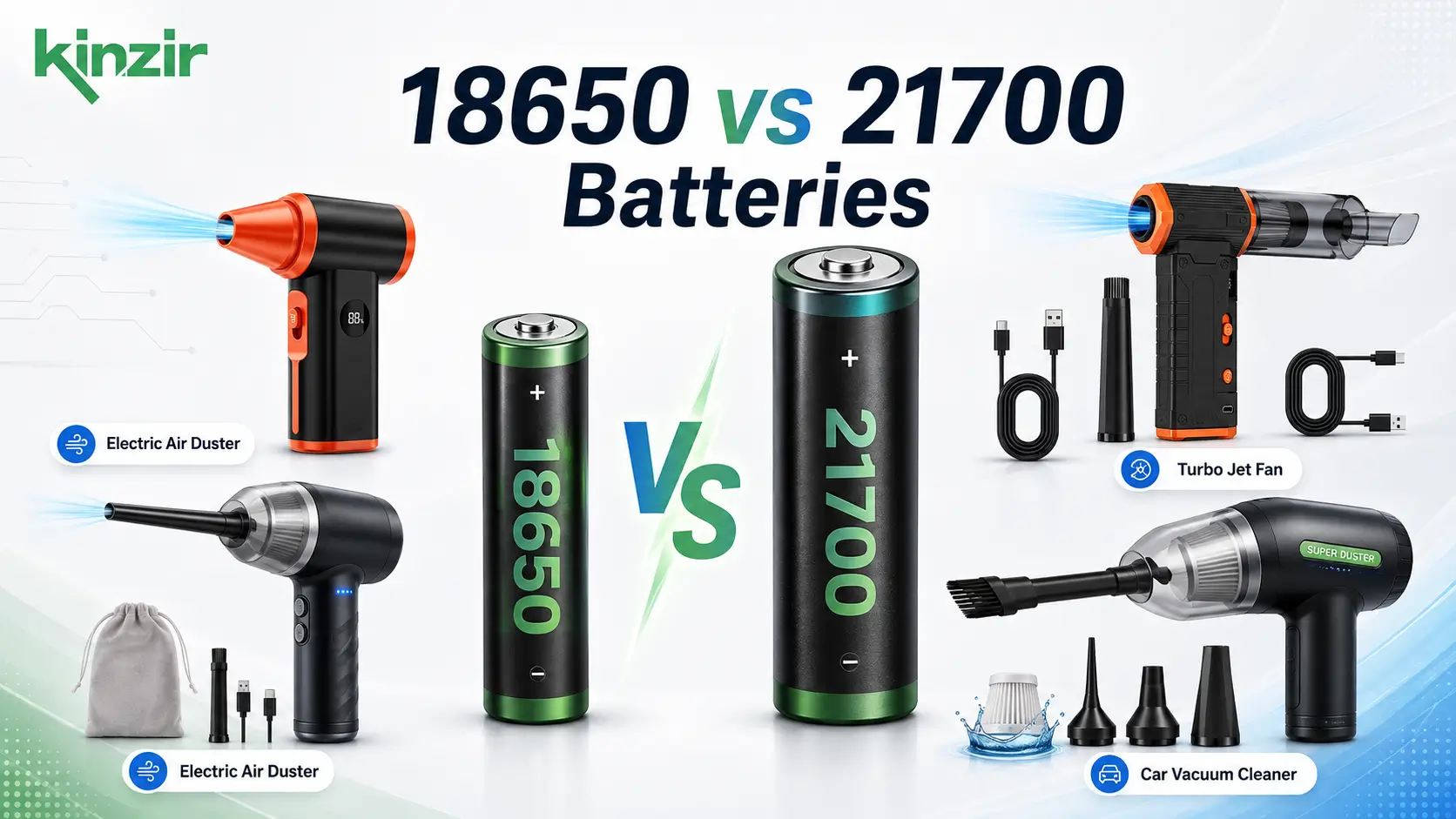
Battery cell choice can change:
- Pack dimensions
- Capacity
- Weight
- Current capability
- Cell sourcing
- Battery housing
- BMS
- Product runtime
- Transport documentation
A standard battery used across an existing production platform is easier to quote than a completely new battery specification.
Kinzir currently uses 21700 cells in products such as the AD80. Its published specification lists two 4,000mAh 21700 cells in the removable battery system.
Buyers comparing cell formats can read 18650 vs 21700 batteries for cordless cleaning products.
For an MOQ request, specify:
- Desired runtime
- Target battery capacity
- Cell preference, if required
- Removable or built-in battery
The engineering team can then assess whether the standard battery is suitable.
6. Battery Pack Configuration
Battery customization can go much deeper than choosing 18650 or 21700 cells.
A battery pack can change through:
- Series count
- Parallel count
- Cell quantity
- Nominal voltage
- Ah capacity
- Wh
- Discharge capability
- BMS
- Connector
- Battery enclosure
A custom 5S2P battery pack, for example, contains ten cells arranged in five series groups with two cells in parallel per group.
That is a very different purchasing and manufacturing project from a simple two-cell pack.
For the technical details, see What Is a 5S2P Battery Pack?.
From an MOQ perspective, the point is simple:
A new battery pack can bring a new cell MOQ, BMS MOQ, housing requirement and testing/documentation review.
7. Built-In vs Removable Battery
A removable battery is a complete product subsystem.
It may include:
- Battery shell
- Cell holder
- BMS
- Electrical contacts
- Lock
- Release button
- Battery rail
- Charging connection
- Product label
- Spare battery packaging
Developing all of those components from zero can raise the project commitment.
Using an existing removable battery platform can reduce that development work.
The Kinzir AD80 removable battery turbo jet fan currently lists a 500-unit OEM MOQ and uses a user-removable 21700 battery pack.
For European projects, an existing detachable battery architecture can be especially useful when the brand is planning around the battery removability requirements applying from 18 February 2027.
8. Custom PCB and Control Logic
A custom PCB can raise MOQ faster than a logo or packaging change.
Possible requests include:
- Different number of speed levels
- Stepless control
- Battery percentage display
- LED indicator
- Memory function
- Different button logic
- Motor control settings
- Temperature protection
- Battery cutoff behavior
A new PCB can involve:
- Circuit design
- PCB fabrication
- Electronic component purchasing
- Firmware work
- Prototype testing
- EMC review
This should be classified as technical OEM development rather than simple private labeling.
A first-order buyer trying to keep MOQ near 500 units can ask whether the standard PCB already supports the required user experience.
9. Custom Nozzles and Accessories
Nozzles are much easier to customize when the required attachment already exists.
Existing accessories can include:
- Narrow nozzle
- Wide nozzle
- Brush
- Inflation adapter
- Storage bag
- Charging cable
A new molded nozzle needs:
- CAD
- Prototype
- Tooling
- Injection molding
- Packaging space
The nozzle can also adjust airflow, so engineering testing may be required rather than treating it as a decorative accessory.
Kinzir’s current mini turbo jet fan range supports different products for car drying, electronics cleaning, camping, and outdoor use.
10. Retail Packaging
Packaging MOQ is one of the most overlooked parts of a private-label project.
Possible packaging includes:
- Plain kraft box
- Full-color retail box
- Printed sleeve
- Molded tray
- Pulp insert
- EVA case
- User manual
- Product label
- Barcode
- FNSKU
- Master carton
The packaging printer can have a different minimum from the fan factory.
For a low MOQ market test, buyers can ask about:
- Standard box with custom label
- Standard insert
- One-color carton marking
- Shared multilingual package
A full-color retail box is valuable for ecommerce and retail sales, but it should be quoted separately.
11. Language Versions and SKU Consolidation
European distributors can create unnecessary pressure on MOQs by producing a different box for each country.
For example:
- German box
- French box
- Italian box
- Spanish box
- Dutch box
A more manageable first run may use:
One common retail box + multilingual user manual + country-specific label where required
This reduces packaging SKUs.
The exact legal and retailer requirements still need to be checked for the destination markets, but from a manufacturing standpoint, SKU consolidation can help keep the project manageable.
12. Destination Market and Compliance Requirements
A US Amazon order and an EU distributor order may use the same fan body, yet require different:
- Labels
- manuals
- battery information
- packaging
- documentation
Kinzir’s OEM information lists support associated with CE, RoHS, FCC, PSE and UKCA requirements across its product range.
Lithium battery shipping needs separate attention.
For air, sea or courier transport, buyers can read Kinzir’s UN38.3 vs MSDS vs IEC 62133 lithium battery shipping guide.
Final documents should match the battery and product configuration actually ordered.
13. Product Exclusivity
An OEM logo does not automatically make the underlying product exclusive.
There are several levels of exclusivity:
- Exclusive logo
- Exclusive housing color
- Exclusive accessory combination
- Exclusive mold
- Exclusive product design
- Territory exclusivity
A buyer paying for a completely new mold may want to discuss whether the mold can be used for another customer.
A distributor investing heavily in a new design may ask for territory protection.
Those terms affect commercial commitment and should be recorded in the contract.
Do not assume that paying a tooling fee automatically creates market exclusivity.
14. Mold Ownership
For a new ODM housing or accessory, clarify mold ownership before paying the tooling invoice.
Questions include:
- Who legally owns the mold?
- Where will it be stored?
- Can the factory use it for other buyers?
- Who pays for maintenance?
- What is its expected production life?
- Can it be transferred?
- What happens when the project ends?
These issues are far less relevant to a standard 500-unit private-label order, but they become important once the buyer moves into custom tooling.
How MOQ Affects Turbo Jet Fan Unit Cost
MOQ and unit price are connected, but the relationship is not linear.
Ordering twice as many units does not mean the unit price automatically falls by half.
A turbojet fan quotation combines fixed project costs with variable production costs.
Fixed Project Costs
Examples include:
- Engineering
- Tooling
- Sample development
- Artwork setup
- Color matching
- Packaging setup
Variable Costs
Examples include:
- BLDC motor
- Battery
- PCB
- Housing
- Accessories
- Assembly
- Packaging
A 500-unit order spreads fixed setup costs across 500 products.
A 5,000-unit order spreads the same fixed items across a much larger volume and may allow better component purchasing too.
This creates quantity price breaks.
| Purchasing Stage | Typical Commercial Effect |
|---|---|
| Sample | High cost per unit |
| Pilot order | Market-test quantity |
| Standard OEM run | Better production efficiency |
| Larger repeat order | Better component planning |
| Annual program | Forecast-based procurement |
For an accurate turbo jet fan factory price, request quotations for several quantities rather than a single price.
For example:
- 500 units
- 1,000 units
- 3,000 units
- 5,000 units
The result gives the buyer a more useful view of volume pricing.
MOQ vs Tooling Cost, NRE and Engineering Fees
MOQ is not the only way a factory recovers the cost of custom development.
A quotation may contain:
- Mold fee
- Tooling fee
- NRE
- Engineering fee
- Prototype fee
- Sample fee
NRE means Non-Recurring Engineering.
It covers development work that is performed once rather than on every production unit.
A project can sometimes be structured with:
Lower initial production quantity + separate tooling/NRE
instead of forcing all engineering cost into the product unit price.
The actual arrangement depends on the project.
For professional buyers, separate these items in the RFQ:
Unit cost
Tooling cost
NRE
Sample cost
Packaging cost
This makes supplier quotations much easier to compare.
Pilot Order vs Full Production Order
A first order does not need to contain every customization idea planned for the brand’s long-term product line.
A practical development sequence can be:
Sample Stage
A few units are evaluated for:
- Motor output
- Airflow
- battery
- noise
- ergonomics
- nozzle performance
Pilot Order
Use an existing platform with limited branding changes.
The goal is market validation rather than maximum customization.
Full OEM Order
After the buyer has sales data, the next order can add:
- Exclusive color
- custom packaging
- additional accessories
- battery options
Repeat Production
The specification becomes stable and easier to forecast.
This staged approach reduces risk for a new ecommerce or retail product.
Can Kinzir Accept Below 500 Units?
For many existing Kinzir turbo jet fan models, the published OEM MOQ is 500 units.
Kinzir’s OEM page states that more flexible minimum quantities can be available and points to its in-house laser engraving capability as one way to support smaller branded runs.
A below-standard-MOQ project is more realistic when it uses:
- Existing product
- Standard housing
- Standard color
- Standard motor
- Standard battery
- Existing accessories
- Laser-engraved logo
- Standard packaging
A request for 100 units with a completely new housing, new mold, custom PCB and new battery pack is a different type of project.
For low MOQ sourcing, keep the first version close to the existing production platform.
How to Reduce Your First OEM Turbo Jet Fan MOQ
A buyer preparing a new product launch can take several steps to keep the first order manageable.
1. Choose an Existing Kinzir Platform
Start with a fan already in production rather than developing a new structure.
2. Use the Standard Housing Color
Black or another existing production color avoids a separate custom resin run.
3. Use Laser Engraving
A laser logo can be simpler than changing molds or creating a molded brand mark.
4. Keep the Existing BLDC Motor
Test the standard motor before requesting a new RPM or wattage.
5. Keep the Approved Battery
Battery changes can affect sourcing, BMS, runtime, shipping documents and EU technical records.
6. Use Existing Nozzles
A standard nozzle kit avoids new tooling.
7. Start With One SKU
One model, one color and one battery configuration simplify manufacturing and inventory.
8. Use a Multilingual Manual
This can reduce the need for several packaging versions.
9. Avoid New Tooling During Market Validation
Use the sales data from the first batch before investing in an exclusive mold.
10. Add Deeper Customization to the Repeat Order
A second production run can use customer feedback from the first batch.
This is often a better way to manage an OEM turbo jet fan launch than trying to customize every component at once.
Can Several Turbo Jet Fan Models Be Combined to Reach 500 Units?
Not automatically.
Suppose a distributor wants:
- 250 AD71
- 250 AD80
The total is 500 units, but the products use different:
- Housings
- motors
- batteries
- accessories
- packaging
- assembly requirements
The factory needs to quote the mixed-model order based on those individual production runs.
The same applies to a distributor mixing three or four turbojet fan models in a single container.
Shipping quantity can be mixed more easily than production MOQ.
Ask Kinzir for:
- MOQ per model
- mixed-order possibility
- carton quantity
- container loading plan
Can Several Colors Be Mixed Within the MOQ?
Possibly, but ask for the MCQ per color.
A buyer requesting 500 units in one standard color has a different production requirement from five custom colors at 100 units each.
The factory needs enough quantity in each color to justify:
- Material preparation
- Molding setup
- Color inspection
For a new brand, one or two colors are easier to manage than a large color range.
Can Several Packaging Languages Be Mixed?
The same principle applies to packaging.
Product MOQ and packaging-printing MOQ can differ.
Ask separately for:
- Fan MOQ
- Color box MOQ
- Manual MOQ
- Label MOQ
If the packaging printer requires more boxes than the current fan order, the buyer may choose to:
- Keep unused packaging inventory
- Use a standard box
- Use labels
- Combine languages
- Increase the order
This decision should be made before packaging artwork is approved.
Can One Production Batch Be Split Into Several Shipments?
Production quantity and shipment quantity are separate questions.
A buyer could order 1,000 units but request:
- 500 units shipped immediately
- 500 units held for a later shipment
The commercial agreement needs to cover:
- Payment
- Warehouse storage
- Battery storage conditions
- Storage time
- Final shipment deadline
- Additional handling
- Export documents for each shipment
Do not assume the factory will store finished goods indefinitely.
For large annual programs, scheduled production and scheduled shipment can be discussed during quotation.
MOQ for Spare Batteries and Replacement Parts
A removable-battery fan introduces another set of SKUs.
The product MOQ does not automatically determine the MOQ for:
- Replacement battery
- Spare nozzle
- Charging cable
- Battery shell
- Retail battery package
This matters for European product planning.
The EU Battery Regulation places greater attention on battery replacement and spare battery availability for applicable products from 2027. An OEM buyer should ask for a spare battery model number, price and ordering route during product development.
Kinzir’s OEM detachable battery turbo jet fan program includes spare battery planning and removable battery models for EU-focused programs.
Does the EU Battery Regulation 2027 Affect Turbo Jet Fan MOQ?
The EU Battery Regulation does not set an MOQ for turbo jet fans.
It can influence the product architecture the importer selects.
Regulation (EU) 2023/1542 introduces removability and replaceability requirements for applicable portable batteries incorporated into products from 18 February 2027.
A buyer planning an EU launch can choose between:
- Redesigning a built-in battery product
- Using an existing removable-battery platform
The second route can reduce engineering work if the existing platform already matches the buyer’s product requirements.
Kinzir’s EU Battery Regulation 2027 guide covers the wider regulatory requirements.
Brands converting an older integrated-battery fan can read the turbo jet fan removable battery upgrade guide.
The MOQ impact comes from the engineering work, molds and components needed for the selected architecture, not from an MOQ written into the Regulation.
MOQ and International Lithium Battery Shipping
Battery selection can affect freight cost and shipping options.
For example, increasing capacity can change:
- Battery Wh
- Air-shipping classification
- Packaging requirements
- Freight route
A normal order may ship each turbo jet fan with its battery installed.
The buyer may order spare battery packs later.
Those battery-only shipments can use a different transport classification.
Before approving a custom battery, review Kinzir’s UN38.3 vs MSDS vs IEC 62133 lithium battery shipping guide.
This is especially relevant when a private-label buyer moves from a standard battery to a custom high-capacity pack.
Sample Approval Before a 500-Unit OEM Order
A buyer should not place the production order from specifications alone.
Use a structured sample process.
Standard Product Sample
Evaluate:
- Air output
- Motor sound
- Speed control
- Battery runtime
- Charging
- Handle comfort
- Nozzles
Customized Sample
Check:
- Logo
- Color
- Product label
- Controls
- Accessories
Packaging Sample
Review:
- Box
- Tray
- Manual
- Barcode
- FNSKU
- Product positioning
Golden Sample
The final approved sample becomes the reference for production.
Record:
- Product appearance
- Motor specification
- Battery
- accessories
- labels
- packaging
The golden sample should match the signed production specification.
Does the Sample Quantity Count Toward MOQ?
Sample quantity and mass-production MOQ are separate commercial terms.
A sample order may contain:
- 1 product
- Several colors
- Different batteries
- Different accessories
The cost can include:
- Product
- Logo setup
- Color sample
- Prototype work
- Packaging proof
- Express shipping
Ask whether any sample or tooling fees can be credited to a later production order.
Do not assume that a five-unit sample order reduces a 500-unit production MOQ to 495 units.
Quality Requirements Should Not Change With MOQ
A lower order quantity should not mean a different approved product standard.
Quality requirements should be recorded before production.
For a turbo jet fan, buyers may define:
- Housing appearance
- Motor specification
- Airflow
- Battery capacity
- Runtime
- charging
- Button function
- Nozzle retention
- Product label
- Packaging
Kinzir’s current factory information describes five production lines and a ten-person QC team. Its testing equipment includes insertion and extraction life testing, key life testing and transportation vibration testing.
For removable-battery products, the battery release mechanism and electrical contacts should be included in sample and production inspection.
MOQ and Production Lead Time
MOQ is only one factor affecting lead time.
A 500-unit standard product can require far less preparation than a 500-unit fully customized product.
A normal OEM sequence can include:
- Product selection
- RFQ
- Specification confirmation
- Sample preparation
- Sample testing
- Logo approval
- Packaging approval
- Component purchasing
- Production
- QC inspection
- Packing
- Shipment preparation
A new mold, PCB or battery adds development steps before mass production starts.
When asking for the production lead time, tell the factory whether the design is:
- Standard wholesale
- Private label
- Semi-custom OEM
- Full ODM
That gives a more useful schedule than simply asking, “How long for 500 pieces?”
First Order vs Repeat Order MOQ
Repeat orders can become easier to manage once the product has a stable manufacturing record.
On a repeat run:
- Logo artwork already exists
- Color is approved
- Packaging files exist
- Golden sample exists
- Battery is approved
- Component suppliers know the specification
That can reduce development work and shorten preparation.
It does not guarantee that MOQ falls.
A battery supplier, PCB factory or packaging printer may still have its own purchasing minimum.
Ask for the repeat-order MOQ when negotiating the first order.
Annual Forecast and MOQ
An annual purchasing forecast can help a factory plan components.
For example:
First order: 500 units
Quarterly forecast: 2,000 units
Estimated annual volume: 8,000 units
This gives the manufacturer more information than a single 500-unit RFQ.
A forecast can support discussions around:
- Motor procurement
- Battery planning
- Packaging inventory
- Production scheduling
- Volume pricing
A forecast is not automatically a firm purchase order. The sales contract should define any commitment.
For brands expecting regular orders, sharing a realistic forecast can make the OEM quotation more useful.
Payment Terms and MOQ
MOQ can interact with project payment structure.
A quotation may separate:
- Sample payment
- Mold payment
- NRE
- Production deposit
- Balance payment
Several current Kinzir turbo jet fan pages list T/T and Letter of Credit among available payment methods for bulk orders.
Actual payment terms depend on:
- Order value
- Project type
- tooling
- customer relationship
- sales agreement
The quotation should state payment terms together with MOQ and lead time.
MOQ for Amazon, Ecommerce, Retail and Distributor Projects
Different sales channels create different custom requirements.
Amazon and Ecommerce Brands
Common requests include:
- Private label logo
- FNSKU
- UPC/EAN barcode
- Retail box
- Master carton label
- Amazon warehouse shipping
Kinzir’s OEM page states that direct FBA shipment and Amazon warehouse delivery support are available.
The biggest MOQ pressure often comes from custom packaging and multiple SKUs rather than the fan itself.
Retail Brands
Retail programs may need:
- Shelf-ready packaging
- Local-language text
- Retail barcode
- Compliance information
- Different carton configuration
Automotive Accessory Brands
A car-care brand may request:
- Brand color
- Car drying nozzle
- EVA case
- Spare battery
- Private label package
Distributors
A distributor may prefer:
- Standard products
- Mixed models
- Multilingual manuals
- Replacement batteries
- Larger annual volume
The best MOQ structure depends on the sales model.
Four OEM Turbo Jet Fan MOQ Scenarios
These examples show why one “500-unit MOQ” can represent very different projects.
Scenario 1: Simple Private Label AD71
Buyer requirement:
- Kinzir AD71
- Standard housing
- Standard 4,000mAh battery
- Existing motor
- Laser-engraved customer logo
- Standard accessories
- Custom product label
The current Kinzir AD71 turbo jet fan lists a 500-unit OEM MOQ.
This project stays close to the existing production platform and is the type most likely to fit a normal OEM MOQ.
Scenario 2: EU Removable-Battery AD80
Buyer requirement:
- AD80 platform
- Standard removable 21700 battery
- Custom logo
- Multilingual manual
- EU-oriented product labels
- Custom retail box
- Spare battery option
The current AD80 removable battery turbo jet fan lists a 500-unit OEM MOQ.
The existing removable-battery architecture avoids having to create a new battery-release system from scratch.
Scenario 3: Custom Color Ecommerce Fan
Buyer requirement:
- Existing turbo jet fan platform
- Custom Pantone green
- Private label logo
- Existing motor
- Existing battery
- FNSKU
- New retail box
The main drivers of MOQ are no longer the motor or the battery.
They are:
- Custom plastic color
- Packaging
- SKU quantity
This project needs a separate color and packaging quotation.
Scenario 4: Full ODM Turbo Jet Fan
Buyer requirement:
- New housing
- New impeller
- New air channel
- Custom PCB
- New 21700 battery system
- New removable battery base
- Exclusive nozzle
- New molds
- Exclusive appearance
This is not a standard private-label project.
MOQ, NRE, tooling cost, sample stages and lead time become project-specific.
The buyer should compare the full development budget rather than focusing only on a 500-unit target.
What Information Should You Send for an Accurate OEM MOQ?
A detailed RFQ can save several rounds of emails.
Send Kinzir:
- Preferred turbo jet fan model
- Initial order quantity
- Estimated annual volume
- Destination country
- Sales channel
- Target motor RPM
- Desired airflow or application
- Battery capacity
- 18650 or 21700 preference, if any
- Built-in or removable battery
- Housing color
- Logo method
- Number of colors
- Number of SKUs
- Required nozzles
- Accessories
- Retail packaging
- Manual languages
- Barcode or FNSKU requirements
- Spare battery quantity
- Certification/document requirements
- Shipping method
- Target delivery date
- Exclusivity requirements
The quotation can then be separated into:
MOQ
Unit price
Sample cost
Tooling/NRE
Packaging cost
Lead time
This is a much better basis for supplier comparison than asking:
“What is your best price for 500 turbo jet fans?”
Why Work With Kinzir for OEM Turbo Jet Fans?
Kinzir is the brand of Mfine Technology (Huizhou) Co., Ltd., an ISO 9001:2015-certified electronics manufacturer that produces cordless air dusters, car vacuums, and mini turbo jet fans.
Its current OEM manufacturing capabilities include:
- Five production lines
- Dedicated QC team
- In-house laser engraving
- Custom housing
- Color matching
- Logo customization
- Private-label packaging
- Battery configuration
- Nozzle selection
- Product documentation
- OEM and ODM support
- Amazon/FBA shipment support
Kinzir’s existing turbo jet fan range covers compact 130,000 RPM and 150,000 RPM products, removable-battery models and larger battery configurations. Buyers can start with an existing platform and move into deeper customization after the product specification and expected volume are clear.
Browse the Kinzir mini turbo jet fan product range or review the OEM detachable battery turbo jet fan program before requesting a quotation.
OEM Turbo Jet Fan MOQ FAQs
What is Kinzir’s standard OEM turbo jet fan MOQ?
Many current Kinzir turbo jet fan product pages list an OEM MOQ of 500 units, including AD46, AD47, AD51, AD71 and AD80. The final MOQ depends on model and customization.
Why do many Kinzir turbo jet fans have a 500-unit MOQ?
A 500-unit production run gives the factory enough volume to plan components, assembly, branding, testing and packaging for many existing platforms. Custom components may have different minimum purchase quantities, so deeper customization is quoted separately.
Can I order fewer than 500 turbo jet fans?
Some smaller private-label runs may be possible when the project uses an existing product and simple branding. Kinzir’s OEM page states that flexible minimum quantities are available and that in-house laser engraving supports smaller branded runs.
Can I order 100 turbo jet fans with my logo?
Ask for a model-specific quotation. A 100-unit order using a standard product and laser engraving may be more practical than 100 units requiring custom color, PCB, battery and packaging.
What is the MOQ for laser engraving?
There is no single public MOQ covering every model. Kinzir performs laser engraving in-house, which gives more flexibility for compatible private-label products. Ask for the minimum based on the selected model and quantity.
What is the MOQ for custom packaging?
Packaging MOQ depends on the package type, artwork, printing method and box supplier. It can differ from the turbo jet fan MOQ.
What is the MOQ for a custom Pantone color?
Custom color needs a project quotation. Ask for both total product MOQ and MCQ, Minimum Color Quantity.
What is MCQ?
MCQ means Minimum Color Quantity, the minimum practical production quantity for one housing color. An order can meet the total MOQ and still fail to meet the MCQ for several small color splits.
Does each SKU have its own MOQ?
It can. Different batteries, colors, accessory kits or packages can create separate SKUs and separate production requirements.
Can I mix several colors in 500 units?
Possibly, but the factory needs to check the minimum quantity per color. Five 100-unit custom colors are harder to manufacture than one 500-unit standard color.
Can I mix AD46, AD71 and AD80 in one 500-unit MOQ?
Do not assume so. These models use different components and production setups. Ask Kinzir for the MOQ of each model and whether a mixed-model commercial order can be arranged.
Can I use several box languages in one order?
Yes, subject to packaging MOQ and artwork setup. A multilingual manual and one common box may reduce packaging SKUs for a first EU order.
What is the MOQ for a custom 21700 battery?
It depends on cell model, battery capacity, BMS, housing and pack architecture. A standard 21700 battery already used in an existing product is easier to source than a new custom pack.
What is the MOQ for a removable-battery turbo jet fan?
Existing removable-battery models can use their current OEM structure. The AD80 currently lists an OEM MOQ of 500 units. A newly developed removable battery system requires a separate quotation.
What is the MOQ for spare batteries?
Spare battery MOQ should be quoted separately from the turbo jet fan MOQ. The battery pack is its own SKU with cells, BMS, shell, labels and packaging.
Does changing from 18650 to 21700 cells affect MOQ?
It can. The new cells can change battery dimensions, pack design, BMS, sourcing and shipping documentation. See Kinzir’s 18650 vs 21700 battery comparison for the technical differences.
Does a custom PCB increase MOQ?
It can. PCB fabrication, electronic components and firmware work introduce their own setup and purchasing requirements.
Why does a new mold increase MOQ?
A new mold requires design, tooling, trials and engineering validation. That development investment makes the project different from a standard private-label production run.
Who owns a custom mold?
Mold ownership should be defined in the tooling agreement. Discuss ownership, storage, maintenance, exclusivity and transfer rights before paying the mold fee.
Can I request an exclusive turbo jet fan design?
Yes, exclusivity can be discussed for an ODM project. Define whether the request covers the mold, appearance, accessory, territory or complete product design.
Does a sample order count toward the MOQ?
Usually, sample quantity and mass-production MOQ are treated separately. Confirm the commercial terms in the quotation.
Can sample fees be credited after a bulk order?
This depends on the project and quotation. Ask whether sample or development fees can be credited once the agreed bulk order is placed.
Does a higher MOQ reduce the unit price?
Larger volume can improve component purchasing and spread fixed setup costs across more units. The price reduction depends on the product and quantity, rather than on a single fixed percentage.
Can one production order be split into several shipments?
It can be discussed. The storage period, payment, warehouse costs, battery storage, and separate shipping documentation need to be agreed upon before production.
Is the MOQ lower on repeat orders?
It may become easier to manage once artwork, samples and packaging are approved, but component suppliers can still impose minimums. Ask for the repeat-order MOQ during the first negotiation.
Does my annual forecast affect the quotation?
It can help Kinzir plan components and production. Provide both the initial PO quantity and a realistic annual forecast when requesting volume pricing.
Does the EU Battery Regulation 2027 change turbo jet fan MOQ?
No. Regulation (EU) 2023/1542 does not specify a minimum order quantity. It can influence product architecture, particularly removable battery design, which can change tooling and development requirements.
What battery shipping documents are needed?
The required file depends on the battery and shipment configuration. UN38.3 transport documentation, SDS/MSDS and other battery information can be relevant. Read Kinzir’s UN38.3 vs MSDS vs IEC 62133 guide for international shipping details.
How long does a 500-unit OEM turbo jet fan order take?
Lead time depends on customization. A standard existing platform with logo work is faster to prepare than a project requiring a new mold, PCB, battery, and retail package. Ask for sample lead time and mass-production lead time separately.
What information does Kinzir need to quote the MOQ?
Send the model, quantity, annual forecast, destination country, battery, motor, color, logo, accessories, packaging, number of SKUs, documentation needs, and target delivery date. The sales and engineering teams can then quote the actual MOQ, unit price, tooling cost, and lead time.
Planning Your First OEM Turbo Jet Fan Order
A 500-unit OEM Turbo Jet Fan MOQ is a useful starting point for many existing Kinzir platforms, but the quantity should never be treated in isolation from the product specification.
The easiest first production run usually looks like this:
Existing model + standard housing + approved motor + approved battery + simple logo + existing accessories + one package
The project becomes more demanding as the buyer adds:
New color + custom battery + custom PCB + new nozzle + exclusive mold + multiple SKUs
For a first market test, start with the parts that affect the brand most and leave deeper engineering changes for a later production run.
If your product already has sales history and needs a distinct position in the market, custom battery architecture, industrial design, exclusive accessories, and ODM development can make sense.
In both cases, ask for more than one number.
A useful Kinzir OEM quotation should tell you:
MOQ + unit price + sample cost + tooling/NRE + packaging cost + production lead time
That gives an importer enough information to compare the actual cost of launching an OEM turbo jet fan, rather than choosing a supplier based solely on MOQ.


