
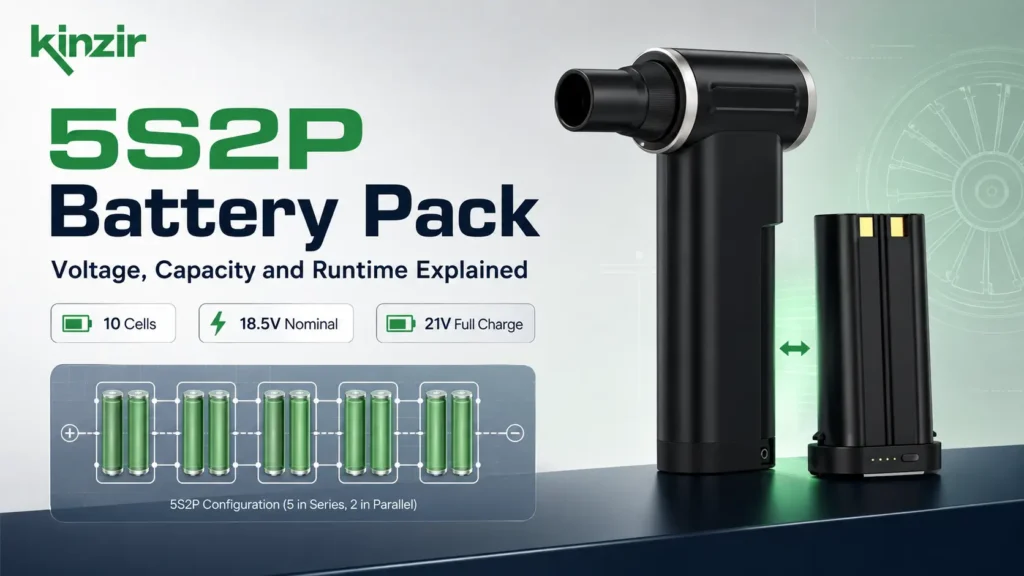
A 5S2P battery pack contains 10 battery cells arranged in five series groups, with two cells connected in parallel inside each group. The five series groups determine the battery-pack voltage, and the two parallel cells determine its Ah capacity. This arrangement is commonly considered for cordless products that need a higher operating voltage, substantial stored energy and enough current for a fast BLDC motor.
For a turbo jet fan buyer, the term 5S2P is useful, but it is only the starting point. It does not tell you the actual battery capacity, Wh rating, cell format, discharge current, BMS limit, charging time or real runtime.
A useful battery specification should answer several questions together:
How many cells are used? What is the nominal voltage? What is the pack capacity? How many Wh does it store? What current can it supply? How long does the finished turbo jet fan run?
This guide explains each of those points and shows how a 5S2P battery configuration can be used in high-speed mini turbo jet fans such as the Kinzir AD47.
What Is a 5S2P Battery Pack?
The easiest way to read 5S2P is to separate the two parts.
5S means five battery groups are connected in series.
2P means two cells are connected in parallel inside each of those groups.
The complete battery contains:
5 series groups × 2 cells per group = 10 cells
Texas Instruments describes the same basic battery-pack principle: adding cells in series raises pack voltage, and adding cells in parallel raises capacity in amp-hours.
A simplified 5S2P structure looks like this:
[Cell ∥ Cell] + [Cell ∥ Cell] + [Cell ∥ Cell] + [Cell ∥ Cell] + [Cell ∥ Cell]
Each pair is one parallel group. The five groups are then connected in series.
What Does S Mean in 5S2P?
S means series.
Series connections add cell voltage.
If one lithium-ion cell has a nominal voltage of 3.7V, five groups in series produce:
3.7V × 5 = 18.5V nominal
If the selected cell uses a 3.6V nominal rating:
3.6V × 5 = 18.0V nominal
The parallel count does not double this voltage.
What Does P Mean in 5S2P?
P means parallel.
Parallel cells increase Ah capacity.
If each cell is rated at 2,500mAh:
2,500mAh × 2 = 5,000mAh
The five series groups do not multiply the battery’s Ah rating.
How Many Cells Are in a 5S2P Pack?
A 5S2P pack contains exactly 10 cells.
| Configuration | Series Groups | Cells per Parallel Group | Total Cells |
|---|---|---|---|
| 5S1P | 5 | 1 | 5 |
| 5S2P | 5 | 2 | 10 |
| 5S3P | 5 | 3 | 15 |
| 5S4P | 5 | 4 | 20 |
The configuration name tells you the electrical arrangement, not the individual cell specification.

5S2P battery pack configuration with 10 lithium-ion cells in five series groups and two parallel cells per group.
What Is the Voltage of a 5S2P Battery Pack?
Voltage comes from the 5S part of the battery configuration.
For common lithium-ion cells:
| Individual Cell Nominal Voltage | Series Count | Pack Nominal Voltage |
| 3.6V | 5S | 18.0V |
| 3.7V | 5S | 18.5V |
Many lithium-ion cells that have a nominal voltage around 3.6V to 3.7V are charged to approximately 4.2V per cell. Texas Instruments uses 3.7V nominal and 4.2V charged voltage in its lithium-ion pack examples.
For a five-series pack:
4.2V × 5 = 21V at full charge
This explains why product listings may describe a similar five-series architecture as:
- 18V
- 18.5V
- 21V Max
Those numbers can refer to different voltage states rather than three completely different battery systems.
Is a 5S2P Battery 18V, 18.5V or 21V?
The exact answer depends on the cells and the way the manufacturer states voltage.
An 18.5V battery can refer to a five-series pack made from cells rated at 3.7V nominal.
A 21V figure can refer to the same five-series pack when every series group reaches approximately 4.2V at full charge.
An OEM specification should list both:
Nominal pack voltage: 18.5V
Maximum charging voltage: 21V
This is more useful than advertising only the largest voltage figure.
How Is 5S2P Battery Capacity Calculated?
The capacity of a 5S2P battery is based on the two parallel cells, not all 10 cells.
The calculation is:
Pack capacity = individual cell capacity × 2
Examples:
| Individual Cell Capacity | Battery Configuration | Cell Count | Pack Capacity |
| 2,000mAh | 5S2P | 10 | 4,000mAh |
| 2,500mAh | 5S2P | 10 | 5,000mAh |
| 3,000mAh | 5S2P | 10 | 6,000mAh |
| 4,000mAh | 5S2P | 10 | 8,000mAh |
| 5,000mAh | 5S2P | 10 | 10,000mAh |
This is one reason 5S2P does not mean one fixed battery capacity.
A 5S2P battery can be 4,000mAh, 5,000mAh, 6,000mAh, 8,000mAh or 10,000mAh depending on the cells inside it.
Why You Should Not Add the mAh of All 10 Cells
This is a common source of incorrect battery specifications.
Suppose a 5S2P battery contains:
10 × 2,000mAh cells
Adding the capacity of all 10 cells gives 20,000mAh.
That is not the normal pack capacity of the 5S2P battery.
The correct calculation is based on the two parallel cells:
2,000mAh × 2 = 4,000mAh
The five series groups increase voltage instead.
Texas Instruments describes xSyP battery nomenclature in this same way, with the series count raising voltage and the parallel count raising Ah capacity.
For B2B product specifications, a large mAh figure by itself is not enough. Ask for:
Battery configuration + nominal voltage + Ah + Wh
That gives you enough information to make a meaningful energy comparison.
How Many Watt-Hours Does a 5S2P Battery Have?
Watt-hours, or Wh, describe the nominal energy stored in the battery.
The calculation is:
Wh = nominal voltage × capacity in Ah
IATA uses the same Wh formula in its 2026 battery guidance:
Wh = V × Ah.
Take a 5S2P pack made from 3.7V nominal cells.
Its nominal voltage is:
3.7V × 5 = 18.5V
If each cell is 2,500mAh, the pack capacity is:
2,500mAh × 2 = 5,000mAh = 5Ah
The nominal battery energy is:
18.5V × 5Ah = 92.5Wh
Several examples make the relationship clearer:
| Cell Capacity | Pack Capacity | Nominal Voltage | Nominal Energy |
| 2,000mAh | 4Ah | 18.5V | 74Wh |
| 2,500mAh | 5Ah | 18.5V | 92.5Wh |
| 3,000mAh | 6Ah | 18.5V | 111Wh |
| 4,000mAh | 8Ah | 18.5V | 148Wh |
| 5,000mAh | 10Ah | 18.5V | 185Wh |
Wh is particularly useful when comparing batteries with different voltages.
Two batteries can both say 5,000mAh and still contain very different amounts of energy if their operating voltages differ.
Kinzir covers this issue from another angle in the guide to 18650 vs 21700 batteries, where battery format, voltage, Ah and Wh are separated rather than treated as one specification.
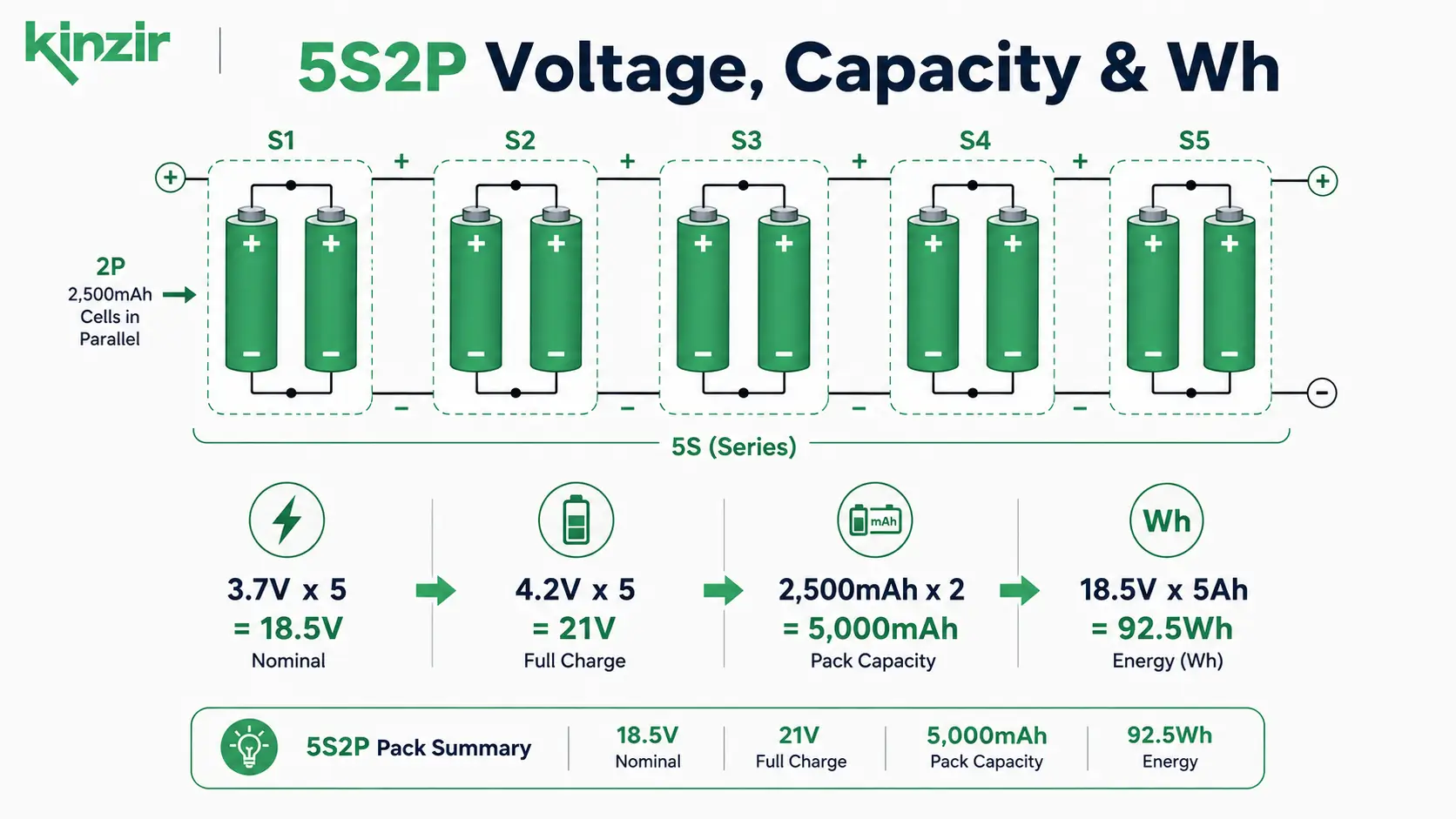
5S2P battery pack voltage capacity and Wh calculation using 3.7V 2500mAh lithium-ion cells.
5S1P vs 5S2P Battery Pack
A 5S1P battery contains five cells.
A 5S2P battery contains 10 cells.
If both packs use the same cell model, their nominal voltage remains the same since both use five groups in series.
Their capacity is different.
| Feature | 5S1P | 5S2P |
| Total cells | 5 | 10 |
| Series groups | 5 | 5 |
| Parallel cells per group | 1 | 2 |
| Nominal voltage | Same | Same |
| Ah capacity | 1 × cell capacity | 2 × cell capacity |
| Nominal Wh | Lower | About twice as much with identical cells |
| Battery size | Smaller | Larger |
| Battery weight | Lower | Higher |
| Current-sharing paths per group | 1 | 2 |
With the same cells, moving from 5S1P to 5S2P does not raise the nominal voltage. It increases Ah and Wh.
That can be useful when a product needs more runtime without changing the voltage platform used by its motor controller.
4S2P vs 5S2P vs 6S2P
Changing the S count changes battery voltage.
Using 3.7V nominal cells:
| Configuration | Nominal Voltage |
| 4S2P | 14.8V |
| 5S2P | 18.5V |
| 6S2P | 22.2V |
The correct choice comes from the motor and controller specification.
A 6S battery is not automatically better than 5S. A motor-control system developed for a five-series pack needs a battery that stays within its approved operating range.
Current Delivery, Parallel Cells and Voltage Sag
Capacity is only one part of a turbo jet fan battery.
A high-speed BLDC motor can demand substantial current, particularly at its highest setting.
The battery needs to supply that current without excessive voltage drop or heat.
How Do Two Parallel Cells Share Current?
In a properly developed parallel pair, both matched cells contribute to the load.
If a pair needs to supply 20A, the current can be shared across the two cells rather than passing through one cell alone.
The split is not always exactly 50/50.
Current sharing is affected by:
- Cell internal resistance
- Cell temperature
- State of charge
- Cell age
- Weld resistance
- Conductor resistance
- Manufacturing variation
This is why two cells with the same printed capacity are not automatically good partners inside one battery pack.
What Is Voltage Sag?
A battery’s terminal voltage can fall when a heavy electrical load is applied.
Texas Instruments identifies equivalent series resistance inside a cell as a factor that limits the peak current the cell can deliver.
In a turbo jet fan, excessive voltage sag can show up as:
- Lower motor RPM
- Reduced air speed
- Earlier battery cutoff
- Shorter usable runtime
- Higher cell temperature
A good-looking no-load voltage reading is not enough. Battery performance needs to be checked with the motor running at demanding settings.
Does 5S2P Double the Battery Current Rating?
Not automatically.
Two parallel cells can provide more current capability than one identical cell under suitable conditions, but the complete battery system sets the real limit.
OEM buyers should check:
- Individual cell continuous discharge rating
- Permitted peak current
- BMS current limit
- Connector rating
- Nickel strip or busbar dimensions
- Wire gauge
- PCB current path
- Temperature rise
Kinzir’s article on 3C vs 5C batteries gives another way to look at battery discharge capability in cordless product applications.
Why 5S2P Can Work Well in Turbo Jet Fans
A high-speed mini turbo jet fan packs a motor, controller, battery and concentrated air channel into a small handheld body.
Its battery has several jobs:
- Supply the motor’s required operating voltage
- Deliver current during high-output operation
- Store enough energy for useful runtime
- Remain within safe operating temperature
- Fit inside a portable product
A 5S2P architecture can be attractive here.
The five-series structure provides a higher-voltage battery platform than a three-series or four-series design using the same cell chemistry.
The two parallel cells increase Ah capacity without changing the five-series nominal voltage.
The second cell in every group gives the pack another current path, subject to the ratings of the cells, BMS, wiring and connectors.
The tradeoff is physical.
Ten cells take more space and add more mass than five.
For a handheld fan, engineers need to balance:
- Battery energy
- Product dimensions
- Grip size
- Total weight
- Motor demand
- Cooling
- Charging time
- Target selling price
That is why battery selection and mechanical design should happen together.
Does 5S2P Make a Turbo Jet Fan Spin Faster?
No.
A 5S2P label does not determine maximum motor RPM.
Motor speed depends on factors such as:
- Battery voltage under load
- BLDC motor design
- Electronic controller
- Available current
- Firmware settings
- Impeller load
- Thermal limits
Two turbo jet fans can use the same 5S2P arrangement and produce very different results.
For a fuller explanation of performance measurements, read Kinzir’s guide to turbo jet fan RPM, airflow, air speed and pressure.

Turbo jet fan cutaway showing a 5S2P 10-cell battery pack BMS detachable battery and BLDC motor.
How Does a 5S2P Battery Affect Turbo Jet Fan Runtime?
5S2P does not tell you runtime by itself.
Runtime comes from the amount of usable battery energy and the rate at which the fan consumes it.
A useful first estimate is:
Runtime in hours ≈ battery Wh ÷ average electrical consumption in watts
Take a hypothetical 92.5Wh battery.
If the fan averaged 100W during a particular operating condition:
92.5Wh ÷ 100W = 0.925 hours
That mathematical result is not a real-world runtime guarantee.
Actual operating time can be reduced by:
- Motor losses
- Controller losses
- Voltage sag
- Battery cutoff voltage
- Cell temperature
- Battery age
- High discharge rate
- Motor speed setting
- Air resistance
This is why a measured runtime table is more useful than a theoretical number.
Kinzir’s guide to mini turbo jet fan battery life, runtime and charging looks at runtime from the finished-product side rather than battery configuration alone.
Why Does Maximum Speed Shorten Runtime?
A BLDC motor running close to its highest output draws battery energy faster than it does at a lower level.
For a buyer comparing samples, ask the manufacturer to test runtime at:
- Low setting
- Medium setting
- Highest setting
- Continuous operation
- Repeated short bursts
Ask for the test conditions too.
Battery temperature, starting state of charge and ambient temperature can change the result.
Cell Matching Matters in a 5S2P Pack
A 10-cell pack needs cells that behave closely enough to work together.
Cell matching can include:
- Same cell model
- Similar capacity
- Similar internal resistance
- Similar open-circuit voltage
- Similar age
- Controlled production batches
The two cells inside one parallel group share the load.
If one cell has noticeably higher internal resistance, current sharing can become uneven.
Differences between the five series groups create another issue. The group that reaches its upper or lower voltage limit first can determine when the battery protection system stops charging or discharging.
This means a 10-cell pack is only as useful as its weakest series group under real operation.
Cell Balancing in a 5S2P Battery
A multi-series lithium-ion battery needs the five series groups to remain within the intended voltage range.
Cell balancing is one method used to reduce voltage differences between series groups.
Texas Instruments battery monitors support cell-balancing functions for multi-series battery packs.
In a 5S2P battery, each parallel pair behaves electrically as one series group for pack-voltage monitoring.
The BMS can monitor:
- Group 1 voltage
- Group 2 voltage
- Group 3 voltage
- Group 4 voltage
- Group 5 voltage
A pack that becomes badly imbalanced may lose usable capacity since one group can reach a protection threshold before the others.
Thermal Management in a High-Output 5S2P Pack
A battery under heavy load produces heat.
The motor controller and BLDC motor create heat of their own.
In a compact turbo jet fan, those components may sit close together.
Testing should cover more than room-temperature bench operation.
Useful tests include:
- Continuous highest-speed operation
- Repeated acceleration
- Low-to-high speed cycling
- Charging after heavy use
- Warm ambient conditions
- Battery pack removal after operation
- Aging samples
Temperature monitoring becomes especially useful where the battery module is detachable and contains its own protection electronics.
What Does the BMS Do in a 5S2P Battery?
A battery management or protection circuit watches the pack and can interrupt charging or discharging when operating conditions move outside preset limits.
A modern multi-series battery system may monitor:
- Cell overvoltage
- Cell undervoltage
- Overcurrent during discharge
- Overcurrent during charging
- Short circuit
- Battery temperature
- MOSFET temperature
- Series-group imbalance
Texas Instruments’ 5S to 7S battery-pack reference design includes monitoring of cell voltage, pack current and temperature together with protection functions for multi-cell lithium batteries.
Is Any 5S BMS Suitable for a 5S2P Turbo Jet Fan?
No.
Matching the number of series groups is only the first step.
A BMS for a high-speed turbo jet fan needs current and thermal ratings that fit the motor system.
An OEM engineering specification should state:
- BMS series count
- Continuous discharge limit
- Peak discharge limit
- Overcurrent threshold
- Short-circuit protection
- Temperature cutoff
- Charge current
- Balancing function where used
A low-current 5S protection board may fit the voltage and still be unsuitable for a high-load motor.
Charging a 5S2P Battery Pack
For conventional lithium-ion cells with a maximum charge voltage of 4.2V per series group:
5 × 4.2V = 21V maximum pack charging voltage
The correct charger needs to match more than that one number.
Check:
- Battery chemistry
- Maximum pack voltage
- Charge current
- Charging profile
- BMS
- Connector
- Polarity
- Thermal limits
A charger marked 21V should not be substituted simply because the printed voltage matches.
Does 5S2P Take Longer to Charge Than 5S1P?
Using identical cells, a 5S2P battery has twice the Ah capacity of a 5S1P pack.
At the same charging current, the larger-capacity pack needs more time to receive the same percentage of charge.
Increasing charging current can shorten charge time only when the cells, BMS, conductors and temperature limits support that current.
For B2B buyers, charging time should be measured with the supplied charger rather than estimated from the battery label alone.
Can a 5S2P Battery Use 18650 or 21700 Cells?
Yes.
5S2P describes cell arrangement, not cell size.
A manufacturer can build a 5S2P pack with 18650 cells, 21700 cells or another suitable cell format when the entire product is developed around those cells.
5S2P With 18650 Cells
18650 cells have a smaller cylindrical format.
A 10-cell 18650 pack may suit a product where the industrial design already accommodates the narrower cell diameter.
Available capacity and discharge capability depend on the exact cell selected.
5S2P With 21700 Cells
21700 cells are physically larger.
Higher-capacity and high-current 21700 models are available, but 10 of those cells can create a noticeably larger and heavier battery pack.
A higher-capacity 21700 cell can push pack Wh above 100Wh very quickly in a 5S2P arrangement.
For a detailed cell-format comparison, read 18650 vs 21700 batteries for car vacuums, air dusters and turbo jet fans.
Kinzir AD47 5S2P Turbo Jet Fan Example
The Kinzir AD47 Mini Turbo Jet Fan Blower provides a real product example of a detachable 5S2P battery architecture.
Kinzir’s current published AD47 specifications list:
- 150,000 RPM BLDC motor
- 10,000mAh 5S2P battery pack
- Detachable battery base
- Up to 10 minutes of continuous operation under the stated condition
- 617g product weight
- Applications including car drying, leaf clearing, light snow removal and electronics cleaning
The public product page identifies the complete pack as 10,000mAh 5S2P, but it does not publish the capacity of each individual cell. For that reason, the calculations earlier in this article are examples using hypothetical cell capacities rather than an attempt to reverse-engineer the AD47 pack.
For an OEM version, the engineering specification should record:
Cell manufacturer + cell model + cell capacity + 5S2P + nominal voltage + pack Ah + pack Wh + discharge current + BMS limits
That is much clearer for importers, engineers and compliance teams.
Kinzir’s OEM detachable battery turbo jet fan program includes the AD47 among its large-capacity removable-battery platforms.
Built-In vs Detachable 5S2P Battery Packs
The terms 5S2P and detachable battery describe two separate things.
5S2P tells you how the cells are electrically arranged inside the battery.
Detachable tells you how the complete battery module connects to the appliance.
A 5S2P battery can be:
- Permanently built into a product
- Accessible behind a battery cover
- Installed in a removable base
- Sold as a replaceable spare pack
A removable design can give users a practical route to replace an aging battery rather than discarding the complete turbo jet fan.
For brands converting older built-in products, Kinzir has a separate guide to turbo jet fan removable battery upgrades for EU 2027.
5S2P Battery Packs and the EU Battery Regulation 2027
Battery configuration does not determine EU compliance.
A 5S2P pack can be used in an EU-bound appliance, but the complete battery and product need to meet the rules that apply to them.
Article 11 of Regulation (EU) 2023/1542 applies from 18 February 2027. It requires applicable portable batteries incorporated into products to be readily removable and replaceable by the end user, subject to the conditions and derogations in that Article.
A useful point for 5S2P packs appears directly in Article 11:
The obligation applies to the entire battery, not to the individual cells or other internal parts of the battery.
For a detachable 10-cell 5S2P module, that means the regulatory focus is on removal and replacement of the complete portable battery pack, rather than asking an end user to open the pack and replace one cylindrical cell.
For more detail, see Kinzir’s EU Battery Regulation 2027 guide for cordless car vacuums, air dusters and turbo jet fans.
End-of-life electrical product obligations are covered separately in Kinzir’s EU WEEE Requirements guide.
Why Wh Matters for Lithium Battery Shipping
Wh affects more than runtime.
It is a key figure in lithium-ion battery transport.
IATA’s 2026 guidance separates several lithium-ion air-transport provisions according to whether a battery is at or below 100Wh or above 100Wh. The exact requirements then depend on whether batteries are shipped alone, packed with equipment or contained in equipment.
This becomes relevant very quickly with 5S2P packs.
Using an 18.5V nominal system:
| Pack Capacity | Nominal Energy |
| 4Ah | 74Wh |
| 5Ah | 92.5Wh |
| 6Ah | 111Wh |
| 8Ah | 148Wh |
| 10Ah | 185Wh |
A change from 5Ah to 6Ah moves the pack from below 100Wh to above 100Wh.
The configuration is still 5S2P, but the transport treatment can change.
Does a 5S2P Battery Need UN38.3 Testing?
Lithium-ion cells and batteries offered for normal air transport need to meet the applicable UN Manual of Tests and Criteria Part III, subsection 38.3 requirements. IATA’s 2026 guidance states that cells and batteries in its lithium-ion classification flowchart must be tested in accordance with UN 38.3, subject to the limited special provisions for eligible prototypes or low-production runs.
Manufacturers and shippers should have access to the battery test summary containing the required identification and test information.
For an OEM detachable battery program, ask about shipping documentation before deciding on a larger battery simply to advertise longer runtime.
What Should an OEM Buyer Specify for a 5S2P Battery Pack?
“5S2P battery” is not enough for a purchase specification.
Ask for these details:
| Specification | What the Buyer Should Confirm |
| Cell manufacturer | Approved source |
| Cell model | Exact part number |
| Cell format | 18650, 21700 or other |
| Cell chemistry | Exact lithium-ion chemistry |
| Individual cell capacity | mAh or Ah |
| Configuration | 5S2P |
| Total cell count | 10 |
| Nominal pack voltage | V |
| Maximum charge voltage | V |
| Pack capacity | Ah |
| Pack energy | Wh |
| Continuous discharge current | A |
| Peak discharge current | A plus permitted duration |
| BMS current rating | A |
| Overcurrent threshold | Specified limit |
| Temperature protection | Sensor and cutoff values |
| Connector | Mechanical and electrical specification |
| Battery dimensions | Length × width × height |
| Battery weight | Complete module |
| Charger | Output voltage and current |
| Runtime | Tested at each operating level |
| Battery access | Built-in or removable |
| Shipping documents | Relevant battery test documentation |
For a high-speed turbo fan, add:
- BLDC motor specification
- Controller input range
- Maximum measured current
- Heat-rise test data
- Runtime at the highest setting
This gives the buyer a battery specification that can be checked against the finished product.
Kinzir supports OEM and ODM production for electric air dusters, cordless vacuums and turbo jet fans through an ISO 9001:2015-certified factory with five production lines and a dedicated QC team.
10 Common 5S2P Battery Specification Mistakes
1. Adding the mAh of All 10 Cells
In a 5S2P battery, capacity is based on the two cells connected in parallel.
Five series groups raise voltage.
2. Calling 21V the Nominal Voltage
For a conventional five-series lithium-ion architecture using 4.2V full-charge cells, 21V describes the fully charged pack voltage. Nominal voltage is lower.
3. Assuming Every 5S2P Pack Has the Same Capacity
5S2P specifies the arrangement, not mAh.
4. Comparing Battery Packs Using mAh Alone
A 5,000mAh 7.4V battery and a 5,000mAh 18.5V battery store very different amounts of energy.
Compare Wh.
5. Assuming Two Parallel Cells Automatically Double Usable Current
The cells, BMS, conductors, connector, controller and temperature limits all affect usable current.
6. Mixing Different Cell Models in One Pack
Battery packs should use cells selected and matched for the intended pack design.
7. Selecting the Battery After the Motor Has Already Been Finalized
Battery voltage, motor characteristics and controller need to work as one electrical system.
8. Using Any Charger With a Matching Voltage Label
The charging profile, current, chemistry and connector need to match the approved battery.
9. Ignoring the Pack’s Wh Rating
Wh affects energy comparison and can change lithium-battery transport requirements.
10. Publishing a Battery Capacity Without an Engineering Specification
For OEM and private-label products, publish the pack figures only after the final battery configuration has been confirmed.
5S2P Battery Pack Selection Checklist for Turbo Jet Fans
Before approving a production sample, confirm:
- Is the battery actually 5S2P?
- Does it contain 10 cells?
- What cell brand and model are used?
- What is the capacity of one cell?
- What is the actual pack Ah?
- What is the actual pack Wh?
- What is the nominal pack voltage?
- What is the full-charge voltage?
- What is the continuous discharge rating?
- What peak current is allowed?
- What is the BMS current limit?
- Does the BMS monitor temperature?
- What is the complete battery weight?
- What is the complete product weight?
- What is the measured runtime at the highest setting?
- What is the runtime at lower settings?
- Is the battery removable?
- Can replacement packs be ordered?
- What charger is supplied?
- What battery transport documents are available?
A clear answer to these questions makes supplier comparison much easier.
FAQs About 5S2P Battery Packs
What does 5S2P mean in a battery pack?
5S2P means five battery groups connected in series, with two cells connected in parallel inside each group. The battery contains 10 cells.
How many cells are in a 5S2P battery?
There are 10 cells: five series groups multiplied by two parallel cells.
What is the nominal voltage of a 5S2P lithium-ion battery?
Using 3.7V nominal lithium-ion cells gives approximately 18.5V nominal. Using cells rated at 3.6V nominal gives approximately 18V.
Why is a 5S battery sometimes called 21V?
Five conventional lithium-ion series groups charged to approximately 4.2V each reach about 21V when fully charged.
What is the capacity of a 5S2P battery?
Multiply the capacity of one cell by two. A 2,500mAh cell produces a 5,000mAh 5S2P pack.
Does 5S2P mean 10,000mAh?
No. A 5S2P pack is 10,000mAh only if each cell contributes approximately 5,000mAh within the two-cell parallel groups.
How do I calculate Wh for a 5S2P battery?
Multiply nominal pack voltage by pack capacity in Ah. An 18.5V, 5Ah battery stores approximately 92.5Wh nominal energy.
What is the difference between 5S1P and 5S2P?
Both have five series groups. With identical cells they have the same nominal voltage. 5S2P has twice the Ah and about twice the nominal Wh of 5S1P.
Does 5S2P give twice the runtime of 5S1P?
With identical cells and the same load, 5S2P contains about twice the nominal stored energy. Real runtime does not scale perfectly since electrical losses, voltage sag, temperature and discharge conditions affect usable energy.
Is 5S2P good for a turbo jet fan?
It can be a suitable layout for a high-output turbo jet fan that needs a five-series voltage platform, substantial battery energy and current sharing across two parallel cells. The motor, controller and battery still need to be matched.
Does 5S2P increase turbo jet fan RPM?
Not by itself. RPM depends on motor design, controller settings, battery voltage under load, current capability and mechanical load.
Can a 5S2P battery use 18650 cells?
Yes. A 5S2P battery can use 18650 cells when the battery and product are developed around those cells.
Can a 5S2P battery use 21700 cells?
Yes. The larger cell format can be used in the same series-parallel arrangement, subject to product dimensions, weight, current and Wh requirements.
What BMS does a 5S2P battery need?
It needs a protection or management system suitable for five series groups, the selected cell chemistry, battery current, charging current and thermal conditions.
What charger does a 5S2P battery need?
Use the charger specified for the finished battery pack. Voltage alone is not enough to determine charger compatibility.
How long does a 5S2P turbo jet fan battery last?
There is no fixed runtime for the configuration. Runtime depends on battery Wh, motor load, speed level, battery temperature, cell condition and system efficiency.
Can a 5S2P battery be removable?
Yes. 5S2P describes the cell arrangement inside the battery. The complete module can be built into the product or made detachable.
Does a removable 5S2P pack meet the EU Battery Regulation?
Removability is one part of the applicable requirements. From 18 February 2027, Article 11 requires applicable portable batteries incorporated into products to be readily removable and replaceable by the end user, subject to the Article’s conditions and derogations. The rule applies to the complete battery rather than its individual internal cells.
Does a 5S2P battery need UN38.3 documentation?
Lithium-ion battery types offered for normal transport need to meet the applicable UN 38.3 test requirements, with limited provisions for certain prototypes and low-production runs. Manufacturers and shippers should be able to make the relevant test summary available.
Choosing a 5S2P Battery Pack for a Turbo Jet Fan
A 5S2P battery pack can be a practical architecture for a high-speed turbo jet fan, but the label alone is not enough to judge the battery.
The 5S part determines the five-series voltage platform.
The 2P part doubles Ah capacity compared with a 5S1P pack using identical cells and gives two cells in each group a way to share the load.
The individual cells then determine much of the remaining battery specification: capacity, Wh, discharge capability, physical size and weight.
For an OEM turbo jet fan project, define the complete battery around the finished product:
Cell model + configuration + nominal voltage + Ah + Wh + current rating + BMS + charger + temperature + measured runtime.
Kinzir’s AD47 Mini Turbo Jet Fan shows how a detachable 5S2P platform can be paired with a 150,000 RPM BLDC motor for a high-output cordless blower.
For private-label development, Kinzir’s OEM detachable battery turbo jet fan solutions cover removable battery structures, motor options, branding and product development for distributors and OEM buyers.
Authoritative References
1. Characteristics of Rechargeable Batteries
Author: Chester Simpson, Texas Instruments
URL: https://www.ti.com/lit/an/snva533/snva533.pdf
Technical reference for series/parallel battery arrangements, capacity and internal resistance.
2. Non-Military Drone, Robot, or RC 2S1P Battery Management Solution
Author: Texas Instruments
URL: https://www.ti.com/lit/ug/tidubq4a/tidubq4a.pdf
Explains xSyP terminology, series voltage, parallel Ah capacity and Wh calculations.
3. Cell Balancing With BQ769x2 Battery Monitors
Author: Matt Sunna, Texas Instruments
URL: https://www.ti.com/lit/sluaa81
Technical reference for multi-cell battery balancing.
4. 5s to 7s Battery Pack Reference Design With Low-Side MOSFET Control
Author: Texas Instruments
URL: https://www.ti.com/lit/pdf/tiduf44
Reference design covering cell-voltage, pack-current and temperature monitoring with battery protection functions.
5. IATA Guidance Document for Lithium Batteries and Sodium Ion Batteries, 2026
Author: International Air Transport Association
URL: https://www.iata.org/contentassets/05e6d8742b0047259bf3a700bc9d42b9/lithium-battery-guidance-document.pdf
Current guidance for Wh calculations, UN38.3 test summaries and lithium battery air-transport classification.
6. Regulation (EU) 2023/1542 Concerning Batteries and Waste Batteries
Author: European Parliament and Council of the European Union
URL: https://eur-lex.europa.eu/eli/reg/2023/1542/oj/eng
Primary EU legal source for portable battery requirements, including Article 11 on battery removability and replaceability.


