
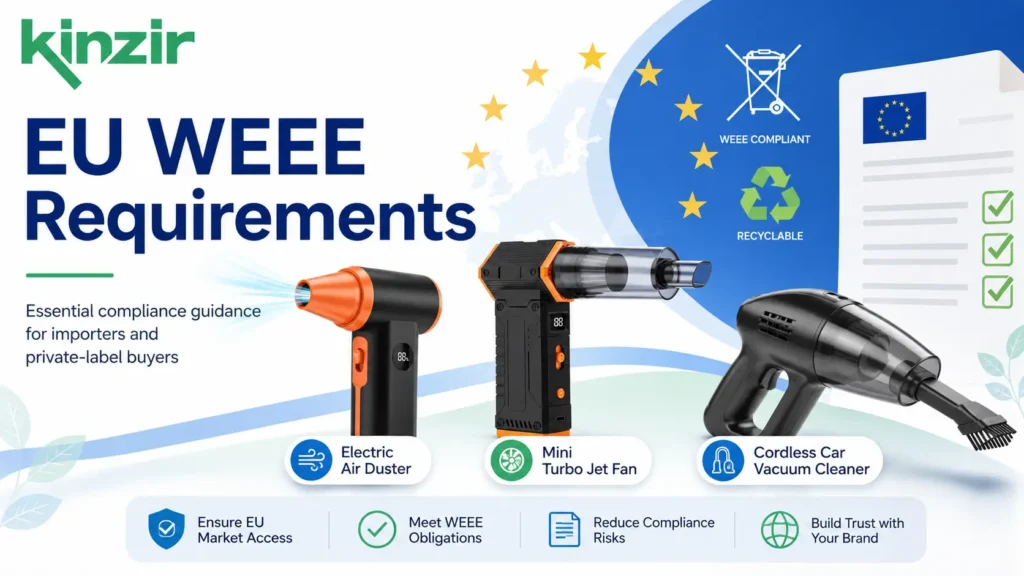
EU WEEE Requirements apply to many electrical and electronic products sold in the European Union, including cordless car vacuums and many rechargeable air dusters and mini turbo jet fans. For importers, private-label brands, distributors and online sellers, WEEE compliance is much more than adding a crossed-out wheeled bin to the product. Depending on your role and destination country, you may need to register as a producer, report the quantity of electrical and electronic equipment placed on the market, finance waste collection and treatment, provide disposal information, meet take-back duties and keep records for national authorities. (Eur-Lex)
This matters for Kinzir buyers. Cordless car vacuums, mini turbo jet fans, electric air dusters and multifunction vacuum-and-blower products contain motors, rechargeable batteries, control boards, switches and charging electronics. They are electrical and electronic equipment, or EEE, when they meet the Directive’s scope.
This guide focuses on the practical questions an EU importer or private-label brand should answer before launching these cordless products.
Important: WEEE Directive 2012/19/EU sets an EU framework, but Member States implement WEEE through national systems. Registration procedures, fees, reporting schedules and compliance schemes can differ by country. Confirm the current national requirements for every market where your product will be placed on the market. (European Union)
EU WEEE Requirements at a Glance
For most small cordless cleaning products, the basic process looks like this:
| WEEE Requirement | Cordless Car Vacuum | Electric Air Duster | Mini Turbo Jet Fan |
|---|---|---|---|
| Check whether product is EEE | Yes | Yes | Yes |
| Determine WEEE category | Yes | Yes | Yes |
| Identify legal producer | Yes | Yes | Yes |
| National producer registration | Where applicable | Where applicable | Where applicable |
| WEEE product marking | Yes | Yes | Yes |
| Track EEE placed on market | Yes | Yes | Yes |
| Periodic reporting | Based on national system | Based on national system | Based on national system |
| Finance waste management | Producer responsibility applies | Producer responsibility applies | Producer responsibility applies |
| Consumer disposal information | Applicable | Applicable | Applicable |
| Review lithium battery rules separately | Yes | Yes | Yes |
The WEEE Directive requires Member States to maintain producer registers. Producers supplying EEE by distance selling must be registered in the Member State they sell to under the Directive’s framework. National registers collect information about EEE placed on the market and WEEE flows. (Eur-Lex)
A WEEE symbol on the housing does not replace registration, reporting or producer-responsibility duties.
What Is WEEE?
WEEE stands for Waste Electrical and Electronic Equipment.
Directive 2012/19/EU establishes EU rules for electrical and electronic products after they become waste. Its goals include preventing waste, encouraging separate collection, supporting reuse and recycling, improving recovery of materials and reducing environmental and health impacts associated with discarded electrical equipment. (Environment)
The current WEEE Directive entered into force in 2012. The consolidated legal text incorporating later amendments remains in force. (Eur-Lex)
What Is EEE?
EEE means electrical and electronic equipment.
Article 3 defines EEE as equipment dependent on electric currents or electromagnetic fields to work properly, within the voltage limits stated in the Directive. (Eur-Lex)
A rechargeable cordless car vacuum clearly depends on electricity to operate its motor, controller and battery system.
The same logic applies to an electric air duster or mini turbo jet fan.
What Is the Difference Between EEE and WEEE?
The distinction is straightforward:
EEE is the electrical or electronic product placed on the market and used by the customer.
WEEE is that equipment once it becomes waste.
The Directive states that WEEE includes components, subassemblies and consumables that are part of the product when it is discarded. (Eur-Lex)
For a cordless vacuum, that can include the appliance, electronics and components present when the product enters the waste stream.
Do WEEE Requirements Apply to Cordless Car Vacuums?
Yes, a normal cordless car vacuum sold in the EU falls within the type of equipment covered by the WEEE framework.
The legal text makes this especially clear. Annex IV expressly lists vacuum cleaners among examples of Category 5 small equipment. Category 5 covers small equipment where no external dimension exceeds 50 cm. (Eur-Lex)
A typical rechargeable car vacuum contains:
- Electric or BLDC motor
- Rechargeable lithium-ion battery
- PCB
- Motor controller
- Charging electronics
- Switches
- LED indicators or display
- Wiring and electrical contacts
Kinzir supplies several cordless car vacuum cleaner models for OEM and private-label projects. For EU programs where battery replacement is part of the product specification, buyers can review Kinzir’s OEM removable battery car vacuum solutions.
The Kinzir VC26R removable battery cordless car vacuum is one example of a compact rechargeable appliance combining vacuum and blowing functions. (Kinzir Air Duster)
Do WEEE Requirements Apply to Electric Air Dusters?
A rechargeable electric air duster normally meets the definition of EEE since it depends on electrical current for its motor, battery, electronic control circuit and charging system. (Eur-Lex)
The words electric air duster do not appear as a named product in Annex IV. The Directive has an open-scope structure, and Category 5 includes small household appliances, consumer equipment and small electrical and electronic tools where no external dimension exceeds 50 cm. (Eur-Lex)
For a compact handheld electric air duster, Category 5 is a reasonable classification starting point. The final reporting category should be checked with the national WEEE register or compliance scheme used in the country concerned.
Kinzir’s OEM detachable battery electric air duster program includes rechargeable products intended for computer cleaning, keyboards, car interiors, office equipment and similar applications. (Kinzir Air Duster)
Do WEEE Requirements Apply to Mini Turbo Jet Fans?
A rechargeable mini turbo jet fan normally qualifies as EEE for the same reason.
The product commonly contains:
- High-speed BLDC motor
- Rechargeable lithium-ion cells
- Motor control PCB
- Battery protection circuit
- USB-C charging components
- Speed control
- Display or battery indicators
A handheld model under the relevant dimensional threshold will commonly be assessed under Category 5 small equipment. Turbo jet fans are not individually named in Annex IV, so importers should confirm their national classification rather than treating the category as automatic. (Eur-Lex)
Kinzir manufactures mini turbo jet fans with different motor speeds, airflow levels and battery configurations. Buyers comparing their electrical design can read Turbo Jet Fan Specifications: RPM, CFM, Air Speed and Pressure. (Kinzir Air Duster)
Kinzir’s detachable-battery range includes products such as the AD80 removable battery turbo jet fan, built around a rechargeable lithium battery module and BLDC motor. (Kinzir Air Duster)
Which WEEE Category Applies?
Since 15 August 2018, Annex III divides EEE into six categories:
- Temperature exchange equipment
- Screens, monitors and equipment containing screens over the stated area
- Lamps
- Large equipment
- Small equipment
- Small IT and telecommunications equipment
For Kinzir-type cordless cleaning products, Category 5, Small Equipment is usually the category requiring close examination. It covers equipment where no external dimension exceeds 50 cm and includes household appliances, consumer equipment and electrical and electronic tools. (Eur-Lex)
Annex IV explicitly names vacuum cleaners within Category 5. (Eur-Lex)
A practical classification table looks like this:
| Product | Likely WEEE Category | Basis |
|---|---|---|
| Cordless car vacuum | Category 5 | Vacuum cleaners explicitly listed |
| Mini handheld vacuum | Category 5 | Small electrical appliance |
| Electric air duster | Usually Category 5 | Small electrical equipment |
| Mini turbo jet fan | Usually Category 5 | Small rechargeable electrical equipment |
| Vacuum + air duster | Usually Category 5 | Multifunction small EEE |
| Vacuum + blower + turbo fan | Usually Category 5 | Small multifunction EEE |
For air dusters and turbo jet fans, the category shown above is an interpretation based on the Directive’s category wording and product characteristics. National registers or producer-responsibility organisations should confirm the final category used for registration and reporting.
Who Is the “Producer” Under the WEEE Directive?
This is one of the most common areas of confusion for private-label sourcing.
The factory that physically makes the product is not automatically the WEEE producer.
Article 3 uses a legal definition based partly on where the business is established, whose name or trademark the EEE carries, who places imported equipment on a Member State market and whether the company sells directly across borders. (Eur-Lex)
The definition covers situations where a business:
- Manufactures EEE under its own name or trademark
- Has EEE manufactured and markets it under its own name or trademark
- Imports EEE professionally from a third country or another Member State
- Sells EEE through distance communication directly into another Member State (Eur-Lex)
This has major consequences for OEM products.
Private-Label Example
Suppose a German brand asks Kinzir to manufacture 20,000 cordless car vacuums.
The product carries the German brand’s trademark.
Kinzir manufactures the hardware in China.
The German company has the product manufactured and markets it under its own trademark in Germany.
That structure can place the German brand within the WEEE producer definition. (Eur-Lex)
EU Importer Example
Suppose an importer established in France purchases Kinzir-branded electric air dusters from China and professionally places them on the French market.
The WEEE producer definition expressly covers a company established in a Member State that places EEE from a third country onto that Member State’s market. (Eur-Lex)
Cross-Border Ecommerce Example
Distance selling matters too.
The Directive includes persons selling EEE directly to households or other users in a Member State from another Member State or a third country within the producer definition. (Eur-Lex)
Brands selling through their own websites or online marketplaces should examine each destination market rather than assuming ecommerce removes producer-responsibility duties.
Is the Chinese Manufacturer Responsible for EU WEEE Registration?
There is no single answer for every supply chain.
The answer depends on:
- Whose trademark appears on the product
- Who imports the EEE
- Who first places it on the national market
- Whether the Chinese supplier sells directly to EU end users
- Which Member State receives the product
- How national WEEE law implements producer responsibility
For a standard OEM transaction where Kinzir manufactures a private-label product and an EU buyer imports and places that product on its market, the EU brand or importer needs to determine its legal WEEE producer status.
Kinzir can support the product side of the project with items such as:
- WEEE symbol placement
- OEM product labels
- Brand identification
- Product dimensions
- Net product weight
- Battery specifications
- User manuals
- Private-label packaging
- Product configuration records
- Removable battery structures
Kinzir should not be represented as issuing an “EU WEEE certificate.” WEEE is not a factory certificate in the same sense as a laboratory test report.
Huizhou Mfine Technology Co., Ltd., owner of the Kinzir brand, is an ISO 9001:2015-certified electronics manufacturer producing electric air dusters, vacuum cleaners and mini portable turbo jet fans. Kinzir operates five production lines and offers OEM/ODM manufacturing and product-testing support.
Is There One WEEE Registration for the Entire European Union?
No.
This is one of the most important facts for importers to know.
Your Europe instructs companies to register with the authorities responsible for WEEE management in each EU country where they sell their products. (European Union)
A registration connected with Germany should not be assumed to cover:
- France
- Italy
- Spain
- Poland
- Netherlands
- Belgium
- Sweden
- Other Member States
One EU Directive creates the common framework, yet national implementation creates country-level registration and administration.
National systems may differ in:
- Registration process
- Product category structure
- Reporting periods
- Compliance-scheme arrangements
- Fees
- Producer identification
- Authorized representative procedures
- Take-back administration
For a brand launching the same cordless vacuum in ten EU markets, WEEE planning should be carried out market by market.
How to Register for WEEE
The exact registration portal and procedure depend on the Member State.
A practical B2B workflow is:
Step 1: List Every Destination Country
Start with the actual sales plan.
Do not write “EU” as one destination.
List Germany, France, Spain, Italy and every other market separately.
Step 2: Identify the WEEE Producer
Review:
- Brand ownership
- Import structure
- Legal entity
- Marketplace model
- Distance selling
- Destination country
Use the producer definition in Article 3 as the starting point. (Eur-Lex)
Step 3: Classify the Product
For compact Kinzir-type products, assess Category 5 first.
Vacuum cleaners are expressly listed there. Air dusters and turbo jet fans need classification based on their characteristics and national registration system. (Eur-Lex)
Step 4: Register With the National System
Article 16 requires Member States to establish registers of producers. (Eur-Lex)
Your Europe provides access to the network of national WEEE registers. (European Union)
Step 5: Arrange Producer Responsibility
Depending on the national system, this may involve joining a producer-responsibility or collective compliance scheme or using another permitted arrangement.
The WEEE framework applies Extended Producer Responsibility. The Commission describes the system as requiring producers to bear costs associated with collection, transport and treatment of WEEE. (Environment)
Step 6: Prepare the Product Marking
Confirm the crossed-out wheeled bin, producer identification and applicable date identification before mass production.
Step 7: Track Market Quantities
Create a reporting system from the first shipment.
Useful data fields include:
- SKU
- Country
- Product category
- Units placed on market
- Net EEE weight
- Reporting period
- Brand
- Battery configuration
Step 8: Submit Required Reports
The Directive establishes registration and reporting requirements, but the operational schedule faced by a producer depends on the national system. (Eur-Lex)
Step 9: Maintain Records
Keep registration, product, quantity, weight and compliance information in a structured format.
This becomes much harder if a company waits until the end of the year and tries to rebuild the data from invoices.
Do You Need a WEEE Registration Number?
Registered producers receive identification through the applicable national system.
The key wording is national.
There is no single universal “EU WEEE number” that automatically covers every Member State.
Article 16 requires national producer registers. Annex X sets out information submitted for registration, including producer identity, address, national identification information, EEE category and other details. (Eur-Lex)
For product launches, confirm whether the destination country’s rules require a registration number to appear:
- On invoices
- Marketplace listings
- Contracts
- Websites
- Product records
- Other commercial documentation
Those operational details should be checked with the relevant national authority or compliance scheme.
Is WEEE a Certification?
No. Treating WEEE as a simple product certification creates problems.
A laboratory may test a product for electrical safety or restricted substances. WEEE works differently.
WEEE includes ongoing obligations connected with:
- Producer registration
- Waste-management financing
- Reporting
- Product marking
- Collection
- Treatment
- Recycling
- Consumer information
- Take-back systems
The European Commission describes WEEE as an Extended Producer Responsibility framework. (Environment)
A supplier saying:
“Our vacuum has a WEEE symbol.”
does not tell you whether the company placing that vacuum on the German or French market has completed its producer-registration duties.
A crossed-out bin is one visible element of a much larger compliance process.
What Are the WEEE Labeling Requirements?
The most recognizable WEEE marking is the crossed-out wheeled bin.
Annex IX states that the symbol for separate collection of EEE is a crossed-out wheeled bin. The symbol must be printed visibly, legibly and indelibly. (Eur-Lex)
The symbol tells users that electrical equipment should enter separate collection rather than unsorted municipal waste.
Where Should the WEEE Symbol Appear?
Article 14 requires appropriate marking of EEE.
The normal approach is to put the symbol on the electrical product itself. In exceptional cases linked to product size or function, the Directive permits the symbol to be printed on the packaging, instructions for use and warranty. (Eur-Lex)
For a Kinzir car vacuum, air duster or turbo fan, the product housing normally provides enough area for a durable label or marking.
Possible locations include:
- Bottom battery housing
- Rear motor housing
- Product rating label
- Removable battery compartment area
- Handle rating plate
The final position should remain visible and readable after normal manufacturing and assembly.
What Does the Bar Under the WEEE Bin Mean?
The Directive requires equipment to carry a mark enabling the date on which it was placed on the market to be determined as equipment placed after 13 August 2005. The consolidated text names EN 50419:2022 as the preferred European standard for this purpose. (Eur-Lex)
Private-label buyers should discuss this during artwork approval, not after finished goods have been packed.
WEEE Label vs CE Mark vs RoHS
These requirements serve different purposes.
| Requirement | Main Focus | Typical Product Mark |
|---|---|---|
| WEEE | End-of-life electrical waste and producer responsibility | Crossed-out wheeled bin |
| RoHS | Restriction of hazardous substances in EEE | Managed within applicable EU conformity framework |
| CE | Declaration that applicable EU harmonisation requirements have been addressed | CE marking |
| EU Battery Regulation | Battery sustainability, safety, labeling, waste and lifecycle duties | Battery-related markings |
| GPSR | General consumer-product safety requirements | Not a replacement for WEEE |
RoHS Directive 2011/65/EU restricts certain hazardous substances in electrical and electronic equipment and forms part of the conformity framework for applicable EEE. (Eur-Lex)
WEEE deals mainly with the waste stage and producer responsibility.
A CE mark does not replace WEEE registration.
A RoHS report does not replace WEEE registration.
A WEEE number does not replace CE or RoHS obligations.
Importers need to treat each applicable framework separately.
WEEE Requirements vs EU Battery Regulation
This distinction matters greatly for cordless products.
A Kinzir car vacuum or turbo jet fan can contain two regulated product streams in one finished appliance:
- The electrical appliance
- The lithium-ion battery
The WEEE Directive deals with electrical and electronic equipment at end of life.
Regulation (EU) 2023/1542 creates separate requirements for batteries and waste batteries. (Eur-Lex)
That means:
WEEE compliance does not replace battery compliance.
Battery compliance does not replace WEEE compliance.
This is particularly relevant for Kinzir’s detachable-battery product range.
For a deeper battery-specific guide, read:
- EU Battery Regulation 2027 for Car Vacuums, Air Dusters and Turbo Jet Fans
- OEM Removable Battery Car Vacuums
- OEM Detachable Battery Turbo Jet Fans
- OEM Detachable Battery Electric Air Dusters
- Turbo Jet Fan Removable Battery Upgrade for EU 2027
Regulation (EU) 2023/1542 contains requirements concerning removability and replaceability of portable batteries incorporated into appliances, with Article 11 applying from 18 February 2027. (Eur-Lex)
What Happens to the Lithium Battery When a Cordless Product Becomes WEEE?
This is where WEEE and battery design meet at the recycling stage.
Annex VII of the WEEE Directive lists batteries among components that must be removed from separately collected WEEE during selective treatment. (Eur-Lex)
A cordless vacuum may reach a treatment facility containing:
- Lithium-ion cells
- Battery PCB
- Motor
- Main PCB
- Plastic housing
- Copper wiring
- Electronic switches
- Metal components
The battery needs to enter the appropriate treatment stream.
This gives removable-battery product architecture another practical benefit. A detachable battery can support replacement and service during product life and can make the battery physically accessible at end of life.
Battery removability alone does not make the complete appliance WEEE compliant.
Registration, marking, reporting and producer-responsibility duties still remain.
Kinzir has developed removable-battery structures for car vacuums, electric air dusters and turbo jet fans intended for EU-focused product programs. (Kinzir Air Duster)
What Must WEEE Producers Report?
Article 16 requires producer registration and information reporting.
The Directive’s registration framework covers data such as:
- Producer name and address
- National identification information
- EEE category
- Type of equipment
- Brand
- Selling technique
- Compliance method
- Quantity of EEE placed on the national market (Eur-Lex)
Member States collect annual information about quantities and categories of EEE placed on their markets, WEEE collected, preparation for reuse, recycling, recovery and exports, measured by weight. (Eur-Lex)
The reporting frequency faced by an individual producer can depend on the national registration system.
Do not assume that one EU-wide quarterly or annual schedule applies to every company.
Why Product Weight Matters
OEM buyers often focus on carton weight for freight.
WEEE creates another reason to maintain accurate weight data.
National reporting systems can require quantities of EEE placed on the market by weight.
For each Kinzir private-label SKU, retain an approved product specification containing:
- Net unit weight
- Battery weight where needed
- Packaging weight separately
- Model number
- Product category
- Units shipped
- Destination country
Do not mix product net weight with master-carton shipping weight.
A reporting database built around SKU-level specifications is far easier to manage than recalculating each shipment later.
Who Pays for WEEE Collection and Recycling?
WEEE is built around producer responsibility.
For household WEEE, the Directive requires producers to finance relevant collection, treatment, recovery and environmentally sound disposal arrangements. It permits financial guarantees through mechanisms such as participation in an appropriate financing scheme, recycling insurance or a blocked bank account. (Eur-Lex)
For equipment used by businesses, Article 13 contains separate financing provisions for WEEE from users other than private households. (Eur-Lex)
The Commission describes the WEEE system as applying the polluter-pays principle through Extended Producer Responsibility. (Environment)
Is There a Standard EU WEEE Fee Per Product?
No single EU-wide fee applies to every car vacuum or electric air duster.
Cost can vary with:
- Member State
- Equipment category
- Product weight
- Scheme
- Quantity placed on market
- Product characteristics
- National financing system
Your Europe notes that financial waste-management obligations vary from one EU country to another. (European Union)
For sourcing calculations, separate these costs:
Factory product cost
+
International transport cost
+
Import cost
+
National WEEE/EPR compliance cost
+
Battery producer-responsibility cost where applicable
+
Packaging EPR obligations where applicable
This gives a much more realistic landed compliance cost.
What Are the WEEE Take-Back Responsibilities?
The WEEE framework includes collection and return systems for discarded electrical equipment.
Consumer information under Article 14 must cover available return and collection systems, separate collection and the user’s role in reuse and recycling. (Eur-Lex)
The detailed take-back model can depend on national law and the seller’s role.
An importer should examine this point if products are sold through:
- Own ecommerce website
- Amazon
- Retail chains
- Electronics stores
- Automotive accessory stores
- Distributors
- Direct B2B sales
Do not assume the recycling scheme alone handles every retailer-facing duty.
What Information Should Consumers Receive?
Article 14 requires users of household EEE to receive information about several subjects. These include:
- The need to keep WEEE out of unsorted municipal waste
- Available return and collection systems
- The user’s role in reuse and recycling
- Potential environmental and health effects from hazardous substances
- The meaning of the crossed-out wheeled bin (Eur-Lex)
For a private-label Kinzir product, this information can be incorporated into:
- Printed user manual
- Digital manual
- Packaging where appropriate
- Product-support webpage
- Recycling information page
An OEM project should decide who supplies the final legal wording and language translations.
The manufacturer can print the approved content, but the market operator should verify the legal text needed for the destination country.
What Information Must Be Available to Treatment Facilities?
This part of WEEE receives far less attention than the crossed-out-bin symbol, yet it matters.
Article 15 requires producers to provide preparation-for-reuse and treatment information for new types of EEE placed on the Union market, within one year after first placement on the market. The information should identify components and materials, plus locations of dangerous substances and mixtures where treatment facilities need that information. (Eur-Lex)
For an OEM product program, useful records may include:
- Bill of materials
- Battery type
- Battery location
- Battery removal method
- PCB locations
- Motor location
- Housing materials
- Fastener locations
- Disassembly sequence
- Relevant material information
This is another reason to source from a manufacturer capable of maintaining structured product specifications rather than buying an anonymous product with little technical documentation.
WEEE Recovery and Recycling Targets for Small Equipment
From 15 August 2018, Annex V sets minimum recovery targets for the six current EEE categories.
For Category 5 and Category 6, the Directive sets:
- 75% recovery
- 55% preparation for reuse and recycling (Eur-Lex)
These percentages are treatment and recovery targets within the WEEE system.
They do not mean that a particular car vacuum must be manufactured using 55% recycled material.
They do not mean the importer should print “55% recyclable” on the packaging.
Those are different claims.
WEEE Compliance for Private-Label Products Made in China
Consider a realistic OEM project.
A European brand orders:
20,000 cordless car vacuums with its own logo, box and user manual from Kinzir.
The buyer plans sales in Germany, France and Italy.
Before mass production, the buyer should answer:
- Which company is the WEEE producer in each country?
- Which national registrations are required?
- What category will each register use?
- Is a producer-responsibility organisation required?
- Which WEEE registration information is needed?
- What product weight will be reported?
- Where should the crossed-out wheeled bin appear?
- What producer/date identification is required?
- What consumer recycling information belongs in the manual?
- What lithium battery obligations apply separately?
- What sales data must be retained?
- Who will submit ongoing national reports?
Kinzir can then build the approved compliance artwork into the manufacturing specification.
For example:
Product label
- Brand
- Model
- Electrical information
- WEEE symbol
- Other approved regulatory markings
Manual
- Product instructions
- Battery information
- Waste-disposal information supplied by the buyer
- Local-language content
Packaging
- Approved compliance marks
- Importer information where applicable
- Recycling information where applicable
- Barcode and SKU information
This sequence is far safer than manufacturing 20,000 units first and asking the factory to add WEEE information afterward.
Does WEEE Apply to B2B Electrical Products?
WEEE is not limited to products bought by household consumers.
The Directive recognizes WEEE from users other than private households and contains separate financing provisions for that waste stream. (Eur-Lex)
This can matter when cordless products are supplied to:
- Car-detailing businesses
- Commercial cleaning companies
- Computer-service companies
- Garages
- Workshops
- Automotive distributors
- Tool distributors
- Corporate buyers
A product commonly used by both consumers and businesses may still fall within the household-WEEE definition where its nature and quantity are similar to household waste. The Directive expressly addresses equipment likely to be used by both private households and other users. (Eur-Lex)
WEEE Compliance Checklist for EU Cordless Products
Use the following checklist before approving mass production.
Product and Classification
- ☐ Confirm the product meets the definition of EEE
- ☐ Determine the WEEE category
- ☐ Confirm whether it is household or non-household EEE
- ☐ Record product dimensions
- ☐ Record net product weight
- ☐ Record battery type and battery weight where needed
Producer Status
- ☐ Identify the brand owner
- ☐ Identify the EU importer
- ☐ Identify the company first placing the product on each market
- ☐ Review distance-selling structure
- ☐ Determine producer status country by country
- ☐ Check authorized representative requirements
National Registration
- ☐ Identify every EU country of sale
- ☐ Find the national WEEE register
- ☐ Complete producer registration
- ☐ Join the required compliance arrangement where applicable
- ☐ Record national registration details
Product Marking
- ☐ Add the crossed-out wheeled bin
- ☐ Confirm size and legibility
- ☐ Confirm durability
- ☐ Add producer identification where required
- ☐ Apply appropriate post-2005 identification
- ☐ Check final artwork before tooling or printing approval
Reporting
- ☐ Track units by SKU
- ☐ Track net EEE weight
- ☐ Track sales by Member State
- ☐ Track product category
- ☐ Store shipment records
- ☐ Submit reports according to the national schedule
Consumer Information
- ☐ Explain separate collection
- ☐ Explain the WEEE symbol
- ☐ Provide return/collection information
- ☐ Add required local-language information
- ☐ Keep digital product documentation
Battery Requirements
- ☐ Review Regulation (EU) 2023/1542
- ☐ Check battery producer responsibility
- ☐ Check battery marking
- ☐ Check waste-battery requirements
- ☐ Prepare for applicable 2027 removability and replaceability requirements
- ☐ Plan replacement-battery availability for removable-battery products
Other EU Product Requirements
- ☐ Review applicable CE legislation
- ☐ Review RoHS
- ☐ Review REACH obligations where relevant
- ☐ Review GPSR
- ☐ Review WEEE
- ☐ Review Battery Regulation
- ☐ Review packaging obligations for the destination market
This should become part of the product-development process, not a last-minute customs checklist.
10 Common WEEE Mistakes Made by Importers
1. Thinking CE Marking Covers WEEE
It does not.
CE conformity and WEEE producer responsibility address different obligations. RoHS itself sits within the EU conformity framework for applicable EEE, whereas WEEE focuses on collection, treatment, waste management and producer responsibility. (Eur-Lex)
2. Asking the Factory for a “WEEE Certificate”
There is no single EU WEEE certificate that replaces producer registration and ongoing reporting.
Ask the manufacturer for product-side data and marking support. Handle the applicable producer-registration duties through the relevant national system.
3. Assuming One Registration Covers the Entire EU
Your Europe tells businesses to register with the relevant WEEE authorities in each EU country where they sell applicable products. (European Union)
4. Printing the WEEE Symbol Without Registering
Marking and registration are separate obligations.
5. Registering but Forgetting Ongoing Reporting
WEEE is an ongoing producer-responsibility system. Maintain shipment data from the beginning.
6. Tracking Units but Not Weight
The WEEE system uses weight-based data. Article 16 refers to quantities by weight in Member State data collection. (Eur-Lex)
7. Ignoring Distance Sales
The producer definition expressly covers distance selling into a Member State from another Member State or a third country. (Eur-Lex)
8. Treating WEEE and Battery EPR as One Registration
The appliance and its lithium battery can create separate regulatory responsibilities.
9. Assuming Every Small Rechargeable Product Uses the Same Category
Vacuum cleaners have clear Category 5 support in Annex IV. Air dusters and turbo fans need a classification review based on the Directive and national system. (Eur-Lex)
10. Waiting Until Mass Production to Discuss WEEE
Label area, manual text, product weight, battery architecture and country-specific product information are easier to fix at sample stage.
Compliance review should be part of OEM sample approval.
WEEE vs Battery Regulation vs RoHS vs GPSR
An EU-bound cordless cleaning product can be affected by several legal frameworks at the same time.
| EU Requirement | Main Subject for a Cordless Product |
|---|---|
| WEEE Directive 2012/19/EU | End-of-life EEE, registration, collection, treatment and recycling |
| Regulation (EU) 2023/1542 | Batteries, waste batteries, labeling, EPR and battery lifecycle |
| RoHS Directive 2011/65/EU | Restricted hazardous substances in EEE |
| GPSR 2023/988 | Consumer product safety framework |
| Applicable CE legislation | Product conformity requirements where relevant |
A single product can need attention under several of these rules.
For Kinzir buyers planning EU product programs, the EU Battery Regulation 2027 guide is the natural companion to this WEEE article.
The OEM detachable battery turbo jet fan guide and OEM removable battery car vacuum guide cover product-development options for brands preparing new battery architectures.
Is the EU WEEE Directive Changing in 2026?
This deserves attention for products being planned now.
The current consolidated Directive 2012/19/EU remains in force. Article 24a requires the European Commission to assess the need for revision no later than 31 December 2026 and to present a legislative proposal where appropriate. (Eur-Lex)
The Commission published its WEEE evaluation in July 2025. It identified issues involving scope, collection, recovery of critical raw materials, harmonisation of Extended Producer Responsibility systems and treatment requirements. (Environment)
The Commission’s current Circular Economy policy page says the findings from the WEEE evaluation will inform a proposal to revise the Directive as part of the forthcoming Circular Economy Act. The Circular Economy Act is scheduled for adoption in 2026 according to that Commission page. (Environment)
For importers, the practical message is:
Do not assume that a new WEEE regime has already replaced Directive 2012/19/EU.
As of August 2026, the current Directive remains the legal starting point in the official sources reviewed for this article. Businesses preparing 2027 launches should check for new EU legislation and national implementation before placing the finished product on the market. (Eur-Lex)
How Kinzir Supports EU-Bound Cordless Product Projects
Kinzir manufactures cordless car vacuum cleaners, electric air dusters, mini turbo jet fans and multifunction vacuum-and-blower products for OEM, ODM and private-label customers.
For buyers preparing products for Europe, Kinzir can support product development with:
- Removable battery structures
- 18650 and 21700 lithium battery options
- Custom battery capacities
- BLDC motor configurations
- Product labels
- WEEE symbol placement
- Custom logos
- Private-label packaging
- Multilingual manuals
- Product weight information
- Battery specifications
- Sample development
- Production inspection
- OEM/ODM manufacturing
Kinzir’s owner, Huizhou Mfine Technology Co., Ltd., is an ISO 9001:2015-certified electronic factory with five production lines. Its QC team works across production lines, with testing equipment covering areas such as insertion and extraction life, key life and transportation vibration.
For removable-battery programs, Kinzir currently offers solutions across its three major cordless product groups:
- OEM Removable Battery Car Vacuums
- OEM Detachable Battery Electric Air Dusters
- OEM Detachable Battery Turbo Jet Fans
Kinzir can prepare the product according to approved WEEE marking, battery, label and packaging specifications. The company that falls within the applicable producer definition should arrange its national WEEE registration, producer-responsibility scheme and ongoing reporting for each destination market.
EU WEEE Requirements FAQs
Do cordless car vacuums need WEEE registration in the EU?
Cordless car vacuums are EEE, and vacuum cleaners are expressly listed within the Category 5 examples in Annex IV. The entity meeting the producer definition should determine registration duties in each Member State where the product is placed on the market. (Eur-Lex)
Do electric air dusters fall under WEEE?
A rechargeable electric air duster normally meets the EEE definition since it relies on electrical current to function. A compact handheld air duster will commonly be assessed under Category 5 small equipment, though the product is not individually named in Annex IV. Confirm the final category with the relevant national system. (Eur-Lex)
Do turbo jet fans fall under WEEE?
Rechargeable turbo jet fans normally meet the EEE definition. Compact models can fit the Category 5 dimensional framework. National classification should be checked before registration. (Eur-Lex)
Which WEEE category does a cordless car vacuum belong to?
Category 5, Small Equipment, is the direct fit for compact vacuum cleaners. Annex IV expressly lists vacuum cleaners as an example. (Eur-Lex)
What is WEEE Category 5?
Category 5 covers small equipment where no external dimension exceeds 50 cm, excluding products placed in Categories 1 to 3 and 6. Examples include household appliances, consumer equipment and small electrical or electronic tools. (Eur-Lex)
Who is considered a WEEE producer?
The legal definition can cover the manufacturer under its own brand, a private-label brand having EEE manufactured under its trademark, an importer placing EEE from another country on a Member State market, or a distance seller supplying another Member State. (Eur-Lex)
Is an EU importer responsible for WEEE?
It can be. Article 3 includes businesses established in a Member State that professionally place EEE imported from a third country or another Member State onto that national market. (Eur-Lex)
Is a private-label brand considered the WEEE producer?
It can be. The Directive includes companies having EEE designed or manufactured and marketing it under their own name or trademark. (Eur-Lex)
Does a Chinese manufacturer need WEEE registration?
It depends on how the manufacturer sells and places the product on the EU market. Direct distance selling from a third country can fall within the producer definition. A Chinese OEM factory selling to an EU importer under the importer’s private label presents a different structure. Review the actual supply chain and national requirements. (Eur-Lex)
Is there one WEEE registration for all EU countries?
No. Your Europe states that a company must register with WEEE authorities in each EU country where it sells applicable products. (European Union)
Is WEEE registration the same as WEEE certification?
No. WEEE is a producer-responsibility framework covering registration, reporting, marking and end-of-life management. It should not be treated as a one-time laboratory certificate. (Environment)
Is the crossed-out wheeled bin mandatory?
The Directive requires appropriate marking of EEE with the Annex IX symbol. Annex IX describes the crossed-out wheeled bin and requires it to be visible, legible and indelible. (Eur-Lex)
Can the WEEE symbol be printed only on packaging?
The normal approach is marking the EEE. Article 14 permits the symbol on packaging, instructions and warranty in exceptional cases where product size or function makes product marking necessary to handle differently. (Eur-Lex)
Is WEEE the same as RoHS?
No. WEEE addresses waste electrical equipment and producer responsibility. RoHS restricts specified hazardous substances in electrical and electronic equipment. (Eur-Lex)
Is WEEE included in CE marking?
No. WEEE producer registration and waste-management duties are separate from CE marking. RoHS is one example of EU legislation tied to CE conformity for applicable EEE, but WEEE registration is not replaced by a CE mark. (Eur-Lex)
Is WEEE the same as EPR?
WEEE uses Extended Producer Responsibility as a core policy mechanism. EPR is the broader principle under which producers bear financial or organizational responsibility for products at the waste stage. WEEE is one EU sector-specific framework applying that principle. (Environment)
Does WEEE cover lithium batteries?
The WEEE treatment rules recognize batteries as components that must be removed from separately collected WEEE during selective treatment. The battery itself is subject to the separate EU Battery Regulation. (Eur-Lex)
Do I need both WEEE and battery compliance?
For a rechargeable cordless product, yes, both legal frameworks can be relevant. The appliance and its battery need to be assessed against their respective requirements. (Eur-Lex)
How often must WEEE reports be filed?
There is no safe single reporting frequency to apply to every importer across the EU. The Directive establishes registration and reporting structures, with national systems administering producer obligations. Check the current schedule in each Member State where your company is registered. (Eur-Lex)
How are WEEE fees calculated?
Fees depend on national arrangements and may reflect equipment category, weight, quantity and the producer-responsibility scheme used. Your Europe states that waste-management financial obligations can differ between EU countries. (European Union)
Does an Amazon or ecommerce seller need WEEE registration?
Selling through a marketplace does not remove WEEE producer duties. The Directive expressly includes distance-selling situations in its producer definition. Registration should be assessed for each country receiving the product. (Eur-Lex)
What happens if a company does not comply with WEEE requirements?
The Directive requires Member States to establish penalties for infringements through their national implementation. Enforcement details and penalties differ by country. Companies should check the laws of each destination market rather than relying on a single EU penalty figure. (Eur-Lex)
Final Checklist for EU Importers
For a cordless car vacuum, electric air duster or turbo jet fan sourced from China, do not reduce WEEE compliance to one question:
“Does the product have the crossed-out bin?”
Ask these questions instead:
- Is the product covered by WEEE?
- Which category applies?
- Which company is the producer?
- In which countries must that company register?
- What WEEE information belongs on the product?
- What information belongs in the manual?
- What net product weight must be tracked?
- Which reporting schedule applies in each market?
- Which producer-responsibility scheme will handle waste?
- What retailer or take-back duties apply?
- What separate battery obligations apply?
- Are current 2026 requirements likely to change before the planned launch date?
For private-label programs, resolve these points during specification and sample approval. This leaves enough time to prepare product labels, molds, manuals, packaging, battery architecture and reporting data before mass production.
Kinzir can support the hardware, product marking, removable-battery structure, private-label packaging and OEM manufacturing side of the project. EU brands, importers and sellers should confirm their own WEEE producer status and national registration duties before the product enters each market.
Authoritative References
1. Directive 2012/19/EU on Waste Electrical and Electronic Equipment (WEEE), consolidated text as of 8 April 2024
Author: European Parliament and Council of the European Union
Source: EUR-Lex, Official Journal of the European Union
URL: https://eur-lex.europa.eu/eli/dir/2012/19/2024-04-08/eng
This is the primary legal source for WEEE scope, definitions, categories, producer responsibilities, marking, registration, reporting, treatment and recovery targets. (Eur-Lex)
2. Waste from Electrical and Electronic Equipment (WEEE)
Author: European Commission, Directorate-General for Environment
Source: European Commission
URL: https://environment.ec.europa.eu/topics/waste-and-recycling/waste-electrical-and-electronic-equipment-weee_en
Provides the Commission’s overview of the WEEE Directive, its objectives, implementation and current evaluation. (Environment)
3. WEEE Responsibilities for Manufacturers and Producers
Author: European Commission, Your Europe
Source: Your Europe
URL: https://europa.eu/youreurope/business/product-rules-compliance/recycling-waste-management/weee-responsibilities/index_en.htm
Explains national registration, producer responsibilities and waste-management obligations for businesses selling EEE in EU countries. (European Union)
4. WEEE Label: What Does the Label Mean and What Are the EU Requirements?
Author: European Commission, Your Europe
Source: Your Europe
URL: https://europa.eu/youreurope/business/product-rules-compliance/recycling-waste-management/weee-label/index_en.htm
Covers the crossed-out wheeled bin, product identification and WEEE labeling responsibilities. (European Union)
5. Circular Economy: New Evaluation Looks at How to Improve WEEE Directive
Author: European Commission, Directorate-General for Environment
Published: 2 July 2025
URL: https://environment.ec.europa.eu/news/new-evaluation-looks-how-improve-weee-directive-2025-07-02_en
Summarizes the Commission’s evaluation of WEEE performance and areas considered for future revision. (Environment)
6. Regulation (EU) 2023/1542 Concerning Batteries and Waste Batteries
Author: European Parliament and Council of the European Union
Source: EUR-Lex, Official Journal of the European Union
URL: https://eur-lex.europa.eu/eli/reg/2023/1542/oj/eng
Primary legal source for battery-specific obligations relevant to rechargeable car vacuums, air dusters and turbo jet fans. (Eur-Lex)
7. Directive 2011/65/EU on the Restriction of Hazardous Substances in Electrical and Electronic Equipment
Author: European Parliament and Council of the European Union
Source: EUR-Lex
URL: https://eur-lex.europa.eu/eli/dir/2011/65/oj/eng
Primary source for RoHS requirements referenced in the WEEE vs RoHS comparison. (Eur-Lex)
8. Circular Economy, Circular Economy Act
Author: European Commission, Directorate-General for Environment
URL: https://environment.ec.europa.eu/strategy/circular-economy_en
Current Commission information on the planned Circular Economy Act and the intended use of the WEEE evaluation in preparing future revision work. (Environment)


