
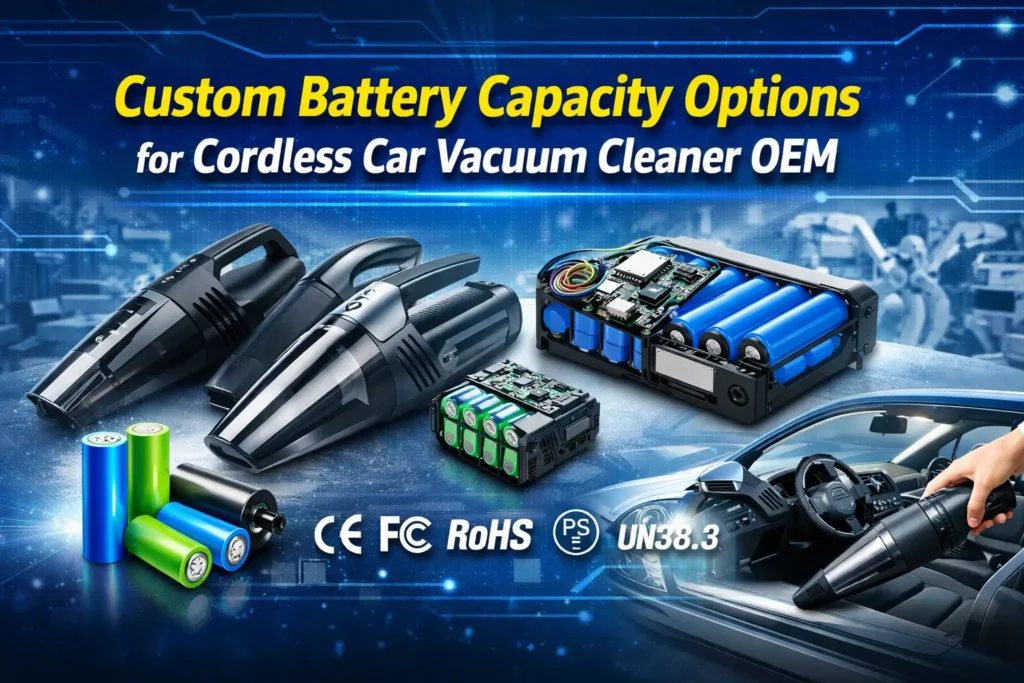
Custom battery capacity options for cordless car vacuum cleaner OEM projects directly affect product performance, runtime, and market positioning. When partnering with a Cordless Car Vacuum Cleaner manufacturer in China, understanding battery customization is essential to meet your target market’s needs. Kinzir, a leading OEM and ODM manufacturer, exports 3 million car vacuums annually. We offer strict quality control and technical support to help international distributors select optimal configurations. Our OEM services include customized battery solutions and comprehensive performance testing.

Your battery capacity choice determines how long your cordless car vacuum operates between charges and affects overall power system performance. Different markets have varying runtime expectations, so partnering with an experienced OEM supplier helps you match battery specifications to your customers’ needs. Whether you require compact batteries for lightweight tools or high-capacity options for extended use, factory-level customization is available.
Battery capacity affects motor performance and manufacturing pricing. Your choices regarding battery configuration and quality control influence your product’s competitiveness. Understanding these factors enables informed decisions for your private label line.
Why Battery Capacity Matters In Cordless Car Vacuum Cleaner OEM
Battery capacity determines your cordless car vacuum’s runtime, weight, and market price. Your selection influences product performance, manufacturing costs, and customer satisfaction across all segments.
Impact On Runtime
Cordless car vacuum battery life depends on the milliamp-hour (mAh) rating you select for your OEM product. A 2000mAh battery typically delivers 12-15 minutes of runtime, while a 4000mAh option extends operation to 25-30 minutes under standard suction modes.
Runtime decreases significantly at maximum power settings. For example, a 3000mAh battery may provide 20 minutes at normal suction but only 10-12 minutes in boost mode. This variance influences customer perceptions of product value.
Higher-capacity batteries deliver consistent performance across multiple sessions. Since cleaning a vehicle interior usually takes 8-12 minutes, your battery should support at least 1.5 cleaning cycles per charge to meet user expectations.
Impact On Product Weight
Battery cells add weight to your cordless car vacuum. Each 1000 mAh of capacity increases the total product weight by approximately 25-35 grams, depending on cell chemistry and configuration.
A 2000mAh unit typically weighs 450-550 grams, while a 5000mAh version can exceed 750 grams. Target market preferences vary: consumers often prefer lighter units for quick cleanups, while professionals accept heavier models for longer runtime.
Balance battery capacity with portability. Products over 700 grams often receive complaints about hand fatigue during extended or overhead use.
Impact On Suction Stability
As the battery voltage sags, suction power decreases as the charge depletes. Lower-capacity batteries experience voltage drops earlier, reducing suction strength by 20-30% when the charge falls below 40%.
Your battery capacity choice affects how consistently the motor maintains strong suction and power output. A 3500mAh battery sustains a stable voltage longer than a 2000mAh option, ensuring more uniform cleaning performance.
Premium lithium-ion cells with higher capacity offer better discharge curves, resulting in steady suction power. Distributors often prioritize these specifications to ensure a superior user experience.
Impact On Product Price
Battery cells account for 25-35% of total manufacturing costs. A 2000mAh battery costs about $3.50-$4.50 per unit, while a 4000mAh option ranges from $7.00-$9.00 at standard OEM quantities.
Your pricing strategy should reflect these capacity-based cost differences:
- 2000-2500mAh: Budget tier ($15-$25 retail)
- 3000-3500mAh: Mid-range tier ($28-$45 retail)
- 4000-5000mAh: Premium tier ($48-$75 retail)
Volume orders reduce per-unit battery costs by 15-25%, but higher capacity selections require larger minimum order quantities. Evaluate market demand in your target regions before committing to specific capacities.
Customer Expectations For Portable Car Vacuums
Market research shows 68% of consumers expect at least 15 minutes of continuous runtime from cordless vehicle vacuums. Your battery capacity should meet this baseline to remain competitive.
Customer segments have different capacity needs. Rideshare drivers require 25 or more minutes per charge for multiple cleanings, while occasional users accept 12-15 minutes for maintenance.
OEM specifications should align with regional preferences. North American buyers typically expect 3000-4000mAh capacities, while European markets prefer compact 2000-2500mAh units prioritizing portability.
Product reviews often cite battery performance as a key factor. Selecting battery capacities that match your use cases and price positioning helps reduce returns and negative feedback.
Common Battery Types Used In Cordless Car Vacuum Cleaners
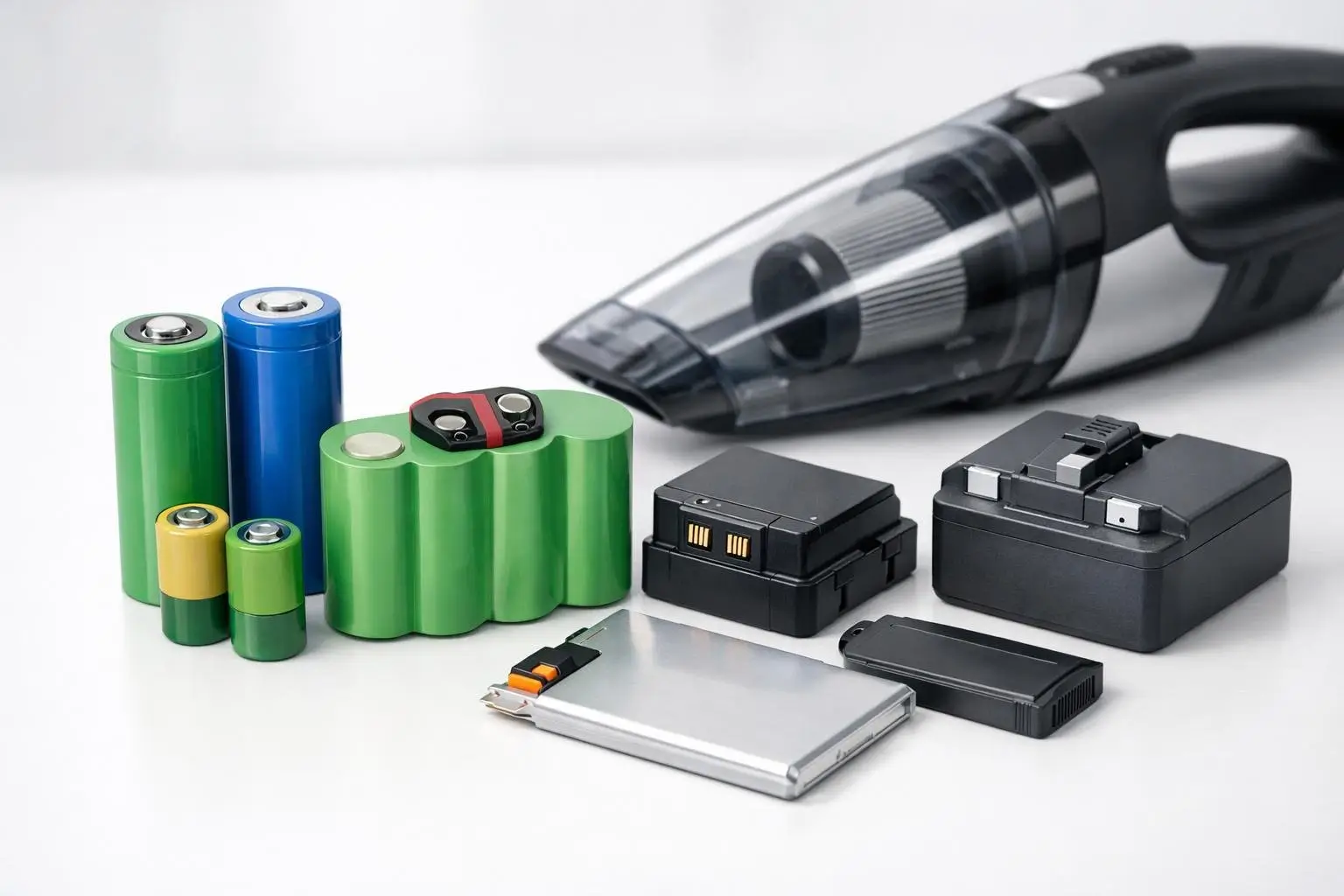
Efficient cordless vacuum cleaners and car units rely on specific battery technologies that determine runtime, power output, and overall performance. The choice between lithium-ion, lithium-polymer, and specific cell configurations directly affects your product’s market positioning and customer satisfaction.
Lithium Ion Battery
The car vacuum cleaner lithium ion battery represents the most widely adopted power source in the cordless portable vacuum cleaner technology sector. These batteries deliver consistent voltage output throughout the discharge cycle, maintaining steady suction power until nearly depleted.
Lithium-ion batteries offer energy densities ranging from 150-250 Wh/kg, providing adequate runtime for typical car cleaning sessions of 15-30 minutes. They require minimal maintenance and lack memory effect, allowing partial charging without degrading capacity.
Cost efficiency makes lithium-ion the standard choice for mid-range cordless car vacuum models. The technology supports 300-500 full discharge cycles before capacity drops to 80% of its original performance.
Lithium Polymer Battery
Lithium-polymer batteries use gel-like electrolytes instead of liquid solutions, enabling flexible form factors for portable car vacuum lithium batteries. This construction method allows manufacturers to create custom-shaped battery packs that fit compact vacuum housings.
LiPo batteries deliver higher discharge rates than standard lithium-ion, supporting more powerful motors in battery-powered handheld vacuum cleaner applications. They weigh approximately 10-20% less than equivalent lithium-ion cells with the same capacity.
The flexible pouch design eliminates rigid metal casings, though it requires protective circuitry to prevent swelling during charge cycles. LiPo batteries cost 15-30% more than standard lithium-ion options but provide design advantages for premium product lines.
18650 Lithium Battery Cells
The 18650 lithium battery vacuum cleaner configuration uses cylindrical cells measuring 18mm in diameter by 65mm in length. These standardized cells offer capacities between 2000 and 3500mAh per cell, with multiple cells connected in series and parallel arrangements.
Common 18650 Configurations:
- 3S1P: 10.8V-12.6V, 2000-3500mAh
- 2S2P: 7.2V-8.4V, 4000-7000mAh
- 3S2P: 10.8V-12.6V, 4000-7000mAh
Manufacturing simplicity and widespread availability keep costs competitive at $2-5 per cell, depending on capacity and brand. The rigid cylindrical structure provides excellent thermal management and mechanical stability during operation.
21700 Lithium Battery Cells
The 21700 lithium battery vacuum cleaner format measures 21mm diameter by 70mm length, offering 35-50% more capacity than 18650 cells in comparable configurations. Individual cells deliver 4000-5000mAh capacity with improved energy density of 250-300 Wh/kg.
This newer cell format supports higher continuous discharge rates of 15-20A, enabling more powerful motor designs in cordless car vacuum lithium battery packs. The increased thermal mass improves heat dissipation during sustained use.
Despite higher per-cell costs of $4-8, the 21700 format reduces total battery pack complexity by requiring fewer cells for target voltage and capacity specifications. Your product can achieve longer runtime or higher power output within similar physical dimensions.
Built In Battery Vs Removable Battery
Built-in battery designs integrate power cells directly into the vacuum housing with charging ports on the unit exterior. This approach reduces manufacturing costs by 20-30% and eliminates electrical connectors that can fail over time.
Removable battery configurations allow users to swap depleted packs for charged ones, extending work sessions without downtime. This design appeals to professional detailers and simplifies the provision of spare parts for your customers.
| Cost | Lower | Higher |
| Convenience | Moderate | High |
| Replacement | Service Required | User-Replaceable |
| Weatherproofing | Better Sealing | Potential Gaps |
The removable option increases unit cost by $8-15 but provides clear value for power users. Built-in batteries simplify product design and reduce points of ingress for dust and moisture.
Custom Battery Capacity Options Available For OEM Projects

Battery capacity selections range from compact 2000mAh units to premium options exceeding 6000mAh, each designed to meet specific performance requirements and market positioning strategies. The choice directly impacts runtime, device weight, and charging characteristics of your cordless car vacuum product line.
2000mAh Compact Models
These entry-level batteries power lightweight, budget-friendly cordless handheld car vacuum units ideal for quick cleaning tasks. A 2000mAh compact cordless car vacuum battery typically delivers 8-12 minutes of continuous operation at standard suction settings.
The reduced capacity keeps your product weight under 400 grams, making it highly portable for consumers who prioritize convenience over extended cleaning sessions. Charging time averages 2-2.5 hours with standard adapters.
This configuration works well for promotional products, airline amenity kits, or secondary cleaning devices that complement primary vacuum systems. Manufacturing costs remain low while maintaining reliable lithium battery vacuum cleaner performance for light-duty applications. These models are frequently paired with a crevice tool to enhance versatility in tight spaces.
4000mAh Standard Models
Standard capacity options represent the most popular choice for mainstream cordless car vacuum battery configurations. Your custom battery capacity cordless car vacuum achieves 15-20 minutes of runtime, sufficient for thorough interior vehicle cleaning.
These batteries balance performance and portability effectively. Product weight typically ranges from 500 to 650 grams, which most users find comfortable for extended handheld operation.
The 4000 mAh capacity provides consistent suction power throughout the discharge cycle. Many brands pair this capacity with advanced brushless motors to improve efficiency and longevity. Car vacuum cleaner lithium battery sourcing at this capacity level offers favorable pricing due to high production volumes and component availability.
Charging takes 3-4 hours, aligning with consumer expectations for overnight or between-use charging.
6000mAh High Performance Models
High-capacity 6000mAh batteries position your product as a premium, long runtime cordless car vacuum in competitive markets. Runtime extends to 25-30 minutes of continuous operation, enabling complete vehicle detailing without recharging.
This high-capacity battery-powered vacuum configuration appeals to professional detailers, ride-share drivers, and consumers with larger vehicles that require extended cleaning sessions. The increased cell count adds 150-200 grams compared to standard models, bringing total unit weight to approximately 750-850 grams.
Advanced battery management systems become essential at this capacity level to optimize cell balancing and thermal management. Your custom lithium battery vacuum cleaner maintains consistent performance throughout its extended runtime.
Charging time increases to 4-5 hours with standard chargers, though fast-charging implementations can reduce this to 2.5-3 hours.
Higher Capacity Options For Premium Products
Custom configurations beyond 6000 mAh serve specialized applications that require maximum runtime and professional-grade performance. Options include 8000mAh, 10000mAh, and modular battery systems for cordless car vacuum battery upgrade opportunities.
These premium specifications support sustained high-power suction modes. They power additional features like multi-stage filtration and a HEPA filter that demand increased energy consumption. This ensures the cordless vacuum remains effective for heavy-duty detailing.
Portable cleaning device battery technology at these capacities enables 40+ minutes of operation, eliminating range anxiety for commercial users. Your sourcing strategy should account for longer lead times and minimum order quantities for specialized cell configurations.
Fast-charging infrastructure becomes standard rather than optional, with many implementations supporting quick-charge protocols that restore 80% capacity within 90 minutes.
Runtime
Actual runtime varies based on suction power settings, ambient temperature, and battery age. Maximum suction modes typically consume 35-45W, reducing operational time by 30-40% compared to standard settings.
Your testing protocols should measure performance at both maximum and eco modes to provide accurate specifications. A 4000mAh battery delivers approximately 15-18 minutes at high power versus 25-30 minutes at reduced suction.
Temperature affects lithium cell performance significantly. Runtime decreases by 15-20% in cold weather below 10°C, which matters to customers in colder climates.
Battery management systems with accurate state-of-charge indicators prevent unexpected shutdowns and improve user experience with your long runtime cordless car vacuum products.
Product Weight
Each 1000 mAh capacity increase adds approximately 35-45 grams to the total product weight. Your design team must balance battery capacity against ergonomic requirements for handheld operation.
Compact 2000mAh models maintain portability advantages crucial for travel and emergency use applications. Standard 4000 mAh configurations fall within the optimal weight range, where most users can comfortably operate the device for full cleaning sessions.
Premium 6000mAh+ models require careful weight distribution and grip design considerations. Some manufacturers offset battery weight by using lighter motor housings or composite materials in non-structural components.
Consumer research indicates 800 grams represents a practical upper limit for comfortable single-handed operation during typical 5-10 minute cleaning tasks.
Charging Time
Charging duration directly correlates with battery capacity and charger output specifications. Standard 5V/2A adapters charge 4000mAh batteries in 3-4 hours, while 6000mAh units require 4-5 hours.
Fast-charging implementations using 9V/2A or 12V/1.5A outputs reduce charging time by 35-50%. Your custom lithium battery vacuum cleaner can incorporate quick-charge capabilities with appropriate battery management circuitry and thermal monitoring.
USB-C charging ports provide versatility for users who prefer charging from laptops, power banks, or automotive USB outlets. This feature adds value without significant cost increases.
Trickle charging extends battery longevity by switching to maintenance mode once the battery reaches full capacity. Quality battery management systems prevent overcharging damage that reduces cycle life in cordless handheld car vacuum battery applications.
Battery Pack Configuration Options
The car vacuum cleaner battery pack design involves selecting the right combination of cells, voltage levels, and protection systems to match your product specifications. These configuration choices directly impact runtime, charging speed, and safety performance.
Number Of Battery Cells
The car vacuum cleaner battery configuration typically uses 3 to 10 cells connected in series, depending on your required voltage and capacity targets. A 3-cell pack provides 10.8V-12.6V, suitable for compact models with 50-80W motors. A 5-cell configuration delivers 18V-21V for mid-range units with 100-150W motors.
For high-performance models, 6 to 10 cells arranged in series-parallel combinations can achieve both higher voltage and capacity. Your OEM manufacturer can configure cells in 2S2P, 3S2P, or 5S2P arrangements to balance power output with physical dimensions.
The cell count affects the battery management complexity and cost. More cells require additional monitoring circuits and balancing components.
Battery Pack Voltage
Standard car vacuum cleaner battery pack voltage options include 10.8V, 14.4V, 18V, and 21V nominal ratings. The 10.8V packs work well for lightweight handheld vacuum lithium battery pack applications under 80W. The 14.4V configuration suits general-purpose cleaning with 100-120W motors.
Higher voltage packs at 18V and 21V enable 150-200W motors for maximum suction power. Your chosen voltage must match the motor specifications and charging infrastructure. The voltage directly influences the current draw—higher voltage reduces current requirements for the same power output, improving efficiency.
Most portable vacuum cleaner battery pack designs use 18V as the standard for balancing performance and compatibility with existing tool ecosystems.
Battery Management System
The car vacuum cleaner battery management system monitors cell voltages, temperatures, and current flow to protect the pack during operation. Your BMS prevents overcharging by cutting power at 4.2V per cell and stops discharge at 2.5-3.0V per cell to extend lifespan.
Active cell balancing redistributes charge among cells during charging cycles, maintaining uniform capacity across the pack. Temperature sensors trigger protection when cells exceed 60-70°C during heavy use or charging.
Key BMS Functions:
- Real-time voltage monitoring for each cell
- Current limiting during discharge and charge cycles
- Short circuit protection with automatic cutoff
- State of charge calculation and communication
- Thermal management and overheat protection
Your BMS choice affects the portable vacuum cleaner battery design, reliability and warranty coverage.
Battery Protection Board
The car vacuum cleaner battery protection board serves as the primary safety barrier against electrical faults and misuse conditions. This circuit board houses MOSFETs that disconnect the battery when overcurrent is detected, typically set at 15-30A for vacuum applications.
Protection boards include multiple safety layers: primary protection responds within microseconds to short circuits, while secondary protection handles sustained overcurrent conditions. The board also prevents reverse polarity connections that could damage internal components.
Physical placement within the handheld vacuum lithium battery pack varies—some designs integrate the protection board with the BMS, while others use separate modules. Your board must handle the peak current demands of your motor, typically 2-3 times the rated operating current for startup surges.
Cell Brand Options
You can select from tier-one manufacturers like Samsung, LG, or Panasonic for premium builds. These brands offer 18650 or 21700 cells with proven performance data. Our quality control team ensures these cells meet strict safety testing documentation.
Tier-two options from manufacturers such as EVE, Lishen, and BAK offer competitive pricing while maintaining acceptable quality standards. Your cell choice affects cycle life expectations—premium cells deliver 500-800 cycles to 80% capacity, while economy options typically reach 300-500 cycles.
| Samsung/LG | 2500-3000mAh | 600-800 | Premium |
| Panasonic | 2900-3500mAh | 500-700 | Premium |
| EVE/BAK | 2200-2600mAh | 400-600 | Mid-range |
The cell brand impacts your product positioning and warranty terms. Premium cells justify higher retail prices and extended warranty periods.
Charging System Options For Different Battery Capacities
Battery capacity directly influences which charging system works best for your cordless vacuum cleaners and other car vacuum OEM products. Higher-capacity batteries require more robust charging infrastructure, while smaller cells can use standard USB solutions.
USB Type C Charging
USB Type C has become the standard for cordless car vacuum charging systems with capacities up to 2500 mAh. This connector delivers up to 100W of power through compatible cables and adapters, making it suitable for most consumer-grade models.
Your vacuum cleaners with 1500-2000mAh batteries typically charge at 5V/2A through USB Type C ports. Universal compatibility lets customers charge their devices with phone chargers, power banks, or car USB ports.
Key USB Type-C specifications for car vacuums:
- Power delivery: 15W to 45W
- Voltage range: 5V to 20V
- Current capacity: Up to 3A standard, 5A maximum
- Cable durability: 10,000+ insertion cycles
Models with higher-capacity batteries benefit from the USB Power Delivery (PD) protocol, which automatically negotiates an optimal charging voltage.
DC Charging Ports
DC charging ports provide dedicated power for batteries ranging from 2000 mAh to 5000 mAh in professional-grade units. These circular barrel connectors provide stable voltage delivery without the complexity of USB protocols.
Your 12V DC charging systems work efficiently with 2.5mm or 5.5mm barrel jacks. They connect directly to wall adapters rated between 1A and 3A, depending on battery size.
DC ports eliminate compatibility concerns since each charger pairs specifically with your vacuum model. The dedicated connection prevents voltage mismatches that could damage battery cells. Manufacturing costs remain lower than implementing full USB PD systems, though you sacrifice the convenience of universal charging.
Fast Charging Options
Fast-charging car vacuum cleaners utilize specialized circuits that deliver higher current during the initial charging phase. Your units with batteries of 3000 mAh or larger benefit most from this technology.
Standard fast charging protocols push 2.5A to 3.5A during the first 60-70% of the charge cycle. This reduces overall charging time by 35-45% compared to conventional 1A charging. The system automatically switches to trickle charging as cells approach full capacity.
Fast charging implementation requirements:
- Battery Management System (BMS) with temperature monitoring
- High-grade lithium cells rated for 1C or higher charge rates
- Thermal sensors to prevent overheating
- Smart charging ICs that adjust current flow
Your premium models can incorporate both USB PD and proprietary fast charging, giving customers flexibility in power sources.
Charging Time Comparison
Car vacuum cleaner charging time varies significantly based on battery capacity and charging system implementation. Understanding these differences helps you select appropriate configurations for target markets.
| 1500mAh | 1.5 hours | 1.2 hours | 0.8 hours |
| 2000mAh | 2.0 hours | 1.6 hours | 1.1 hours |
| 2500mAh | 2.5 hours | 2.0 hours | 1.4 hours |
| 3000mAh | 3.0 hours | 2.4 hours | 1.7 hours |
| 4000mAh | 4.0 hours | 3.2 hours | 2.2 hours |
Your 2500mAh models with standard USB charging complete a full cycle in approximately 2.5 hours. The same capacity using fast charging technology drops to 1.4 hours. Budget-conscious customers often accept longer charging times, while professional users prioritize quick turnaround between cleaning sessions.
Battery Safety Certifications For Export Markets
Export markets mandate specific safety certifications to ensure lithium battery safety meets international standards. Distributors must verify these certifications to sell a cordless vacuum in regulated regions. You need transport documentation and environmental compliance marks.
UN38.3 Certification
UN38.3 lithium battery certification is mandatory for shipping lithium batteries internationally by air, sea, or ground transport. This certification requires your battery to pass eight specific tests: altitude simulation, thermal conditioning, vibration, shock, external short circuit, impact, overcharge, and forced discharge.
You must obtain this certification before transporting any cordless car vacuum cleaner containing lithium-ion or lithium-polymer batteries. The testing process typically takes 4-6 weeks and validates that your batteries can withstand the stresses of international shipping without posing fire or explosion risks.
Battery transport regulations for lithium batteries depend on this certification. Without UN38.3, carriers will refuse your shipments, and you face potential legal penalties in most countries.
MSDS Documentation
The Material Safety Data Sheet (MSDS) provides detailed chemical composition and safety handling information for your lithium batteries. You need this MSDS lithium battery document for customs clearance, warehouse storage, and carrier acceptance in virtually all export markets.
Your MSDS must include 16 specific sections: product identification, hazard identification, composition, first aid measures, firefighting measures, accidental release measures, handling and storage, exposure controls, physical properties, stability data, toxicological information, ecological information, disposal considerations, transport information, regulatory information, and additional data. Each section must accurately reflect your specific battery chemistry and design.
Logistics companies require updated MSDS documentation that matches your current battery specifications. This is particularly important when shipping via air freight to customers in Europe or North America. You should update this document whenever you change battery suppliers or modify your cell chemistry.
CE Certification
CE certification for car vacuum cleaners requires compliance with the entire product, including battery safety systems. This mark indicates compliance with EU directives covering electrical safety, electromagnetic compatibility, and restricted substances.
For cordless car vacuums, you need compliance with the Low Voltage Directive (LVD), EMC Directive, and Battery Directive. Your battery management system must prevent overcharging, over-discharging, and short circuits to meet LVD requirements.
The certification process involves testing at a notified body and maintaining technical documentation. You must keep test reports, circuit diagrams, and risk assessments on file for regulatory inspections.
FCC Certification
FCC certification handheld vacuum requirements focus on electromagnetic interference generated by your motor and charging system. Part 15 Class B limits apply to consumer products, requiring your device to operate without causing harmful interference to other electronics.
Your vacuum’s switching power supply and DC motor create electromagnetic emissions during operation and charging. These emissions must stay within specified limits across frequency ranges from 150 kHz to several GHz.
You need both radiated and conducted emissions testing at an accredited laboratory. The certification assesses your product’s ability to withstand interference without malfunction, which is critical for battery charging circuits that must operate reliably in electrically noisy environments.
RoHS Compliance
RoHS-compliant vacuum cleaner certification restricts 10 hazardous substances in electrical products sold in the EU, UK, China, and many other markets. Your lithium batteries and circuit boards cannot exceed the maximum concentrations for lead, mercury, cadmium, hexavalent chromium, polybrominated biphenyls, polybrominated diphenyl ethers, and four types of phthalates.
Battery manufacturers typically provide RoHS compliance declarations, but you remain responsible for verifying component compliance throughout your supply chain. You should request test reports showing concentrations below the threshold limits.
Many retailers now require RoHS certification even in non-regulated markets. This certification has become a baseline expectation for consumer electronics worldwide.
PSE Certification For Japan
PSE-certified lithium battery requirements apply to all lithium batteries over 100Wh sold in Japan, though many importers also request it for smaller capacities. The Japanese government requires this mark under the Electrical Appliance and Material Safety Law.
You must register your business with the Japanese government and work with a local authorized representative. Testing covers electrical safety, charging system protections, and battery management system performance under various conditions.
Lithium battery shipping compliance for Japan requires both UN38.3 and PSE marks. The certification process takes 8-12 weeks and involves battery cell testing plus finished product evaluation. You need to prominently display the PSE mark on your product packaging and include Japanese-language safety warnings.
How Battery Capacity Affects OEM MOQ And Pricing
Battery capacity directly influences minimum order quantities and project costs. We provide technical support to help you balance capacity and budget. Certification requirements and tooling expenses scale proportionally with the specs of the cordless vacuum.
Standard Battery MOQ
Standard battery configurations typically require MOQs between 500-1,000 units for cordless car vacuum cleaner projects. These cells use common specifications like 2000mAh, 2500mAh, or 3000mAh in 18650 or 21700 formats already stocked by battery manufacturers.
Your unit costs remain lower because these batteries share production runs with other clients. Lead times average 25-35 days, as no custom battery pack assembly is required.
Common Standard Capacities:
- 2000mAh: $3.20-$4.50 per cell
- 2500mAh: $4.00-$5.80 per cell
- 3000mAh: $5.50-$7.20 per cell
Standard battery MOQs enable faster vacuum cleaner product development launches. Kinzir offers low MOQ options for standard capacities to help emerging brands test market demand before committing to custom specifications.
Custom Battery MOQ
Custom capacity batteries require MOQs starting at 2,000-3,000 units due to dedicated production scheduling. Specifications outside standard ranges—such as 2200mAh, 2800mAh, or 3500mAh—need separate manufacturing batches.
Your per-unit costs increase by 15-25% compared to standard options. Battery suppliers must configure production lines specifically for your order, which will extend lead times to 45-60 days.
Custom Capacity Price Premium:
| 2100-2400mAh | 2,000 units | +15-18% |
| 2600-2900mAh | 2,500 units | +18-22% |
| 3100-3800mAh | 3,000 units | +22-25% |
Volume commitments above 5,000 units can reduce custom pricing to near-standard levels.
Tooling Requirements
Battery pack assembly tooling costs range from $1,800 to $4,500, depending on pack configuration and cell count. Multi-cell packs requiring series-parallel arrangements need custom welding fixtures and protection circuit board holders.
Your tooling investment includes spot-welding jigs, heat-shrink tunnels, and testing fixtures calibrated to your specific voltage and capacity. These costs are amortized across your order quantity.
Single-cell configurations minimize tooling to $1,800-$2,200. Three-cell or four-cell packs increase tooling to $3,200-$4,500 due to balance circuit integration requirements.
Tooling remains your property and can be reused for subsequent orders, reducing costs on repeat productions. Production lead time for standard configurations is typically shorter than for fully customized battery packs.
Battery Certification Costs
UN38.3 transportation certification costs $800-$1,200 per battery configuration and is mandatory for all lithium-ion shipments. IEC 62133 safety certification adds $1,500-$2,800, depending on capacity and chemistry testing requirements.
Your certification expenses scale with capacity because larger cells require extended abuse testing cycles. Batteries above 3000 mAh require additional thermal runaway evaluations, costing $600-$900.
Required Certifications by Market:
- North America: UL 2054 ($2,200-$3,500)
- European Union: CE/RoHS ($1,800-$2,600)
- Asia-Pacific: PSE/KC ($1,400-$2,100)
Certification timelines span 4-8 weeks and must be completed before production begins. You can share certification costs across multiple OEM vacuum cleaner models with identical battery specifications.
Battery Runtime Testing In Factory Production
Factory battery runtime testing and rigorous quality control validate performance specifications. We also facilitate third-party inspection to ensure each cordless car vacuum meets international operational standards before shipping. Testing protocols verify discharge characteristics, load performance, and long-term durability.
Full Charge Discharge Testing
Your battery discharge testing vacuum cleaner protocol begins with a complete charge cycle using calibrated power supplies that match final consumer charging conditions. Each battery pack reaches its maximum voltage threshold, typically 16.8V for a 4-cell lithium configuration, before technicians initiate the discharge sequence.
The discharge test runs at a constant current draw that simulates typical vacuum operation, usually between 3A and 5A, depending on motor specifications. Automated testing equipment records voltage drop over time until the battery management system triggers the low-voltage cutoff, generally around 12V for lithium-ion cells.
Your production line captures critical data points, including total runtime, voltage curve characteristics, and capacity in milliamp-hours. Units that fail to meet the specified runtime threshold in your design parameters are flagged for battery replacement or further diagnosis.
Runtime Testing Under Load
Cordless car vacuum runtime testing under load replicates real-world usage conditions by attaching actual motor assemblies and suction components to battery packs. Your test fixtures apply variable loads that mirror different cleaning scenarios, from light dust pickup at 40W to maximum suction at 120W or higher.
Test operators run each unit through standardized duty cycles that alternate between high-power bursts and moderate continuous operation. A typical cycle includes 30 seconds of maximum suction, followed by 90 seconds at 60% power, repeated until the battery is depleted. This approach reveals how batteries perform during the intermittent usage patterns your customers actually experience.
Your quality inspection system measures temperature rise in both the battery pack and motor housing during these tests. Excessive heat indicates potential issues with cell matching, internal resistance, or inadequate thermal management in your portable vacuum cleaner electronics assembly.
Protection Circuit Testing
Your battery management system undergoes verification testing to confirm that over-discharge, over-charge, short-circuit, and temperature protection functions activate correctly. Technicians deliberately trigger each protection condition using controlled test equipment to ensure the circuitry responds within specification limits.
Over-discharge testing forces the battery below its safe voltage threshold while monitoring the cutoff response time, which should occur within 100 milliseconds. Over-charge testing applies excessive voltage to verify the protection circuit prevents cell damage before reaching dangerous levels.
Short-circuit testing involves momentarily creating a low-resistance path to confirm current limiting engages immediately. Temperature sensor validation uses thermal chambers to verify the system disables charging or discharging when cells exceed safe operating ranges of 0°C to 45°C for charging and -20°C to 60°C for discharging.
Product Durability Testing
Your car vacuum cleaner durability testing subjects random production samples to accelerated battery-cycle-life vacuum cleaner protocols that simulate months or years of typical use. Sample units undergo 300 to 500 complete charge-discharge cycles at elevated temperatures to predict long-term performance degradation.
The vacuum cleaner production line includes drop testing from heights of 1 meter onto concrete surfaces to verify battery pack integrity and connection stability. Vibration testing on shake tables simulates automotive environment stresses that your cordless units encounter during storage in vehicle trunks.
Your car vacuum cleaner quality inspection tracks capacity retention throughout cycle testing, with acceptable products maintaining at least 80% of original capacity after the full test sequence. Units showing premature capacity fade, physical damage, or protection circuit failures trigger batch reviews and potential design modifications.
How Private Label Brands Choose The Right Battery Capacity
Battery capacity selection affects runtime, product dimensions, and market positioning for your cordless car vacuum private-label offering. Private label brands typically align battery choices with target customer expectations and price points across compact, balanced, and premium segments.
Compact Products For Portability
Compact cordless car vacuum models typically use 2000-2500mAh battery packs to minimize weight and size. Your customers prioritize easy storage in glove compartments or door pockets over extended cleaning sessions.
These units weigh between 400 and 600 grams and measure 12 to 15 inches in length. The smaller battery configuration reduces manufacturing costs by 15-25% compared to higher-capacity alternatives. Laser engraving allows for premium branding on these sleek, portable units.
Private-label car vacuum cleaner brands targeting occasional users or secondary vehicle-cleaning tools should choose this specification. The 8-12 minute runtime handles quick cleanups of crumbs, dust, and light debris without requiring professional-grade performance.
Balanced Products for the Amazon Market
Amazon car vacuum supplier partnerships commonly center on 3000-4000mAh configurations that balance performance with competitive pricing. This capacity range delivers 15-20 minutes of continuous operation at moderate suction levels.
Your balanced specification maintains portability while providing enough power for complete cleaning of the vehicle interior. Product weight stays within 650-850 grams, meeting customer expectations for handheld operation without fatigue.
Market positioning advantages:
- Compatible with fast-charging protocols (60-90 minute full charge)
- Competitive price points between $35-$65 retail
- Sufficient runtime for sedan and compact SUV interiors
- Favorable review metrics on marketplace platforms
This segment accounts for 60-70% of private-label cordless car vacuum sales volume across major online retailers.
High-Capacity Products For Premium Positioning
Premium custom portable vacuum cleaner design specifications utilize 5000-7000mAh battery systems for professional-grade performance. Your high-capacity models target detail enthusiasts and commercial users requiring 25-35 minutes of runtime.
These products incorporate dual-cell configurations with battery management systems for longevity and safety. They often include a rotating brush head to handle deep-seated dirt in car carpets. The additional capacity adds 200-300 grams to the total unit weight but enables multi-vehicle cleaning sessions.
Private label brands position these models at $80-$150 retail, with enhanced features such as digital displays and multiple power modes. The larger battery housing requires redesigned ergonomics to maintain comfortable handling despite increased dimensions.
Runtime
Runtime requirements directly determine the minimum battery capacity for your portable car vacuum product positioning strategy. A 3000mAh battery provides approximately 15 minutes of operation at 60W, while a 6000mAh battery extends that to 30 minutes at the same wattage.
Customer expectations vary by market segment. Budget-conscious buyers accept 10-12 minute sessions for basic cleaning tasks. Premium segment customers expect 20+ minutes for thorough detailing, including upholstery, floor mats, and the trunk area.
You should calculate runtime based on your motor’s actual power draw under load rather than peak specifications. Include 15-20% capacity buffer to account for battery degradation over 300-500 charge cycles.
Product Size
Battery capacity directly influences the dimensions and handling characteristics of your portable car cleaning device. Each 1000 mAh increase adds approximately 20-30mm to unit length or 15-20mm to diameter, depending on cell configuration.
Size impacted by capacity:
| 2000-2500mAh | 280-320mm length | 400-600g |
| 3000-4000mAh | 320-360mm length | 650-850g |
| 5000-7000mAh | 360-420mm length | 900-1200g |
Your industrial design must compensate for larger batteries through ergonomic grip placement and weight distribution. Single-handed operation becomes challenging above 900 grams for extended periods.
Price
Battery cells account for 25-35% of total manufacturing costs for private-label cordless car vacuum products. A 2000mAh configuration costs $3-$5 in component expenses, while 6000mAh systems range from $9-$15 depending on cell quality and supplier agreements.
Your retail pricing must reflect these cost differences while maintaining competitive margins. Budget models with smaller batteries support a $25-$45 retail positioning, while premium-capacity units justify $75-$150 price points.
Lithium-ion cell quality significantly impacts longevity and safety certifications required for major retailers. Higher-grade cells add $1-$3 per 1000mAh but reduce warranty claims and improve customer satisfaction scores.
Conclusion
Selecting the right battery capacity for your cordless vacuum directly impacts product performance. We integrate strict quality control into every manufacturing stage. Your choice of battery shapes the final market positioning and price point.
Key considerations for battery selection include:
- Usage duration requirements – Match capacity to typical cleaning sessions
- Weight and portability balance – Higher capacity adds weight.
- Target market expectations – Consumer versus professional use cases
- Cost-to-performance ratio – Budget constraints and value proposition
We manufacture custom battery configurations tailored to your specific product requirements. Our engineering team works with you to determine optimal voltage, amp-hour ratings, and cell configurations.
The battery capacity you choose establishes your product’s competitive advantage. A 2000 mAh option suits quick vehicle cleanups, while 4000 mAh or higher serves demanding professional applications. Your target customer’s needs determine the appropriate specification.
Our production capabilities support flexible MOQs across different capacity tiers. You can test market response with smaller initial orders before scaling production. We maintain quality standards across all battery capacities through rigorous testing protocols.
Battery customization options available:
- Capacity ranging from 2000mAh to 6000mAh
- Voltage configurations (7.4V, 11.1V, 14.8V)
- Cell types (lithium-ion, lithium-polymer)
- Custom battery management systems
- Proprietary connector designs
Contact our technical team to discuss your battery capacity requirements. We offer expert technical support and performance data. We provide samples and comprehensive after-sales service for all our distributors.
Frequently Asked Questions
Battery capacity options for OEM cordless car vacuum cleaners range from standard configurations to specialized solutions designed for different operational requirements. Understanding how capacity affects performance, customization possibilities, and charging characteristics helps you make informed procurement decisions.
What are the available battery capacity choices for OEM cordless car vacuum cleaners?
Standard battery capacities typically range from 2000 mAh to 6000 mAh for cordless car vacuum cleaners. Most OEM manufacturers offer three primary tiers: economy models with 2000-2500mAh, mid-range units with 3000-4000mAh, and premium configurations with 5000-6000mAh or higher.
You can select from lithium-ion and lithium polymer battery types across these capacity ranges. Commonly available voltage configurations include 7.4V, 11.1V, 14.8V, and 22.2V systems.
How does battery capacity affect the performance of cordless car vacuum cleaners?
Higher battery capacity directly extends your vacuum’s continuous runtime. A 2000 mAh battery typically provides 12-15 minutes of operation, while a 6000 mAh battery can deliver 35-45 minutes under similar conditions.
Battery capacity influences the sustainability of suction power throughout the cleaning cycle. Larger capacity batteries maintain consistent voltage levels longer, which preserves suction strength until the charge depletes significantly.
The weight and physical dimensions of your vacuum increase with battery capacity. Each 1000mAh increment typically adds 30-50 grams to the overall unit weight.
Can the battery capacity be customized according to the specific needs of the order?
Custom battery capacity configurations are available for orders that meet minimum quantity thresholds. You can specify exact milliampere-hour requirements between standard offerings to match your target runtime and price point.
OEM manufacturers accommodate requests for proprietary battery pack designs that integrate specific cell arrangements. This includes series and parallel configurations to achieve the voltage and capacity combination you desire.
Lead times for custom battery solutions typically extend 4-6 weeks beyond standard production schedules. Engineering validation and safety testing requirements add to the development timeline.
What is the typical battery life for high-capacity cordless car vacuum cleaners?
High-capacity batteries rated at 5000-6000mAh generally provide 500-800 full charge cycles before capacity degrades to 80% of original specifications. This translates to approximately 2-3 years of regular use under normal operating conditions.
Cycle life depends on charging habits and operating temperatures. Batteries maintained between 20-25°C and charged before full depletion achieve longer service lives than those subjected to extreme conditions.
Are there minimum order quantities for custom battery options in cordless car vacuum cleaners?
Standard battery configurations typically require minimum orders of 500-1000 units per production run. Custom capacity specifications generally demand higher thresholds of 1000-3000 units to justify tooling and engineering costs.
Your order volume significantly affects per-unit pricing. Orders exceeding 5000 units often qualify for volume discounts of 15-25% compared to minimum quantity pricing.
Some manufacturers offer flexible MOQ arrangements for established clients or orders combining multiple SKUs. You can negotiate consolidated quantities across different models to meet minimum thresholds.
How do different battery capacities impact the charging time and runtime of cordless car vacuum cleaners?
Charging time increases proportionally with battery capacity when using the same amperage charger. A 2000mAh battery charges fully in approximately 2-2.5 hours, while a 6000mAh battery requires 5-6 hours with a standard 1A charger.
You can reduce charging time by upgrading to higher amperage charging solutions. A 2A charger cuts charging duration by roughly 40-50% across all capacity ranges.
Runtime scales directly with capacity under identical operating conditions. A vacuum drawing 15W of power operates for 20 minutes on a 3000mAh 11.1V battery and 40 minutes on a 6000mAh battery of the same voltage.


