
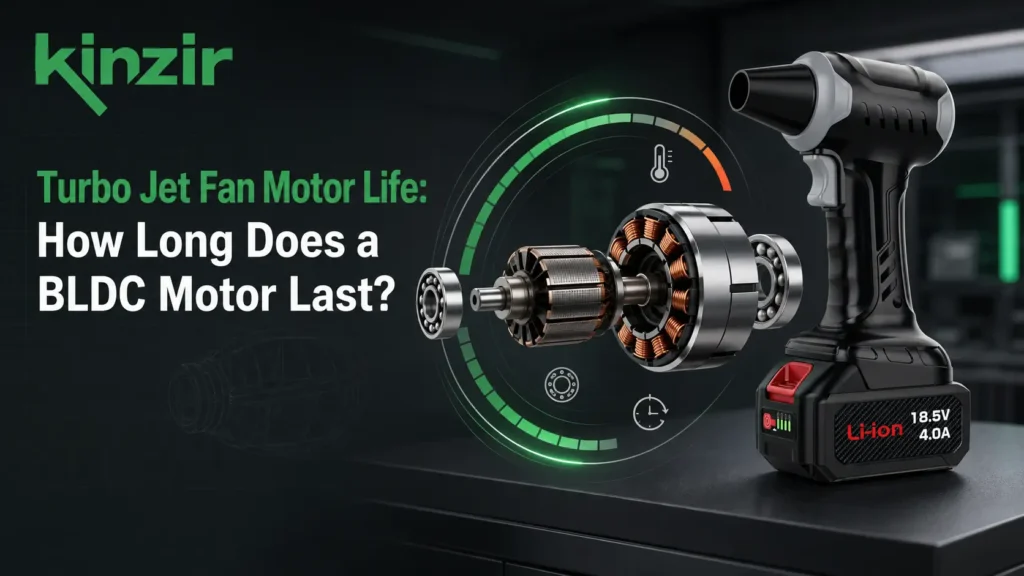
Turbo jet fan motor life depends on bearings, grease, RPM, heat, balance, and duty cycle. A high-speed claim alone tells a buyer little about service life. You need test conditions, sample data, and clear failure limits.
A brushless DC motor removes brushes from the wear system. It still relies on bearings, winding insulation, magnets, adhesives, and electronics. The final fan adds an impeller, battery, controller, air duct, and housing.
Each part changes the result. Buyers should judge the complete product, not a bare motor.
The Short Answer on Turbo Jet Fan BLDC Motor Life
No universal lifespan fits every mini turbo jet fan. A supplier may target 500, 1,000, or 2,000 operating hours. Those figures remain test targets until product-level data supports them.
The test report must name the RPM, load, duty cycle, and ambient temperature. It must record the nozzle, battery, firmware, and cooling setup. Without these facts, an hour claim has little value to buyers.
A daily-use product can accumulate hours slowly. The table below converts a 1,000-hour target into calendar time.
| Daily motor use | Operating hours per year | Time to reach 1,000 hours |
|---|---|---|
| 5 minutes | About 30 hours | About 33 years |
| 15 minutes | About 91 hours | About 11 years |
| 30 minutes | About 183 hours | About 5.5 years |
| 60 minutes | 365 hours | About 2.7 years |
This table does not promise a 1,000-hour product life. It shows how operating hours differ from calendar years. Battery aging, switches, ports, or controller faults may end product use first.
Motor Life, Bearing Life, and Product Life Measure Different Things
Procurement teams often compare lifespan claims that use different units. One supplier quotes motor hours. Another quotes battery cycles or warranty months.
These numbers do not describe the same event.
| Term | What it measures | Common sourcing error |
|---|---|---|
| Motor life | Hours or cycles before the motor reaches a failure limit | Treating it as complete product life |
| Bearing life | Calculated or tested bearing life under stated loads | Treating an L10 value as a guarantee |
| Grease life | Time before lubricant loses working performance | Ignoring grease at high speed |
| Controller life | Driver-board life under electrical and thermal stress | Blaming each shutdown on the motor |
| Battery cycle life | Charge cycles before capacity reaches a set limit | Comparing cycles with motor hours |
| Product life | Life of the complete turbo jet fan | Using one component rating for all parts |
| Warranty period | The supplier’s commercial coverage | Treating coverage as lifespan data |
| Shelf life | Storage time before sale or first use | Ignoring battery aging and corrosion |
A buyer should first define the product failure. Then the supplier can design the right test.
BLDC Motors Remove Brush Wear, Not Every Failure Mode
A brushed motor uses carbon brushes and a mechanical commutator. Friction wears both parts. Electrical arcing can damage the contact surfaces.
A BLDC motor uses electronic commutation. The controller switches current through the stator windings. The rotor carries permanent magnets.
This design removes brush and commutator wear. It suits high-speed products such as mini turbo jet fans. It does not remove bearing wear, grease aging, rotor stress, or winding heat.
| Factor | BLDC motor | Brushed motor |
|---|---|---|
| Commutation | Electronic controller | Brushes and commutator |
| Main wear points | Bearings, grease, insulation, electronics | Brushes, commutator, bearings |
| High-speed use | Better fit | Faster brush and commutator wear |
| Speed control | Accurate electronic control | Simpler control |
| Product cost | Higher | Lower |
| Main buyer risk | Bearing and controller quality | Brush life and commutator wear |
Do not accept “brushless” as proof of long life. Ask for the installed motor test report.
The Weakest Part Sets the Working Life
A turbojet fan motor system comprises more than just a rotor and a stator. Working life can depend on any part of the drive system.
The main life-setting components include the front and rear bearings, grease, and shaft. Rotor magnets, retaining parts, winding insulation, and adhesives matter too. The impeller and controller complete the drive system.
The battery and BMS change current delivery. Firmware sets speed ramps and protection limits. The air path controls motor cooling.
One weak part can end the product’s useful life. A strong bearing cannot save a poor impeller fit. Good windings cannot save a controller that overheats.
Bearings and Grease Often Set the Mechanical Life
High-speed mini turbo jet fans place heavy demands on small bearings. Each bearing turns millions of revolutions in a short test.
Bearing type gives buyers a starting point. The model, grease, preload, fit, and mounting process give the full picture.
| Bearing type | Main strength | Main limit | Typical product fit |
|---|---|---|---|
| Ball bearing | Handles high speed and mixed loads | Needs correct grease and mounting | High-speed turbo jet fans |
| Sleeve bearing | Low cost and simple structure | Heat and shaft position can shorten life | Lower-speed products |
| Fluid dynamic bearing | Low noise and stable rotation | Adds design and supplier complexity | Selected premium designs |
What does L10 bearing life mean?
L10 describes a statistical bearing fatigue life. Under the stated conditions, 90 percent of the bearing population should reach or exceed that value.
ISO 281 gives methods for dynamic load ratings and rating life. It links basic rating life with 90 percent reliability. The standard does not cover wear, corrosion, or electrical erosion. See ISO 281:2007.
Engineers express basic ball-bearing life with these equations:
Here, means the bearing’s dynamic load rating. means the equivalent bearing load. The motor speed appears as , in revolutions per minute.
The formula needs accurate loads. An impeller can add radial and axial forces. Imbalance, shaft runout, preload, and shock can raise the real load.
Why can grease life end before bearing fatigue life?
The L10 fatigue result does not settle grease life. Grease can oxidize, separate, migrate, or lose oil. Heat and speed drive these changes.
SKF identifies bearing type, size, speed, temperature, grease, and environment as main grease-life factors. SKF uses the speed factor in its grease-life work. Read SKF’s grease-life guide.
The mean bearing diameter follows this equation:
The bore diameter appears as . The outside diameter appears as . A small bearing at 150,000 RPM can still reach a high-speed factor.
Ask for the grease name, base oil, thickener, fill level, and temperature range. Ask the bearing maker to confirm the actual speed range.
How do seals, preload, and fits change life?
Contact seals block contamination but add drag. Metal shields or non-contact seals reduce drag. They offer a different level of debris control.
High preload raises friction and bearing heat. Low preload permits shaft movement. That movement can raise noise, impeller runout, and vibration.
Shaft and housing fits need tight control. A rough press process can dent small raceways. A loose fit can allow a bearing to creep into its seat.
Request the bearing model, seal code, grease, preload method, and fit tolerances. Do not accept an ABEC grade as a life rating. ABEC grades describe dimensional tolerances, not complete service life.
Maximum RPM Does Not Equal Continuous RPM
Marketing pages often display one large RPM figure. Buyers need four separate speed values.
| RPM term | Buyer meaning |
|---|---|
| No-load RPM | Bare motor speed without the final impeller load |
| Loaded RPM | Speed with the production impeller and air path |
| Peak RPM | Short-time maximum speed |
| Continuous RPM | Speed the product can hold within approved limits |
A fan may reach 150,000 RPM for a short burst. That figure does not prove continuous use at the same speed.
Higher RPM increases the number of revolutions per hour. It raises the effect of small imbalance errors. The force from imbalance grows with the square of angular speed.
In this equation, means the unbalanced mass. The offset appears as . Angular speed appears as .
Doubling speed can create four times the imbalance force. The exact motor still needs vibration data to be measured.
Ask for a safe operating envelope for every speed setting. The supplier should list the loaded RPM, current, runtime, ambient temperature, and cooldown time.
Use Kinzir’s turbo jet fan specification guide to compare RPM with air speed, pressure, airflow, battery voltage, and nozzle design.
The Impeller and Air Path Set the Real Motor Load
A motor datasheet describes the motor under stated conditions. The final fan changes those conditions.
Impeller diameter, blade angle, shroud clearance, inlet size, and nozzle shape affect torque. They affect airflow and cooling too. A firmware change can shift the operating point again.
The supplier should test the final impeller, production housing, and approved nozzles. A bare motor test cannot represent the finished turbo fan.
| Test condition | Main buyer concern |
|---|---|
| Normal inlet and approved nozzle | Rated current, airflow, RPM, and temperature |
| Restricted inlet | Cooling loss and changed aerodynamic load |
| Alternate nozzle | New pressure, current, noise, and temperature |
| Locked impeller | Stall current and protection response |
| Damaged impeller | Vibration, rubbing, and containment risk |
An inlet restriction does not raise current in every centrifugal design. It may reduce aerodynamic load yet cut cooling airflow. A locked impeller creates a separate high-current fault.
Test both conditions. Record the controller response and internal temperature.
Balance, Runout, and Resonance Control High-Speed Reliability
Small balance errors matter at six-digit RPM. The motor may pass a short function check yet fail after repeated vibration.
The factory should control rotor and impeller balance, as well as final assembly vibration. It should track shaft straightness, bearing-seat runout, and impeller concentricity.
Mold variation can shift blade mass. Adhesive can add uneven mass. A damaged blade can create a new imbalance after sale.
The supplier should sweep through the full speed range. This test can reveal a resonance below maximum RPM. Firmware should pass through that speed instead of holding the motor there.
A buyer should request the balance unit and limit. Common units include g·mm and residual unbalance. Request vibration limits in mm/s, acceleration, or another named method.
Heat Sets the Electrical and Lubrication Limits
Heat attacks several parts at once. It ages winding insulation and grease. It can weaken magnets, adhesives, electronic parts, and battery cells.
Motor current creates winding heat. Controller switching adds heat. Bearings add friction. Airflow removes part of that heat.
A clean inlet may cool the system. A blocked inlet may trap heat. High ambient temperature leaves less thermal margin.
Which temperatures should suppliers measure?
| Measurement point | What it tells the buyer |
|---|---|
| Winding hot spot | Insulation stress |
| Bearing area | Grease and bearing stress |
| Controller MOSFET | Driver thermal margin |
| Rotor or magnet area | Magnet and adhesive risk |
| Battery cells | Cell aging and protection margin |
| Product housing | User contact temperature |
Housing temperature does not show every internal hot spot. A cool grip can hide a hot winding or controller.
Ask for thermocouple locations and measurement methods. The report should state ambient temperature, battery charge, nozzle, gear, and test time.
IEC 60085 separates thermal classes for insulation materials and systems. It sets criteria for evaluating thermal endurance. See IEC 60085:2007.
Do not apply one “10°C halves life” rule to every part. Grease, insulation, magnets, and electronics follow different aging models. Product tests should verify the full temperature system.
Duty Cycle Needs Run Time, Rest Time, and Starts
Duty cycle means more than an on-time percentage. Cycle length changes the motor’s heat path.
Five seconds on and five seconds off creates a 50 percent duty cycle. Five minutes on and five minutes off creates the same percentage. The second cycle can drive a higher internal temperature.
Starts add current and mechanical stress. Hot restarts leave less cooling margin. Rapid gear changes can create new electrical loads.
| Duty detail | Example test condition |
|---|---|
| Run time | 60 seconds |
| Rest time | 120 seconds |
| Speed level | Maximum setting |
| Ambient temperature | 25°C |
| Starts per hour | 20 |
| Hot restart | Allowed or blocked |
| Test length | 500 cycles |
| Temperature limit | Named for each sensor point |
IEC 60034-1 covers ratings and performance for rotating electrical machines. The 2026 edition replaced the 2022 edition. See IEC 60034-1:2026.
Consumer turbo-jet fans require product-specific test profiles. Use the standard’s duty concepts as a reference, then match the test to customer use.
Battery and Controller Behavior Affect Motor Stress
The battery supplies voltage and current. Voltage sag can lower motor speed. The controller may draw more current to hold a target RPM.
That strategy protects airflow but adds heat. Thin wires, weak connectors, or poor solder joints can add resistance.
The controller should manage overcurrent, low-voltage, high-temperature, and locked-rotor faults. Soft start can reduce startup shock. A timed high-speed limit can control heat.
Ask whether the report records battery current, motor phase current, or both. These values do not mean the same thing.
Test at full charge and near low-voltage cutoff. Repeat the test with aged battery samples. A fresh cell can hide weak system margin.
Removable-battery projects need additional interface checks. Review Kinzir’s OEM detachable battery turbo jet fan guide for battery contacts, latches, BMS, testing, and packaging.
Dust, Water, Debris, and Altitude Change Service Life
Field use rarely matches laboratory conditions. Fine dust can enter cooling paths. Hair can wrap around a shaft. Sand can strike the impeller.
Water creates risks for bearings, windings, and electronics. Cold storage changes grease behavior and battery output. High ambient heat cuts thermal margin.
Low air density at high altitude can reduce cooling. It can change airflow and load. Buyers who sell into mountainous regions should include altitude in the test plan.
Do not use “waterproof” without a named test result. IEC 60529 classifies enclosure protection through IP codes. See IEC 60529.
An IP claim needs an exact SKU and test report. Nozzle changes, vents, switches, and charging ports can affect the enclosure result.
Shipping and Storage Can Damage a New Motor
A new fan can reach the buyer with bearing damage. Stationary bearings can suffer false brinelling under repeated transport vibration.
NSK links false brinelling with vibration and swaying at rolling contact points. NSK lists transport vibration as one cause. Read NSK’s false brinelling guide.
The packaging plan should secure the product and protect the impeller. The supplier should run carton vibration and drop tests.
Long storage adds other risks. Humidity can corrode metal parts. Poor battery storage can cut capacity. Heat can age cells and grease before sale.
Ask for storage temperature, humidity, and charge guidance. Add a warehouse-aging check for long seasonal programs.
Real Applications Need Different Life Targets
One test profile cannot represent every buyer. A keyboard duster may run for seconds. A car dryer may run near maximum speed for several minutes.
Commercial detailing can add hours each day. Outdoor use adds water, ash, sand, and temperature swings.
| Application | Common use pattern | Main motor risk |
|---|---|---|
| Keyboard and electronics cleaning | Short bursts and frequent starts | Dust entry and start cycles |
| Car drying | Longer runs at high gear | Heat and duty cycle |
| Workshop cleaning | Repeated daily use | Dust and bearing contamination |
| Camping and fire starting | Outdoor burst use | Ash, heat, and debris |
| Light snow or water removal | Cold and wet use | Moisture and thermal shock |
| Commercial detailing | High daily operating hours | Bearing, battery, and switch wear |
Set the application before you approve the motor. Then define RPM, duty cycle, ambient range, noise, and target life.
Complete Product Life Needs Separate Tests
A durable motor cannot guarantee a durable turbo jet fan. The complete product contains many parts with different failure units.
| Product part | Useful life measure |
|---|---|
| Motor | Operating hours and start-stop cycles |
| Bearings | L10 calculation plus endurance testing |
| Battery | Charge and discharge cycles |
| Trigger or key | Actuation cycles |
| Charging port | Insertion and extraction cycles |
| Impeller | Overspeed, impact, and fatigue tests |
| Housing | Drop and thermal tests |
| Controller | Thermal cycles and operating hours |
A 2,000-hour bare-motor claim does not cover the battery or the trigger. Ask the supplier to map component tests to one product-life target.
A Motor Life Test Needs a Written Plan
A good report starts with a test plan. Many engineering teams call this a DVP&R, or design verification plan and report.
The plan should lock the product configuration. It should name the motor, bearings, impeller, controller, battery, firmware, nozzle, and housing.
| Test item | Information the buyer needs |
|---|---|
| Product configuration | Final parts and firmware revision |
| Sample count | Units started, completed, and failed |
| Operating mode | RPM, gear, nozzle, and inlet condition |
| Duty cycle | Run time, rest time, starts, and hot restarts |
| Environment | Temperature, humidity, dust, and altitude |
| Measurements | RPM, current, temperature, airflow, noise, vibration |
| Failure limits | Exact pass and fail thresholds |
| Test length | Hours, cycles, or both |
| Inspection points | Initial, scheduled, and final checks |
| Failure review | Teardown and root-cause report |
Run the test on production-intent samples. Use the final balance limits and assembly process. A hand-built sample can hide factory variation.
Life Statistics Need Sample Size and Confidence
One surviving unit does not prove a product family. Five units of 100 hours do not add up to 10,000 hours.
Buyers should separate L10, mean life, MTTF, MTBF, unit-hours, and warranty. Each term answers a different question.
| Claim | What it tells the buyer |
|---|---|
| L10 or B10 life | Life that 90 percent should exceed under stated assumptions |
| Mean life | Average life for the modeled population |
| MTTF | Estimated time to failure for non-repairable items |
| MTBF | Reliability measure often used for repairable systems |
| Unit-hours | Total test hours across all samples |
| No failures | A test result within a limited sample and time |
| Warranty | Commercial coverage, not a life model |
Ask for the sample count, failure times, and surviving units. Ask for the confidence level and failure distribution.
Engineers often use Weibull analysis for life data. The shape parameter can help separate early failures from wear-out behavior. NIST describes Weibull as a flexible life distribution model. See the NIST Weibull guide.
A no-failure test still needs a confidence calculation. The report should state what the sample size can support.
End-of-Life Limits Must Cover Performance Drift
A motor can keep spinning after the product loses its value. Speed may fall. Current, noise, vibration, or startup time may rise.
Set failure limits before testing. Record initial and final results with the same instruments and setup.
The limits should cover failure to start, loss of speed, and loss of airflow. They should cover current increase, noise, vibration, bearing play, and thermal shutdown.
Add limits for scraping, odor, controller faults, and impeller contact. A unit that spins may still fail its product specification.
Burn-In, Endurance, and Accelerated Tests Serve Different Jobs
Factories use several tests during development and production. Buyers should know what each test proves.
| Test type | Main job |
|---|---|
| Production function test | Finds assembly and connection faults |
| Burn-in test | Screens early failures |
| Endurance test | Tracks performance across hours or cycles |
| Accelerated test | Speeds selected failure mechanisms |
| Environmental test | Checks heat, cold, dust, water, or vibration |
| Field monitoring | Tracks customer failure patterns |
An eight-hour run test can screen weak units. It cannot prove an eight-year lifespan.
Accelerated tests need a sound model. Excess heat or speed can create a new failure mode. That result may not represent customer use.
Use normal-condition endurance data with accelerated results. Compare both sets with field returns.
Production Control Connects Test Data to Each Batch
A prototype report does not protect later orders. Suppliers can change bearings, grease, magnets, controllers, or firmware.
Lock the approved bill of materials. Mark each controlled part with a manufacturer, model, and revision.
The factory should track bearing lots, motor lots, balance results, and test equipment. It should give the buyer notice before a controlled change.
Repeat key tests after a supplier, material, tooling, or firmware change. Review first-article samples before mass production resumes.
Process capability matters for bearing seats, shaft runout, and impeller fit. Measurement checks matter for RPM, vibration, temperature, and balance equipment.
Field Returns Should Support Laboratory Claims
Laboratory tests create one data set. Customer use creates another.
Ask the supplier to track returns per 1,000 units. Request months in service, failure category, production lot, and root cause.
Separate motor faults from battery faults, water entry, drop damage, and misuse. A single return rate hides the real pattern.
Look for lot clusters. A sudden rise after a bearing or firmware change can expose the cause.
User Care Can Extend Working Life
Users should keep the inlet free from hair and debris. They should use the approved nozzles and follow the run-time limits.
The user should stop after heavy vibration, blade damage, scraping, or burning odor. Continued operation can damage the bearing, impeller, or controller.
Store the fan in a dry place. Keep it away from heat. Follow the battery storage guidance for long breaks.
A maintenance-free motor still needs clean airflow and correct use.
Design Choices Can Extend Motor Life
Motor life starts with a clear target. The engineer can then select bearings, grease, balance limits, cooling, and firmware.
Higher-grade bearings may raise unit cost. Tighter balance limits add production work. Lower continuous RPM may cut heat and noise.
Temperature sensing can protect the winding and controller. Soft start can reduce mechanical shock. Locked-rotor protection can cut fault current.
Buyers should set the target use before chasing the highest RPM. A car-drying fan and keyboard duster need different designs.
The Supplier Data Pack Should Support the Claim
Request documents before you approve the final sample. The list should match the product risk and sales market.
| Document or record | Buyer check |
|---|---|
| Motor datasheet | Loaded RPM, continuous rating, current, and temperature |
| Bearing specification | Model, grease, speed limit, and temperature range |
| Bearing-life calculation | Load, RPM, reliability, and assumptions |
| Grease-life calculation | Temperature and speed factor |
| Safe operating envelope | Gear, run time, ambient temperature, and cooldown |
| DVP&R | Test coverage and acceptance limits |
| Endurance report | Samples, hours, cycles, drift, and failures |
| Reliability analysis | Distribution and confidence level |
| Vibration report | Speed sweep and production limits |
| Balance specification | Rotor, impeller, and final assembly limits |
| Thermal report | Internal sensor locations and limits |
| DFMEA and PFMEA | Design and process failure controls |
| Production control plan | Inspection points and frequency |
| Change-control process | Buyer notice before controlled changes |
| Field-return report | Failure rate, lot, age, and root cause |
| Warranty terms | Coverage, exclusions, and claim route |
A longer document pack does not guarantee quality. The values must match the sample, purchase specification, and mass-production SKU.
Certifications Do Not Prove Motor Lifespan
CE, FCC, RoHS, UKCA, PSE, and California Proposition 65 address defined legal or compliance areas. They do not prove bearing life or motor endurance.
The same rule applies to battery documents. UN38.3 supports transport testing. IEC 62133 covers battery safety requirements. Neither document proves turbo jet fan motor life.
Check each certificate against the exact product model and target market. Match the motor, battery, charger, label, and report revision.
Kinzir’s Turbo Jet Fan Quality Controls
Mfine Technology (Huizhou) Co., Ltd. owns the Kinzir brand. The company manufactures electric air dusters, cordless vacuum cleaners, and mini turbo jet fans.
Kinzir states that its electronic factory holds ISO 9001:2015 certification. The factory runs five production lines. Ten QC staff work across production.
Kinzir runs an eight-hour screening test for high-voltage endurance and insulation resistance. This test can find electrical and assembly faults. It does not prove the product’s full motor lifespan.
The factory uses key-life test machines and connector insertion test machines. It uses double-arm test equipment and transport vibration machines. These tools support product-level checks beyond the BLDC motor.
Kinzir offers OEM and ODM support for motors, impellers, batteries, firmware, accessories, logos, and packaging. Buyers can start with the Kinzir mini turbo jet fan range.
For large private-label projects, review the OEM turbo jet fan MOQ guide. It explains how motor, battery, tooling, packaging, and order volume affect cost.
Kinzir offers a 12-month quality guarantee. Treat that period as a commercial term. Use endurance reports and batch controls to judge expected working life.
Frequently Asked Questions
How many hours does a turbo jet fan BLDC motor last?
No single figure fits every product. Bearings, grease, loaded RPM, heat, balance, and duty cycle set the result. Ask for a product-level report with samples, test hours, failures, and conditions.
Does higher RPM shorten motor life?
Higher RPM adds bearing revolutions and magnifies imbalance forces. It can raise heat and grease stress. Good balance, correct bearings, cooling, and speed limits can control these risks.
Is 150,000 RPM suitable for continuous use?
The number alone cannot answer that question. Ask for loaded RPM, continuous run time, ambient temperature, winding temperature, current, and cooldown limits. Treat peak RPM as a short-time value until a report proves continuous use.
Do ball bearings last longer than sleeve bearings?
Ball bearings often suit high-speed turbo jet fans. Their life still depends on grease, preload, load, fits, temperature, and mounting. A poor ball-bearing system can fail before a good lower-speed sleeve design.
Does an ABEC rating prove long bearing life?
No. ABEC grades cover bearing tolerances. They do not define grease life, contamination control, load, preload, temperature, or complete motor life.
What does L10 bearing life mean?
L10 means 90 percent of a bearing population should reach or exceed the stated fatigue life under the calculation conditions. It does not guarantee each bearing. It does not cover every mode of wear or corrosion.
Can grease fail before the bearing raceway?
Yes. High speed and heat can age grease before rolling fatigue damages the raceway. Ask for the grease specification and speed-temperature calculation.
How hot should a turbo jet fan motor run?
The answer depends on the winding system, bearing grease, magnets, adhesives, controller, and housing. Ask for limits at each measurement point. Do not accept one outside housing temperature as the full result.
Does a 50 percent duty cycle give enough cooling time?
The percentage cannot answer that question. Run time, rest time, cycle length, ambient temperature, and starts control heat. Define all five items in the test plan.
Can a restricted air inlet damage the motor?
It can cut cooling and raise internal temperature. It may change motor load. Test restriction separately from a locked impeller fault.
Does impeller balance affect bearing life?
Yes. Imbalance creates a rotating force. That force grows with the square of speed. It raises vibration and bearing load.
Does battery voltage affect BLDC motor life?
Battery voltage changes RPM, current, and controller behavior. Voltage sag can trigger extra current or speed loss. Test full-charge and low-charge conditions.
What causes a turbo jet fan to lose speed?
Common causes include voltage sag, bearing drag, grease damage, controller heat, winding damage, impeller rubbing, and blocked airflow. Measure current, RPM, vibration, and temperature before teardown.
What noise signals bearing wear?
New rattling, grinding, scraping, or tonal noise can signal bearing or impeller trouble. Compare the noise spectrum with a new reference unit. Stop the fan after heavy vibration or contact noise.
Does an eight-hour factory test prove product lifespan?
No. It screens early faults under defined production conditions. A lifespan claim needs a longer endurance plan, sample data, failure limits, and statistical support.
How many samples should a motor life test use?
The life target, allowed failure rate, test time, and confidence level set the sample count. Ask a reliability engineer to calculate the plan. Do not select a sample count from habit.
Can CE or FCC certification prove motor life?
No. These documents address defined compliance areas. Buyers need separate endurance, thermal, balance, vibration, and duty-cycle data.
What should an OEM buyer request before ordering?
Request the motor and bearing specifications, safe operating envelope, DVP&R, endurance report, thermal data, vibration limits, balance limits, change controls, and field-return data.
Can a supplier replace the motor or impeller module?
The product design sets the service route. Ask about spare assemblies, repair tools, warranty replacement, and parts support. Do not assume a removable battery makes the motor user-serviceable.
How should buyers compare two turbo jet fan quotations?
Compare the loaded operating point and test evidence. Check bearings, grease, balance, temperature, duty cycle, protection, sample count, warranty, and field data. Price per unit tells only one part of the sourcing result.
A Reliable Life Claim Needs Conditions and Data
RPM helps sell a turbo jet fan. Bearings, grease, balance, heat, and duty cycle set its working life.
Do not buy a bare-hour claim. Request test conditions, sample numbers, failure limits, production controls, and field data.
Share the target application with Kinzir before sample approval. State the RPM, run time, rest time, ambient range, battery setup, and annual volume. Kinzir can match an existing platform or review an OEM configuration.
References
- International Organization for Standardization. ISO 281:2007, Rolling Bearings: Dynamic Load Ratings and Rating Life. ISO marked this edition current at the time of writing and listed a revision under development.
- International Electrotechnical Commission. IEC 60034-1:2026, Rotating Electrical Machines: Rating and Performance.
- International Electrotechnical Commission. IEC 60085:2007, Electrical Insulation: Thermal Evaluation and Designation.
- International Electrotechnical Commission. IEC 60529, Degrees of Protection Provided by Enclosures


