
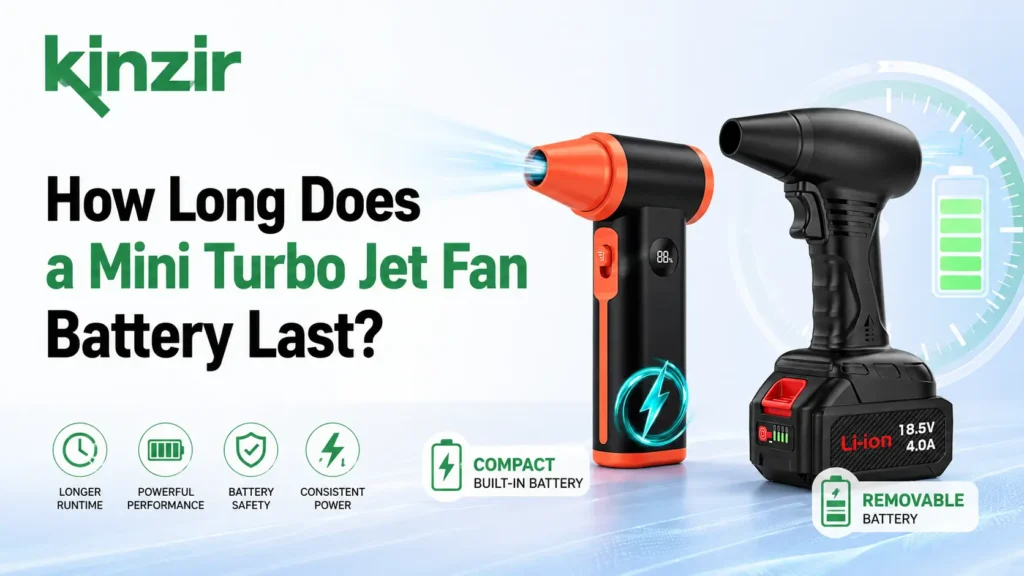
How long does a mini turbo jet fan battery last? Most rechargeable mini turbo jet fans run for about 10 to 60 minutes per charge, but the actual runtime changes with speed setting, motor load, battery voltage, capacity, and battery structure. Compact fans often use built-in 4,000 mAh or 8,000 mAh packs. Larger high-output models may use a removable battery base that supports a bigger pack and faster replacement. Kinzir AD46 and AD47 use removable battery designs, and the AD47 carries a listed 10,000mAh battery with up to 10 minutes of continuous operation under its stated test conditions.
Buyers can view Kinzir’s full range of wholesale mini turbo jet fans, including compact USB-C models, removable-battery blowers, and models that use external tool battery interfaces.
Quick Answer: How Long Does a Mini Turbo Jet Fan Run?
A mini turbo jet fan commonly provides:
| Usage Pattern | Typical Working Time |
|---|---|
| Maximum airflow | About 7 to 15 minutes |
| Medium airflow | About 15 to 30 minutes |
| Low airflow | About 25 to 60 minutes |
| Short intermittent bursts | Can cover a much longer cleaning session |
These are broad reference ranges rather than a promise for every model. The same battery can produce very different results in two fans with different motors, controllers, voltage systems, and airflow settings.
For example, the Kinzir AD71 uses a 4,000mAh battery and provides 25 minutes on Gear 1 or 10 minutes on Gear 8. Its charging time is about 2.5 hours through USB-C.
The Kinzir AD47 has a much larger listed 10,000mAh removable battery, yet its product page states up to 10 minutes of continuous runtime. Its 150,000 RPM motor places a heavy load on the battery during high-output operation.
This comparison shows why battery capacity should never be evaluated in isolation.
Main Types of Mini Turbo Jet Fan Batteries
Mini turbo jet fans can be grouped into three main types based on battery structure.
Compact Fans with Built-In Rechargeable Batteries

Compact handheld models usually place the lithium-ion pack inside the housing. These fans are lighter, smaller, and easy to charge through USB-C.
Common capacities include:
- 4,000mAh
- 6,000mAh
- 8,000mAh
- Dual-cell rechargeable configurations
The Kinzir AD71 small turbo jet fan uses a 4,000mAh built-in battery. It runs for 10 to 25 minutes across its eight airflow levels.
The Kinzir AD57 mini turbo jet fan uses an 8,000mAh rechargeable lithium battery with a 130,000 RPM brushless motor. It suits car cleaning, computer dust removal, and other portable cleaning tasks.
Built-in batteries are suitable for:
- Keyboard and computer cleaning
- Car interior dust removal
- Small car-drying jobs
- Camping equipment
- BBQ ignition
- Inflating small items
- Household gaps and window tracks
Their main limitation is downtime. Once the battery is empty, the user must stop and recharge the complete device.
Turbo Jet Fans with a Removable Battery Base
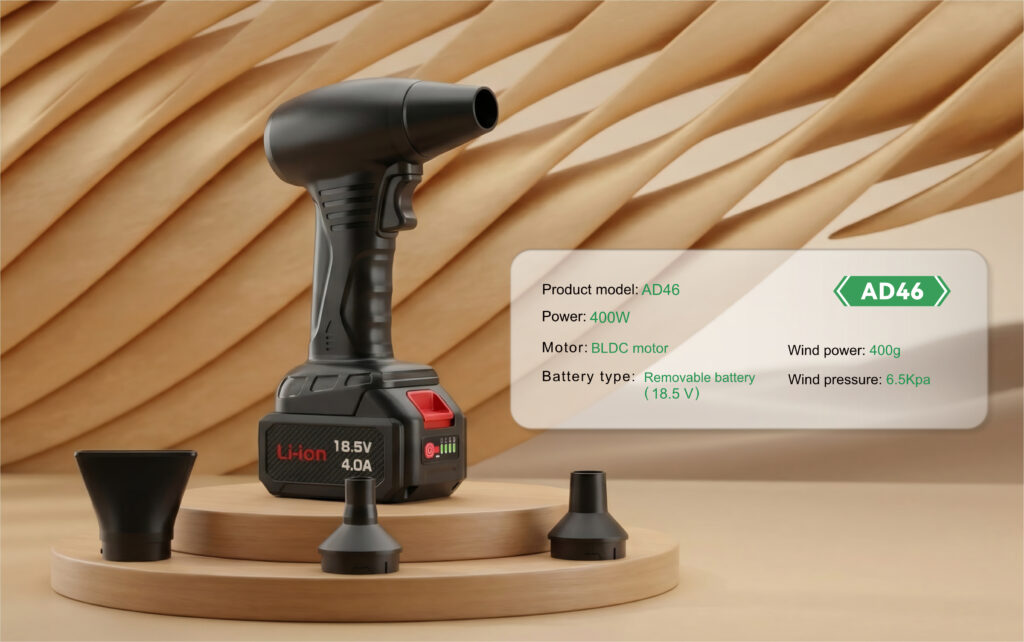
A second type uses a detachable battery base or removable battery pack. This structure supports larger battery capacities and lets the user replace an empty pack with a charged one.
The Kinzir AD46 turbo jet fan uses a removable 4,000mAh battery and a 150,000 RPM brushless motor. It is made for car drying, leaf clearing, light snow, and stubborn dust.
The Kinzir AD47 mini turbo jet fan is the larger-battery version. Kinzir lists it with:
- 10,000mAh battery
- Removable battery structure
- 150,000 RPM brushless motor
- Up to 10 minutes of continuous operation
- 617g product weight
- Car drying, snow clearing, leaf blowing, and electronics cleaning applications
The AD47 shows the main advantage of this format. A large removable battery base provides the fan with more stored energy and lets users keep a spare battery on hand. This is useful for car detailers, workshops, outdoor cleaning teams, and users who cannot pause for charging.
A removable pack can extend total working time without changing the main fan. When one battery runs out, the user can install another charged pack.
Kinzir has published a separate guide to its removable battery air dusters and turbo jet fans for the EU 2027 market. The listed removable-battery range includes AD46, AD47, AD59, AD61, and other models.
Fans with an External Tool Battery Interface
Larger cordless blowers may use an external tool-style battery rather than a small internal pack.
The Kinzir AD61 battery-operated blower uses an 18V-21V removable battery platform and a Makita-style interface. The user can choose a suitable battery capacity or keep several compatible packs for longer jobs.
This format is better suited to:
- Leaf clearing
- Car snow removal
- Wider vehicle drying
- Garage cleaning
- Yard maintenance
- Repeated commercial use
The fan body is larger than a pocket-size turbo jet fan, but the external battery platform gives wholesalers more flexibility in runtime, replacement, and regional battery packaging.
Kinzir Mini Turbo Jet Fan Battery Comparison
| Model | Battery Capacity | Battery Type | Published Runtime | Main Applications |
| AD71 | 4,000mAh | Built-in | 10 to 25 minutes | Camping, electronics, small drying jobs |
| AD51 | 4,000mAh | Built-in | Ask for test data by gear | Cars, keyboards, inflation |
| AD57 | 8,000mAh | Built-in | Ask for test data by gear | Cars, computers, cleaning |
| AD46 | 4,000mAh | Removable base | Ask for current test report | Car water, snow, leaves |
| AD47 | 10,000mAh | Removable base | Up to 10 minutes | Car drying, snow, leaves |
| AD61 | Depends on selected pack | External tool battery | Depends on pack and trigger level | Leaves, snow, outdoor cleaning |
Kinzir’s published turbo jet fan specification guide compares AD46, AD47, AD51, and AD61 by motor speed, battery structure, airflow characteristics, and intended use.
Why Can a 10,000mAh Fan Run for Only 10 Minutes?
Many buyers expect a 10,000mAh battery to run several times longer than a 4,000mAh battery. That is not always the case.
A large-capacity battery can still drain quickly when the fan uses:
- A high-speed brushless motor
- High battery voltage
- Heavy electrical draw
- Maximum airflow
- A narrow high-pressure nozzle
- Continuous trigger operation
- Aggressive controller settings
The AD47 has a listed 10,000 mAh battery, but it runs a high-output 150,000-RPM motor. The stored energy is used to produce concentrated airflow rather than to provide a very long, low-output runtime.
This is similar to comparing two vehicles with the same fuel tank size. The vehicle with the larger engine may consume the fuel much faster.
Why mAh Alone Cannot Predict Runtime
Battery capacity is usually expressed in milliamp-hours (mAh). It measures stored charge, but it does not include battery voltage.
A better energy comparison uses watt-hours:
Watt-hours = Battery voltage × Amp-hours
A 4,000 mAh battery is equivalent to 4 Ah.
Examples:
- 3.7V × 4Ah = 14.8Wh
- 7.4V × 4Ah = 29.6Wh
- 18.5V × 4Ah = 74Wh
All three batteries may carry a 4,000mAh label, yet their stored energy differs greatly.
Wholesale buyers should request:
- Nominal voltage
- Rated capacity in mAh or Ah
- Stored energy in Wh
- Cell configuration
- Maximum discharge rate
- Runtime at each airflow level
- Motor wattage
- Charging time
- Battery safety documents
This gives a much clearer comparison than mAh alone.
How Speed Setting Changes Battery Life
A turbojet fan draws more current at higher speeds. Maximum airflow produces faster drying and stronger debris movement, but runtime drops.
The AD71 provides a clear example:
- Gear 1: About 25 minutes
- Gear 8: About 10 minutes
Low or medium airflow is suitable for keyboards, computer cases, cameras, dashboards, vents, and small inflatables.
Maximum airflow is better for standing water, leaves, snow, garage dust, and wet car grilles.
Users can extend mini turbo jet fan battery life by selecting the lowest airflow level that completes the task.
Continuous Runtime vs Real Working Time
Manufacturers often publish continuous runtime. This means the fan runs without stopping until the battery reaches its cutoff level.
Real use is usually different.
A person cleaning a keyboard may run the fan for five seconds, change position, and run it again. A car detailer may blow water from one mirror, stop, walk around the vehicle, and start again.
A fan rated for 10 minutes of continuous operation may cover a 20-minute or 30-minute task when used in short bursts.
Runtime becomes shorter when the user:
- Holds the trigger continuously
- Uses the highest airflow setting
- Blocks part of the air inlet
- Uses a restrictive nozzle
- Works in high temperatures
- Starts with a partly charged battery
- Uses an old battery with reduced capacity
How Long Does a Mini Turbo Jet Fan Last for Car Drying?
Battery use depends on which parts of the car are being dried.
Mirrors, Grilles and Badges
These areas need short concentrated bursts. A compact 4,000mAh fan may have enough runtime for one vehicle.
Wheels and Door Gaps
Wheels, lug nuts, handles, trim, and panel gaps need repeated bursts. A medium or large battery gives more working time.
Full Car Body
Drying the roof, hood, windows, doors, trunk, wheels, mirrors, and grille requires much more airflow coverage.
A removable-battery fan, such as the AD46 or AD47, is more practical for this job. A spare charged pack can reduce downtime.
Read Can a Mini Turbo Jet Fan Dry a Car After Washing? for a section-by-section car drying guide.
Runtime for Other Common Applications
Computer and Keyboard Cleaning
Low-to-medium airflow and short bursts reduce battery use. One charge may clean several keyboards or computer cases.
Car Interior Cleaning
Dashboard gaps, vents, seat rails, door pockets, and cup holders need controlled bursts. A compact built-in battery is usually enough.
Leaves and Light Snow
These tasks need higher airflow for longer periods. Runtime often sits near the lower end of the published range.
Camping and BBQ Use
Inflating small items, starting charcoal, drying wet socks, and clearing tent dust usually take short bursts. These tasks place less demand on the battery than full-car drying does.
See Top Mini Turbo Jet Fan Applications for more car, home, camping, and outdoor uses.
How to Extend Mini Turbo Jet Fan Battery Life
Select a Lower Airflow Level
Start low and increase the setting only when more airflow is needed.
Use Short Bursts
Point the nozzle at the target before pressing the trigger. Release it when moving to the next area.
Keep the Air Inlet Clear
Do not cover the rear inlet with a hand, cloth, loose hair, or debris. Restricted airflow increases heat and reduces efficiency.
Charge Before Long Tasks
Begin car drying, camping, or outdoor cleaning with a full battery.
Let the Fan Cool Before Charging
After a long maximum-speed session, let the motor and battery return to a normal temperature.
Keep a Spare Removable Battery
For AD46, AD47, AD61, and similar removable-battery models, a second charged pack can double practical working time.
Store the Battery in a Cool, Dry Place
Long exposure to heat can reduce lithium-ion battery capacity. Do not leave the fan inside a hot vehicle for long periods.
Are Removable Batteries Better?
A removable battery is often the better choice for long jobs, commercial users, and after-sales support.
Main benefits include:
- Fast battery replacement
- Less charging downtime
- Spare battery sales
- Easier warranty service
- Longer product service life
- Simpler recycling
- Better preparation for EU battery rules
A built-in battery remains a good option for buyers who prefer lower weight, smaller size, USB-C charging, and a lower retail price.
The best battery type depends on the target application and sales market.
What Should Wholesale Buyers Ask the Manufacturer?
Before placing a bulk mini turbo jet fan order, request:
- Runtime at every airflow level
- Runtime at maximum speed
- Battery capacity and voltage
- Battery energy in Wh
- Cell manufacturer and cell grade
- Built-in or removable battery structure
- Charging time and charger rating
- Battery cycle-life test
- UN38.3 and MSDS documents
- Replacement battery availability
- Spare battery wholesale price
- Runtime test video
- Over-current and overheat protection details
- Packaging options for batteries
- Destination-market certificates
Ask the supplier to test every sample with the same nozzle, room temperature, starting charge, and airflow level.
Kinzir Mini Turbo Jet Fans for Wholesale Buyers
Kinzir manufactures mini turbo jet fans, electric air dusters, air blowers, and cordless vacuum cleaners for wholesale, private-label, OEM, and ODM projects.
The Kinzir factory has five production lines, ten QC staff, in-house testing equipment, laser engraving support, and a 12-month product guarantee. Product certificates include CE, RoHS, FCC, PSE, UKCA, and CA65 across applicable models.
Battery options include:
- Compact built-in rechargeable packs
- USB-C charging
- Digital battery displays
- Removable battery bases
- Large-capacity battery configurations
- External tool battery interfaces
- Spare battery supply
- Regional chargers and plugs
- Custom packaging and branding
Buyers can compare all current models on the Kinzir mini turbo jet fan product page.
FAQs About Mini Turbo Jet Fan Battery Life
How long does a mini turbo jet fan battery last per charge?
Most models run for about 10 to 60 minutes. High-speed use sits near the lower end. Low-speed and intermittent use can last much longer.
How long does a 4,000mAh turbo jet fan last?
A 4,000mAh model may run for about 10 to 25 minutes. The Kinzir AD71 provides 10 minutes on Gear 8 and 25 minutes on Gear 1.
How long does the AD47 10,000mAh battery last?
Kinzir lists the AD47 at up to 10 minutes of continuous operation. Runtime can change with airflow setting, temperature, nozzle, battery condition, and use pattern.
Why does the AD47 have a large battery but a 10-minute runtime?
Its 150,000 RPM brushless motor draws substantial energy during high-output operation. The larger battery supports stronger airflow and a demanding motor, rather than extremely long continuous use.
Is a removable battery better than a built-in battery?
A removable battery is better for long tasks, quick pack changes, commercial use, and easier replacement. A built-in battery keeps the fan smaller and lighter.
Can I use a spare battery with AD46 or AD47?
Yes. Their removable battery design lets users replace an empty pack with a charged one. Confirm battery compatibility with the supplier before ordering spare packs.
Does maximum RPM reduce battery runtime?
Higher motor speed usually increases electrical draw and shortens runtime. Motor efficiency, voltage, controller settings, and airflow resistance affect the final result.
Can one battery charge dry a full car?
A compact fan can dry mirrors, grilles, wheels, badges, and panel gaps in a single charge. Full-body drying may need a larger battery, a removable pack, or a spare battery.
How long does charging take?
Compact models commonly need around two to four hours. The AD71 takes about 2.5 hours to charge via USB-C. Charging time depends on battery size, input rating, cable, and charging circuit.
What is the best battery capacity for a turbo jet fan?
A 4,000mAh pack is suitable for compact cleaning tasks. An 8,000mAh or 10,000mAh pack suits longer or heavier work. Wh rating, motor load, voltage, and tested runtime should be checked with the capacity.
Final Answer
A mini turbo jet fan battery usually lasts 10 to 60 minutes per charge. Compact built-in batteries are light and convenient for keyboards, car interiors, camping, and short drying jobs. Removable battery-base models such as Kinzir AD46 and AD47 are better suited to repeated car drying, leaves, snow, and commercial work.
The Kinzir AD47 has a listed 10,000mAh removable battery and up to 10 minutes of continuous runtime. Its large battery supports a demanding 150,000 RPM motor. Users who need longer total working time can keep a spare charged battery and replace the pack between tasks.
For accurate product comparison, check battery voltage, Wh, motor load, runtime at each airflow level, charging time, and replacement battery availability. Do not choose a mini turbo jet fan from the mAh number alone.


