
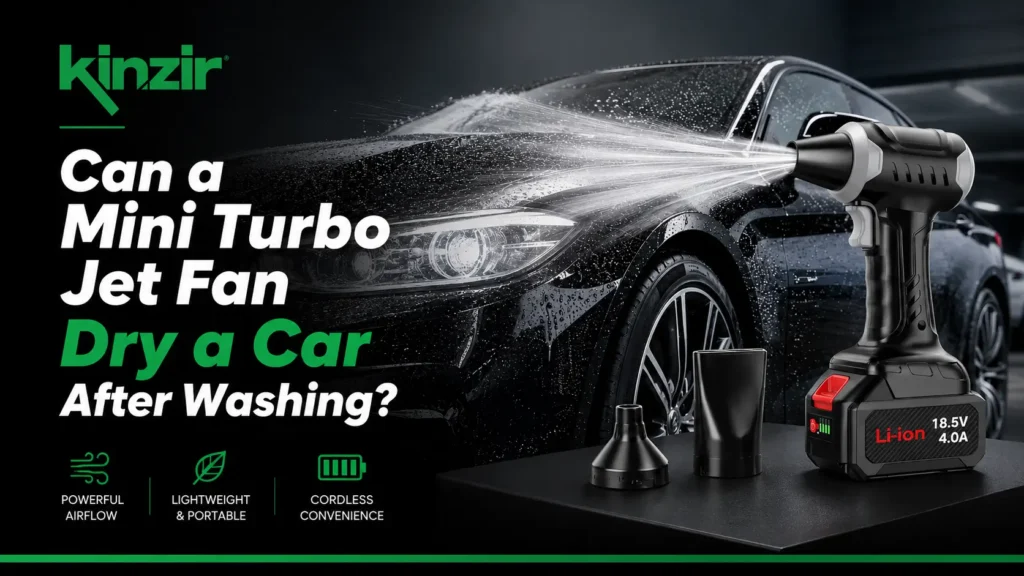
A cordless turbo jet fan works best for detail areas that are difficult to reach with a drying towel. It can handle much of the exterior drying on a small car. For a large sedan, SUV, or truck, combining the fan with a clean microfiber towel is often the quickest method.
How Does a Turbojet Fan Dry a Car?
A turbo jet fan uses a high-speed brushless motor and an internal impeller to draw air through the inlet. The nozzle directs that air into a fast, focused stream.
Unlike a towel, the fan does not absorb water. It moves droplets across the surface and pushes them toward the nearest edge of the panel. This makes it especially useful for removing water trapped inside small openings.
You can learn how motor speed, airflow volume, airspeed, and wind pressure affect actual performance in this guide to turbo jet fan specifications.
Which Parts of a Car Can You Dry with a Turbo Jet Fan?
Painted Body Panels
Start with the roof, hood, windows, trunk, and doors. Point the airflow toward the closest edge rather than moving water back and forth across the panel.
A compact jet fan can dry smaller panels well. Wide panels need more airflow coverage and battery runtime.
Side Mirrors
Water often remains behind the mirror glass and inside the mirror housings. It may drip onto a clean door several minutes after washing.
Directing air around the mirror housing clears these hidden droplets before they leave marks.
Front Grille and Bumper Openings
Modern grilles contain narrow spaces that are difficult to reach with a towel. Focused airflow pushes water out without forcing cloth between delicate grille parts.
Badges, Emblems, and Trim
Water gathers around raised lettering, badges, window trim, and decorative strips. A narrow nozzle clears these areas with little contact.
Door Handles and Panel Gaps
Door handles, fuel doors, trunk seams, window seals, and panel joints can hold surprising amounts of water. Blow along each gap rather than pointing straight into it.
Wheels and Brake Calipers
A turbo blower can remove water from wheel spokes, lug nut holes, valve areas, and brake calipers. Drying these areas early can reduce water running onto the tires or garage floor later.
Avoid blowing loose brake dust toward your face. Wear eye protection if the wheels are dirty.
Door Jambs
Open each door and use a lower airflow setting around the hinges, seals, and jambs. Keep the nozzle away from loose grease, wiring, and exposed electrical connectors.
For more cleaning, drying, inflation, camping, and outdoor uses, read the full guide to mini turbo jet fan applications.
What Are the Benefits of Air Drying a Car?
Less Contact with the Paint
Every towel contact creates some friction. A clean microfiber towel is safe when used correctly, yet dust, grit, or a dirty towel may leave fine marks.
A car drying blower removes water without dragging fabric across the finish. This makes it useful for dark paint, polished vehicles, ceramic coatings, and freshly detailed cars.
Better Access to Narrow Areas
Towels work well on large, flat surfaces. They cannot reach deeply behind badges, grilles, mirrors, wheel spokes, and trim.
A focused air stream reaches these areas and helps prevent water from dripping out after the vehicle has been dried.
Fewer Remaining Droplets
Water spots form when droplets dry and leave minerals on the surface. Blowing water away before it evaporates can reduce the number of remaining droplets.
Air drying cannot remove minerals that have already dried onto the paint. Washing in shade and drying the vehicle soon after rinsing still matter.
Cordless Use Around the Vehicle
A rechargeable mini blower can be carried around the car without an extension cable or air hose. Its compact size makes it easier to keep in a garage, detailing bag, trunk, or workshop cabinet.
More Than One Use
The same fan may be used for car interior dust, keyboards, tools, camping equipment, light leaves, inflation, or loose snow. Browse Kinzir’s range of wholesale mini turbo jet fans to compare sizes and applications.
How to Dry a Car with a Mini Turbo Jet Fan
1. Wash and Rinse the Car Thoroughly
Remove all dirt before drying. Airflow can move loose grit across the paint if the car has not been rinsed properly.
2. Work in the Shade
Direct sunlight can heat the paint and dry the water before you reach it. A shaded area gives you more time to remove droplets.
3. Start at the Top
Begin with the roof and windows. Move down to the hood, trunk, doors, bumpers, and wheels. Water naturally moves downward, so this order prevents repeated work.
4. Hold the Nozzle at a Sensible Distance
Begin about 20-30 cm from the surface. Move closer only where more focused airflow is needed.
Do not press the nozzle against paint, trim, seals, sensors, or glass.
5. Push Water Toward an Edge
Angle the airflow rather than pointing straight down. Move each group of droplets toward the side or bottom of the panel.
Long, controlled passes work better than random movements.
6. Use Higher Airflow for Gaps
Increase the setting around mirrors, grilles, wheel spokes, badges, and panel joints. A narrow nozzle helps direct the air into small spaces.
7. Lower the Setting Around Delicate Parts
Use gentler airflow around loose decals, soft seals, interior fabrics, wiring, sensors, and aging trim.
8. Finish with a Clean Microfiber Towel
Check the paint under good lighting. A soft towel can remove any thin film or isolated droplets left on wide panels.
Turbo Jet Fan vs Microfiber Towel for Car Drying
| Drying Task | Turbo Jet Fan | Microfiber Towel |
|---|---|---|
| Wide body panels | Good, model and runtime matter | Fast and practical |
| Mirrors and grilles | Very effective | Difficult to reach |
| Badges and trim | Very effective | Limited access |
| Wheel spokes | Effective | Time-consuming |
| Touchless drying | Yes | No |
| Absorbing remaining moisture | No | Yes |
| Portable use | Easy with a cordless model | Easy |
| Best method | Focused drying and narrow gaps | Large panels and final wipe |
For many car owners, the best routine is simple: use a towel on large panels and a turbo jet fan on gaps, mirrors, grilles, trim, and wheels.
What Should You Look for in a Car Drying Turbo Jet Fan?
Useful Air Speed
Fast air helps break droplets away from narrow gaps and textured surfaces. Air speed is more useful than motor RPM alone when judging focused car drying.
Suitable Airflow Volume
Higher airflow volume covers wider panels. A very narrow air jet may feel strong yet take longer to dry an entire hood or roof.
Adjustable Speed
Variable control lets you use stronger airflow on wheels and grilles, then reduce it around seals, interiors, and delicate trim.
Practical Battery Runtime
Choose enough runtime for the size of the vehicle and the way you plan to dry it. A short session may be enough for mirrors and gaps. Full exterior drying needs more battery capacity.
Comfortable Weight
A lighter handheld blower reduces wrist strain during longer drying sessions. Balance and handle shape matter just as much as product weight.
Suitable Nozzle Design
A narrow nozzle creates focused airflow for gaps. A wider nozzle covers larger panels. Models supplied with multiple nozzles offer greater flexibility.
Brushless Motor
A BLDC motor offers higher rotational speed, more efficient operation, and a longer service life compared with many basic brushed designs.
Which Kinzir Turbo Jet Fans Are Suitable for Car Drying?
Kinzir AD46
The Kinzir AD46 turbo jet fan for car drying uses concentrated airflow for water, dust, light snow, and small debris. Its compact format suits mirrors, grilles, badges, wheels, and narrow panel gaps.
Kinzir AD47
The Kinzir AD47 mini turbo jet fan blower is suited to buyers seeking a larger battery capacity for longer car-drying and seasonal cleaning tasks.
Kinzir AD51
The Kinzir AD51 cordless turbo jet fan offers adjustable airflow for car cleaning, electronics, camping, inflating, and household tasks.
Buyers planning products for the European market can review Kinzir’s guide to removable-battery air dusters and turbo jet fans.
Can a Turbo Jet Fan Damage Car Paint?
Normal use should not damage sound automotive paint. Problems are more likely when the nozzle is held too close, loose dirt remains on the surface, or the airflow is aimed at peeling paint and damaged decals.
Follow these basic precautions:
- Rinse the vehicle thoroughly before drying.
- Keep the air inlet clear of clothing, hair, sand, and debris.
- Start from a moderate distance.
- Do not strike the car with the nozzle.
- Reduce airflow around loose trim and aging decals.
- Keep the blower away from standing water.
- Do not direct air into exposed electrical sockets.
- Allow the motor to cool after extended high-speed use.
Can a Turbo Jet Fan Prevent Water Spots?
It can reduce the chance of water spots by removing droplets before they dry. The result depends on water hardness, temperature, sunlight, paint condition, and drying speed.
Mineral-rich water may still leave marks if it dries quickly. Wash in shade, work from top to bottom, and remove standing water soon after the final rinse.
Can You Dry a Ceramic-Coated Car with a Turbo Jet Fan?
Yes. Ceramic coatings make water form beads and move more easily across the paint. A turbo jet fan can push these beads off with limited surface contact.
Air drying is useful around coating-sensitive detail areas, where repeated towel contact should be kept to a minimum.
Can a Mini Turbo Jet Fan Dry an Entire SUV?
It may dry an SUV, but the result depends on airflow volume, nozzle width, battery runtime, vehicle size, and weather conditions.
A pocket-sized fan is excellent for mirrors, grilles, wheels, badges, and trim. A larger blower covers broad SUV panels faster. A hybrid method may save time on bigger vehicles.
Kinzir Turbo Jet Fans for Wholesale and OEM Projects
Kinzir manufactures mini turbo jet fans, electric air dusters, cordless car vacuums, and rechargeable air blowers for importers, distributors, automotive accessory brands, retailers, and online sellers.
Kinzir’s OEM and private-label manufacturing service covers logo engraving, colors, packaging, accessories, battery configurations, and product selection. SKD options are available for selected models and markets.
Browse the product range, compare samples, and test airflow, runtime, weight, noise, and nozzle design before confirming a bulk order.
For product samples, OEM details, wholesale pricing, or model recommendations, contact Kinzir for a turbo jet fan quotation.
Final Answer
A turbo jet fan can dry a car after washing, especially around mirrors, grilles, badges, door handles, wheels, trim, and panel gaps. It reduces direct paint contact and clears water from areas that towels cannot reach.
For small cars, a suitable cordless blower may handle most of the exterior. For large vehicles, use the fan for narrow spaces and a clean microfiber towel for broad panels. The right choice depends on air speed, airflow volume, runtime, speed control, nozzle shape, and vehicle size.


